Rule29
CURE International
O'Neil Printing
Wonderkind Studios

Spaces
for Healing

A private experience, for the people who made this possible.

CURE Malawi · Blantyre · 2024–2027 · Private Access
Spaces for Healing · CURE Malawi

Since your last visit

Rule29 · CURE International · O'Neil Printing · Wonderkind Studios

When a child
walks into surgery,
the room matters.

Thank you. Because of you, a two-year mission to transform the spaces where children face their greatest fears is becoming real, room by room. What follows is your story, and the work your generosity has funded. Please keep going with us through to the reveal.

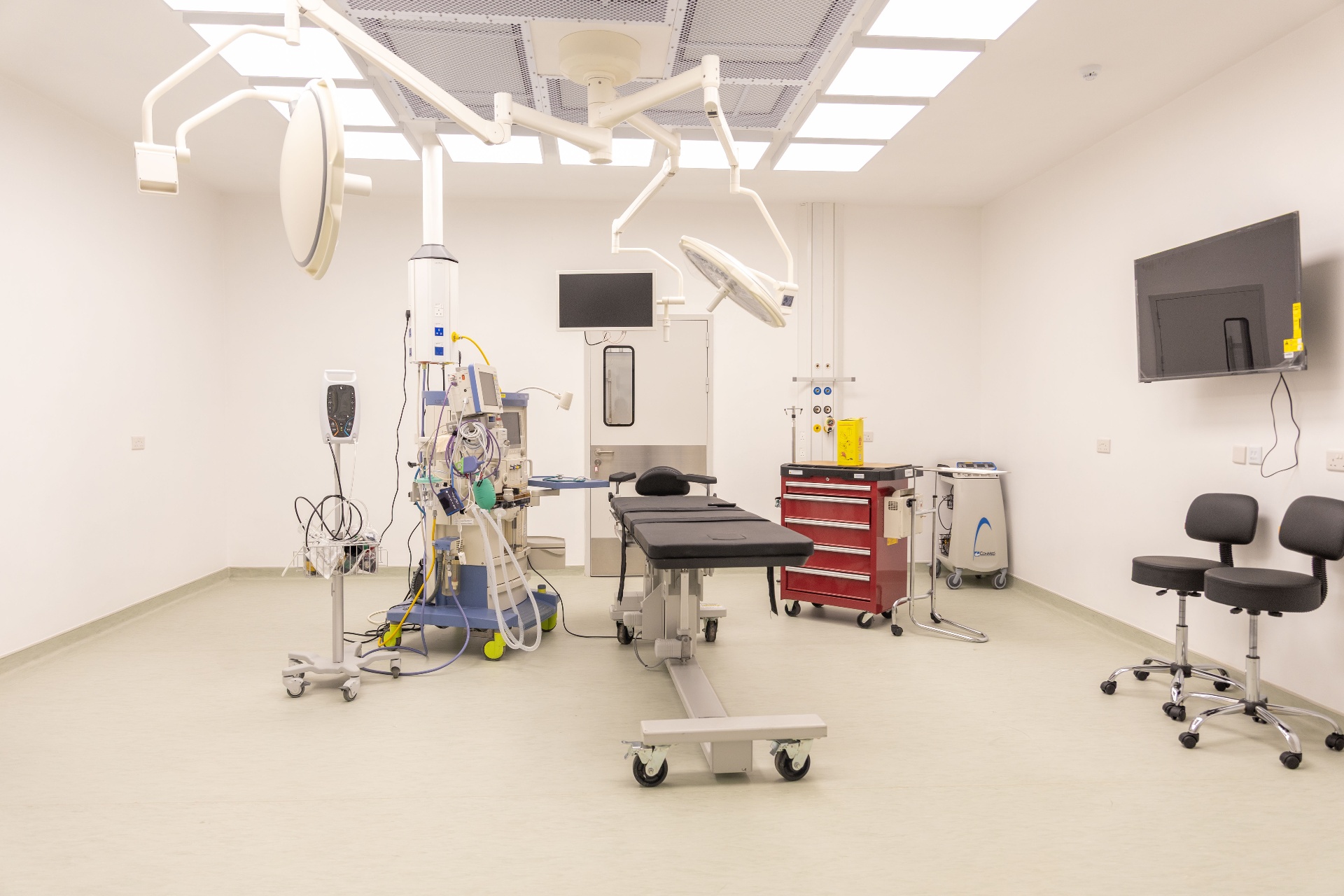
Operating room before transformation, bare clinical space
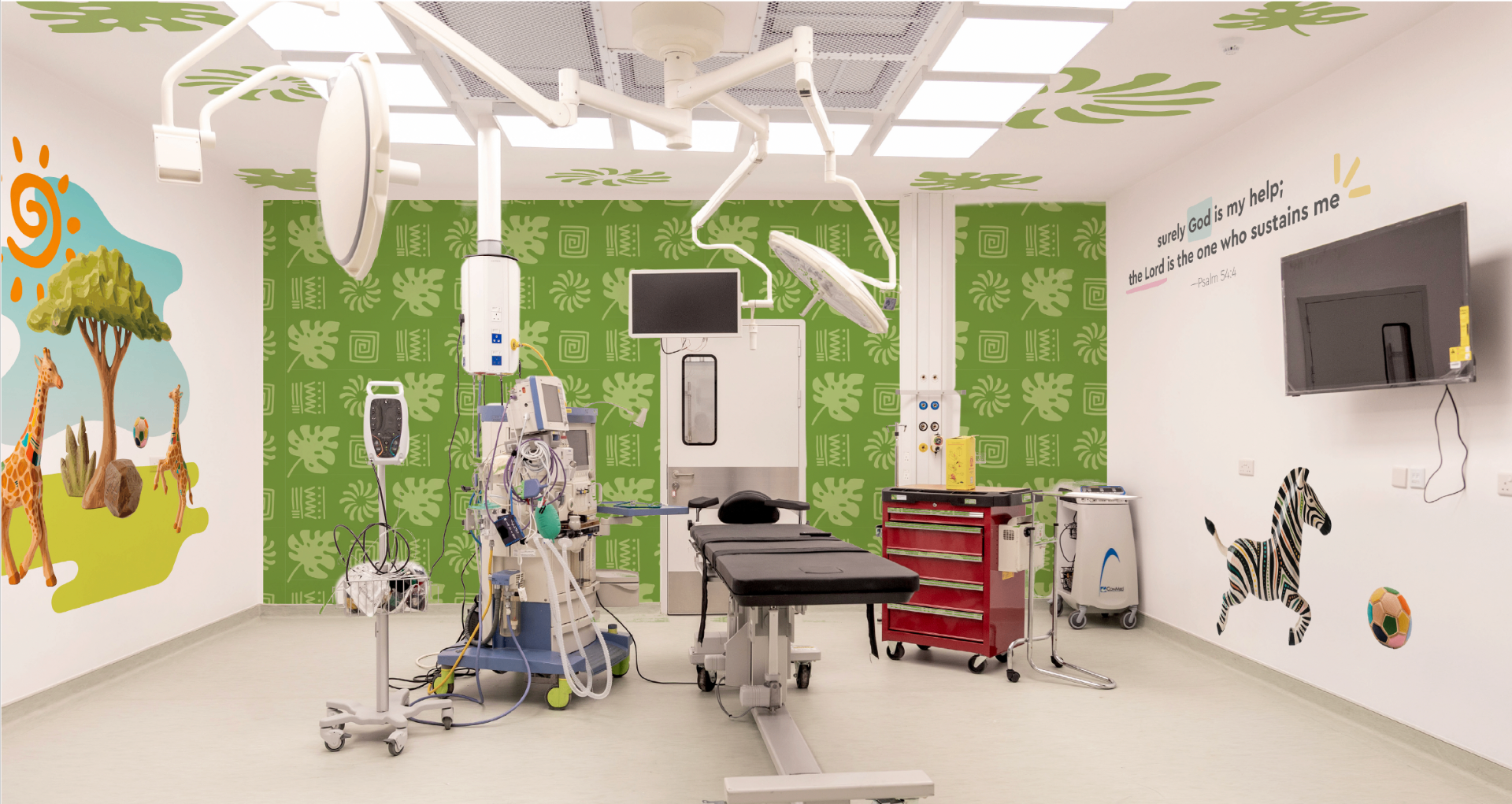
Operating room after transformation, designed healing space with murals
Today
After
⟵ Drag to transform ⟶
The same room. The difference design makes. drag to see it
Scroll to begin the story
Two ways to experience this

You can walk the full story from day one,
or jump straight to where we are right now.

Below is the complete journey your support funded — the science, the place we are serving, the partners, the design phases, and the work happening this month. Go in order, or skip ahead. You can always come back.

The Journey · Funded by You

Here is the work your support
has already made possible.

From the first conversation in April 2024 to the first room installed in Blantyre, every milestone below was paid for, prayed for, and made possible by donors like you. Scroll the timeline to see where we are right now — and if you're moved to help carry the final rooms across the finish line, additional support is always welcomed, gratefully.

← Drag or swipe, click any card to jump to that phase below
April 2024
The Conversation
Justin Ahrens (Rule29) meets Justin Narducci, CEO of CURE, at CURE HQ. The dream: enhance environments for healing, community and connection.
Origin
Spring 2025
Kent State, Phase 1 Research
Evidence base: nature imagery reduces anxiety 20–30%, shortens recovery ~1 day, lowers pain medication use 22%. Science confirmed.
Complete
Fall 2025
Moodboard 01, Calming Landscapes
Rule29 presents first direction: watercolor Malawian landscapes, Lake Malawi at sunrise. CURE wants more cultural depth.
Complete
Fall 2025
Bradley University, Discovery
A Bradley design class takes the Kent State research, Rule29's moodboard, and CURE's input and starts visualizing options.
Complete
Milestone
January 2026
Direction Locked, Animal System
Kent State Phase 2: hand-carved wooden toy illustration style. Parent-child animal scenes. CURE International approves.
Complete
Spring 2026
Color System & Patterns
Fern Green, Midnight Green, Turquoise Blue, Clay, Miracle Yellow locked. Three wall patterns complete. Icons in development.
Complete
June–Aug 2026
Final Artwork & Production
Room-by-room illustration being completed. Icon palette pending. O'Neil specifying overseas production materials.
Active Now
July 2026
July Update
Production milestone. Check back monthly, this is a living document.
Coming Soon
August 2026
August Update, Pre-Trip
Final production confirmation and pre-installation brief before the team departs for Malawi.
Coming Soon
⭐ First Goal
Week of September 7, 2026
First Installation, Blantyre, Malawi
Rule29 travels to CURE Malawi. First room fully installed. Wonderkind Studios documents the transformation. Two years becomes one room a child walks into.
Week of September 7, 2026
Early 2027
🏁 Final Installation & Reveal
All rooms, hallways, wayfinding installed. Full hospital complete. Wonderkind documents it. CURE Malawi becomes the model for eight more hospitals.
Final Goal
2027 & Beyond
Scale to All Nine Hospitals
Kenya. Uganda. Zambia. Zimbabwe. Ethiopia. Niger. Philippines. One design system. Nine hospitals. The vision this project was built to prove.
The Vision

The Place

Malawi. The Warm Heart of Africa.

Read the story of Malawi

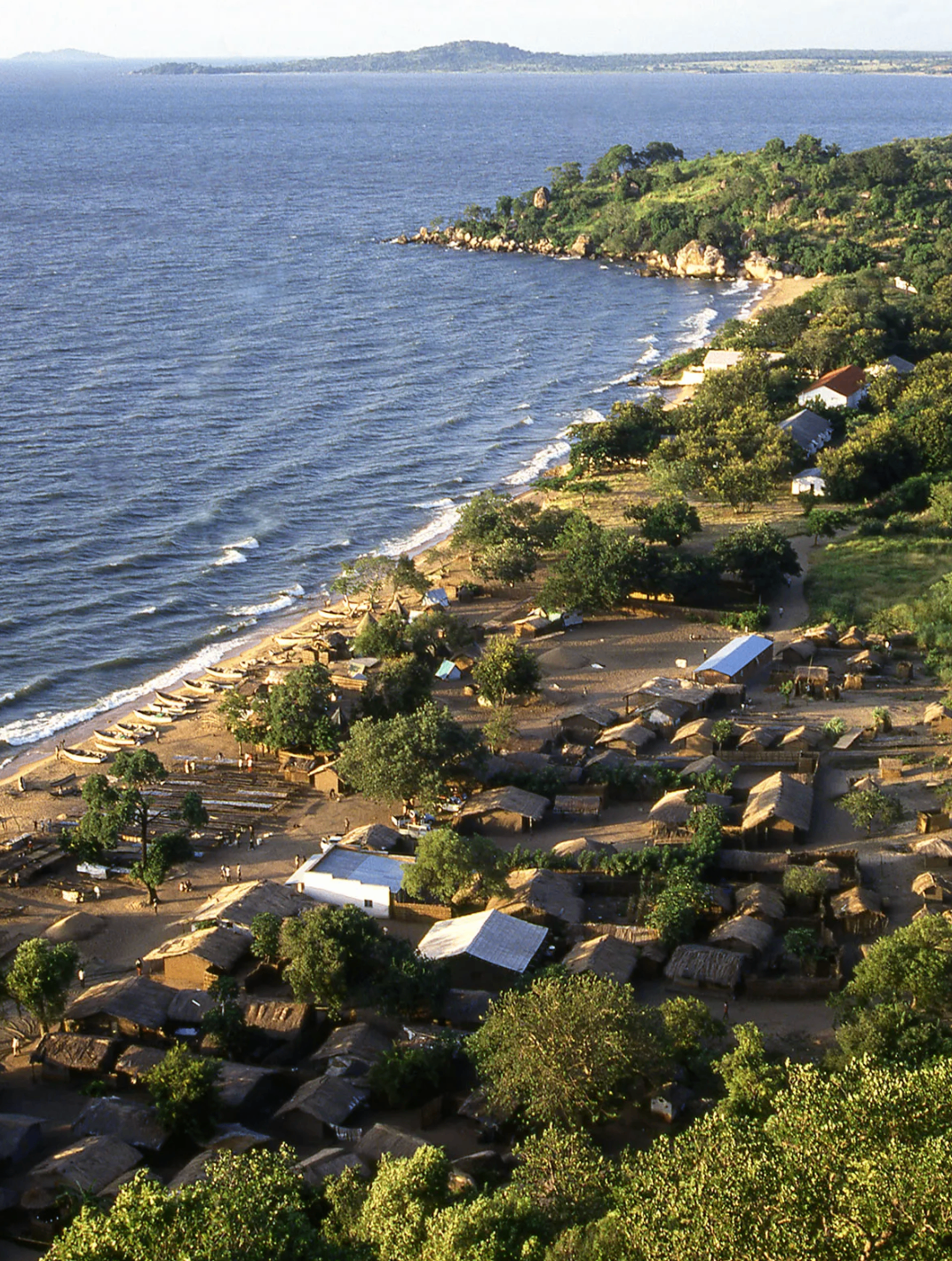
Named from the Chichewa word for "flames," Malawi is a landlocked nation in southeastern Africa of 21 million people, 42% of them children under 14. Lake Malawi, the third-largest freshwater lake in Africa, stretches 585 kilometers through the country, home to more fish species than any lake on Earth.

Called "The Warm Heart of Africa" across the continent, a name earned not from climate alone but from a culture of deep hospitality, communal joy, and resilience. Extraordinary landscapes: highland plateaus, baobab forests, tea fields of Thyolo, the great Rift Valley, Mount Mulanje rising 3,000 meters.

And yet Malawi faces profound challenges. Average annual income: $480. More than 70% below the poverty line. Across all of Sub-Saharan Africa, there is estimated to be one pediatric surgeon for every six million children. For a Malawian child with a treatable condition, surgical access is not a given. It is a gift.

"The name Malawi means flames. This project is about making sure the warmth inside those walls matches the warmth of the people outside them."

People & Culture
Malawi's ethnic groups include the Chewa, Nyanja, Tumbuka, Tonga, Lomwe, Yao, and Ngoni. Chichewa is spoken nationwide. 77% identify as Christian. Music, dance, and storytelling are central to daily life. Wood carving, including the hand-crafted animal figurines that inspired this project's illustration system, is a deep craft tradition passed through generations.
Geography
Size of Pennsylvania. Lake Malawi (365 miles long, 52 miles wide) dominates the landscape. The Shire Highlands rise to 900–1,200 meters where Blantyre sits, temperate, green, dramatic. Mount Mulanje (3,000m) is the highest peak in central Africa. The Great Rift Valley runs through the country's eastern edge.
Healthcare Reality
Malawi has fewer than 2 doctors per 10,000 people (global average: 15). For children with treatable orthopedic conditions, the journey to care can be 8–12 hours on unpaved roads. Infant mortality: 30 per 1,000 live births. Many children never reach a specialist. CURE Malawi exists specifically to close that gap.
Blantyre
Malawi's commercial capital and largest city (~1.2 million). Named after Blantyre, Scotland, birthplace of David Livingstone, who explored the region in the 1850s. CURE's hospital sits on Chipatala Avenue, drawing patients from all three of Malawi's administrative regions, and from Mozambique, Tanzania, and Zambia beyond.
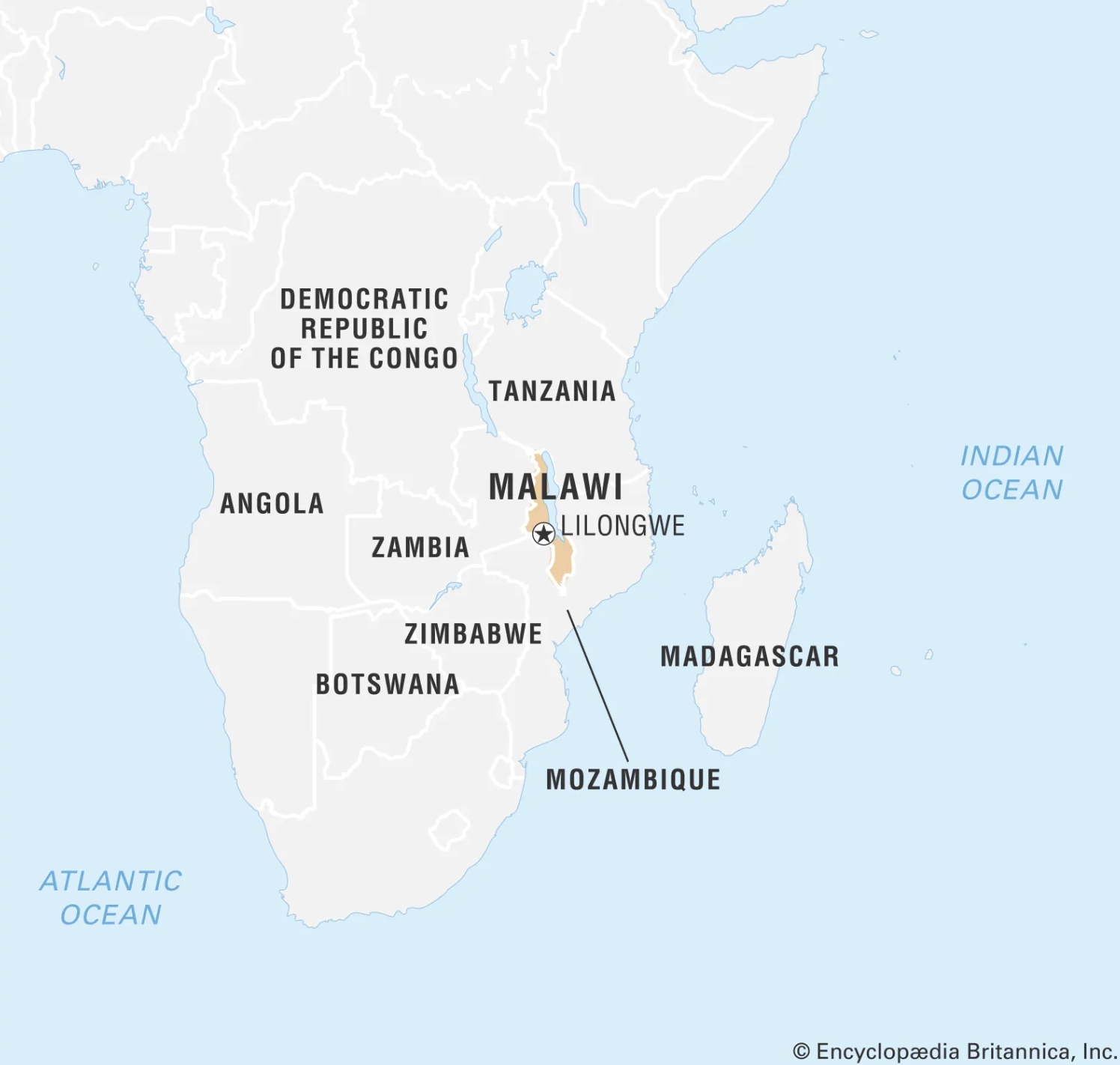
Map of Malawi in southeastern Africa
Malawi · Southeastern Africa
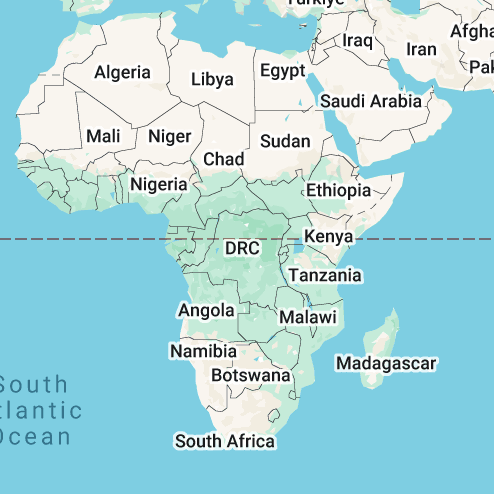
Malawi shown on the African continent
Where Malawi sits on the continent
Lakeside village on Lake Malawi
Lake Malawi, a village on the shore
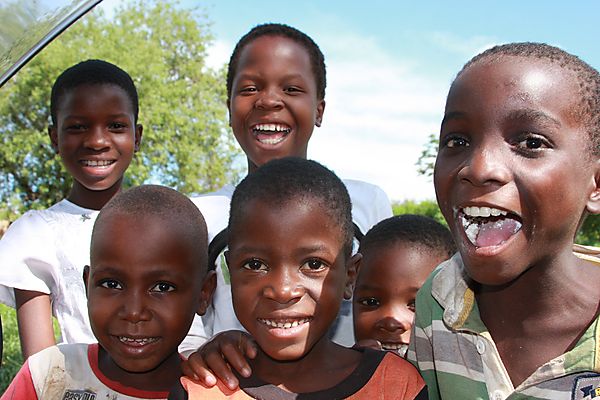
Children in Malawi smiling
The children CURE Malawi serves
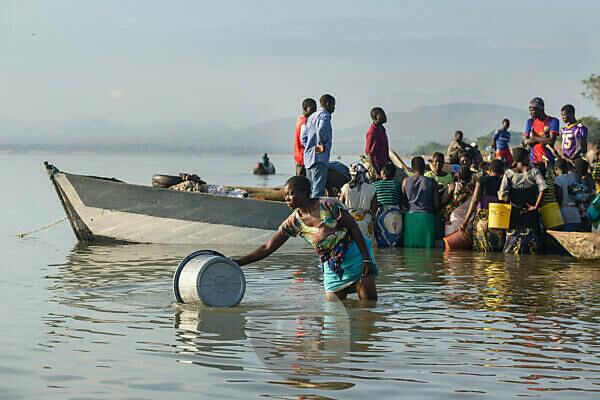
People at fish market on Lake Malawi
Fish market on the lake
21M
Population
42% under age 14
$480
Avg. Annual Income
IMF, 2024
70%+
Below Poverty Line
World Bank, 2024
1:6M
Surgeon:Children
Sub-Saharan Africa
The Hospital

CURE Malawi. The only hospital of its kind.

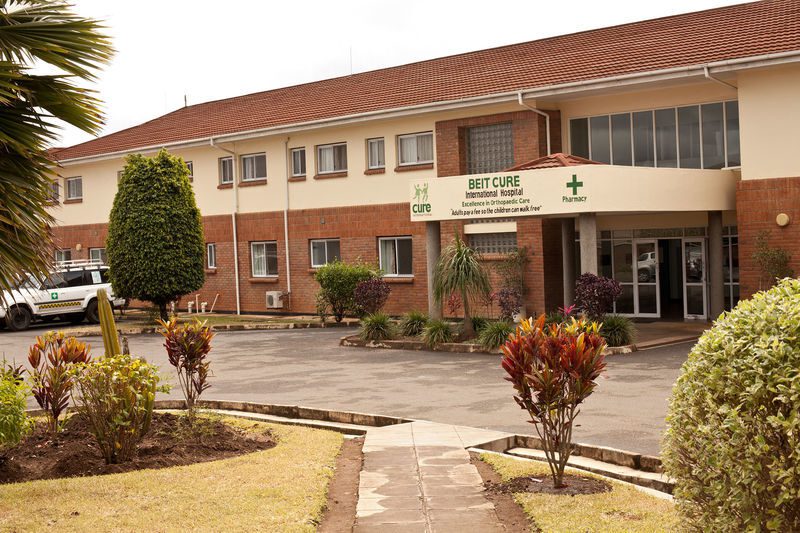
Beit-CURE Children's Hospital has served Blantyre since 2002, a teaching hospital with 58 beds, three operating theaters, and an outpatient clinic. It is the only hospital in Sub-Saharan Africa recognized by the Royal College of Surgeons of England.

Every year, more than 2,500 children receive life-changing reconstructive and orthopedic surgeries here, entirely free of charge. Clubfoot. Burn contractures. Hydrocephalus. Cleft lip and palate. Conditions that in any wealthy country would be routine. In Malawi, without CURE, they can define a child's entire life.

98% of staff are local Malawians. The hospital draws patients from all three regions of Malawi and beyond. Average stay for a single surgery: six days. Average cost to donors: $1,800 per child.

Visit CURE Malawi at cure.org

"He tries to move around like the other children, but I can see how much he struggles.", Monica, mother of former patient Prosper, CURE Malawi

Conditions Treated
Clubfoot, the most common, affecting thousands of Malawian children and causing lifelong mobility challenges when untreated. Burn contractures, open cooking fires are common in rural Malawi; burn scarring can permanently limit limb movement. Hydrocephalus. Cleft lip and palate. Bow legs. Untreated fractures. Spina bifida. All treatable. All life-defining if left alone.
The Patient Journey
A child is identified, often by community health workers, and referred to CURE's mobile outreach clinics across Malawi. They travel to Blantyre, sometimes 8–12 hours on unpaved roads. They are assessed, admitted, prayed over, and prepared for surgery. The average stay is 6 days. Discharge comes with a full follow-up plan. For most families, this is the first time any member has been inside a hospital of this quality.
Recognition
CURE Malawi has achieved SafeCare Level 5 accreditation, the highest available. Recognized by COSECSA (College of Surgeons of East, Central, and Southern Africa). A teaching hospital, training the next generation of Malawian surgeons and nurses. The work does not end when a patient leaves. It multiplies.
Beit-CURE International Hospital, Blantyre, Malawi
2,500+
Surgeries per year, every one free
58
Beds
3
ORs
$1,800
Per Surgery
The Reality & The Scope

The rooms today, and exactly what your gift is transforming.

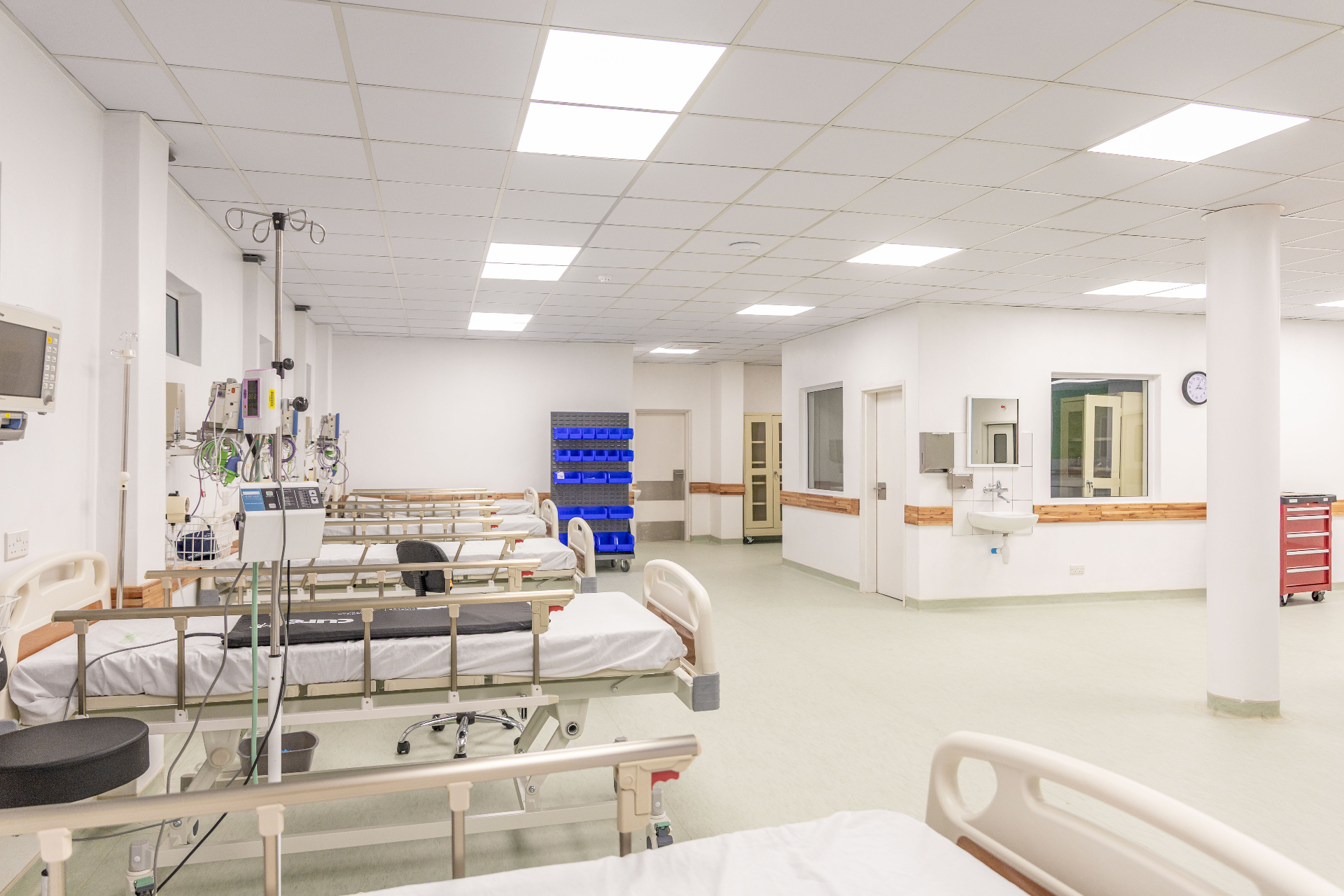
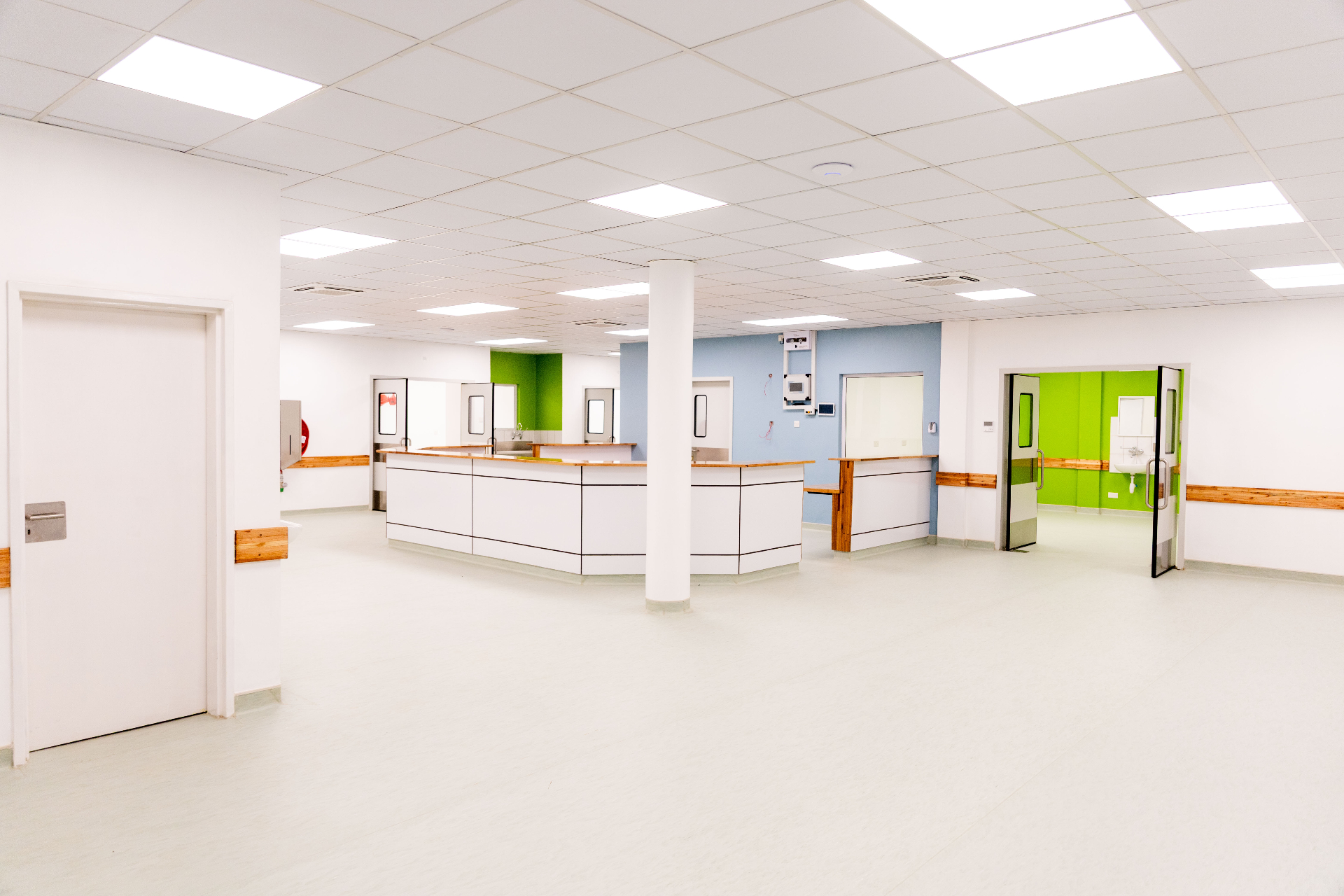
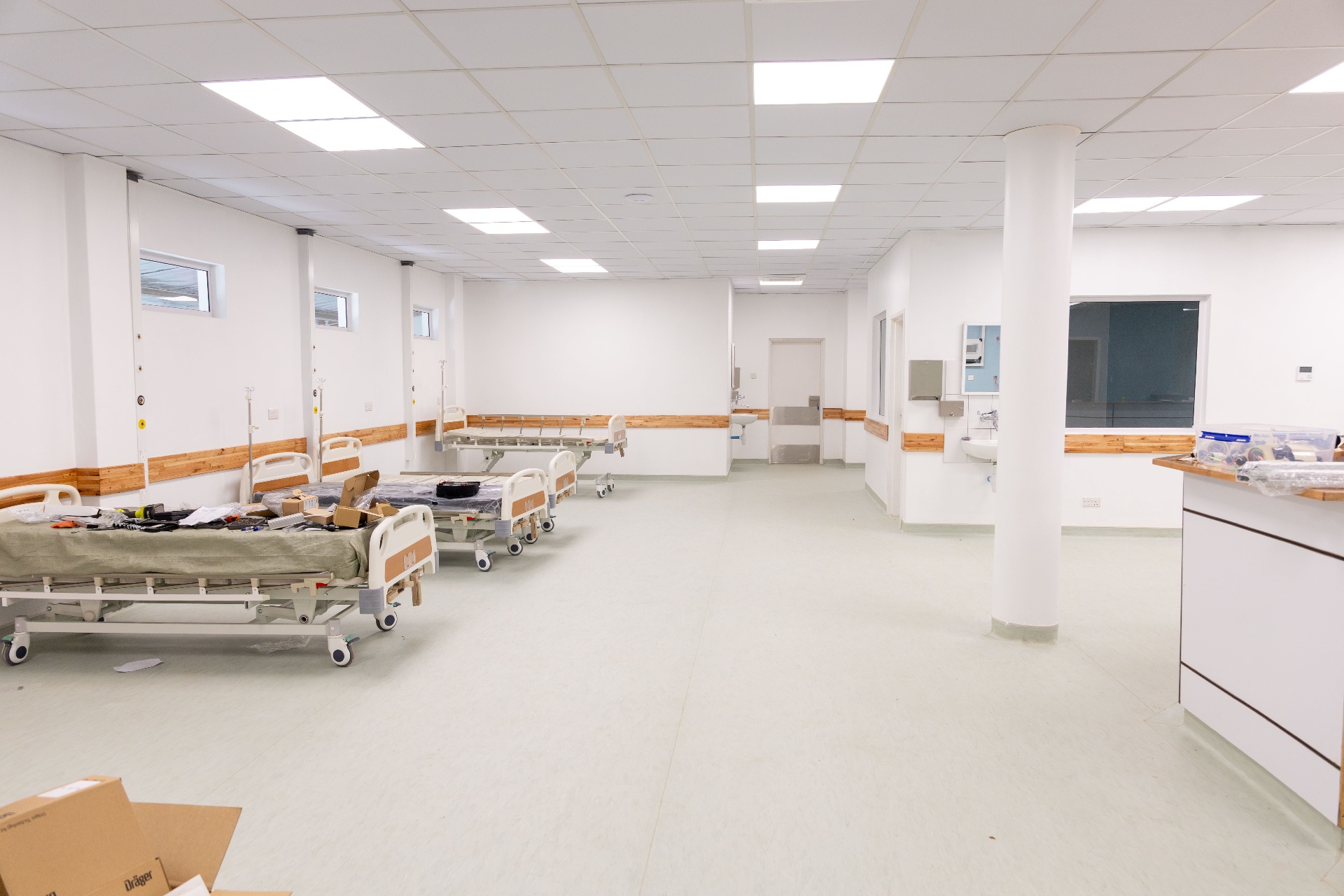
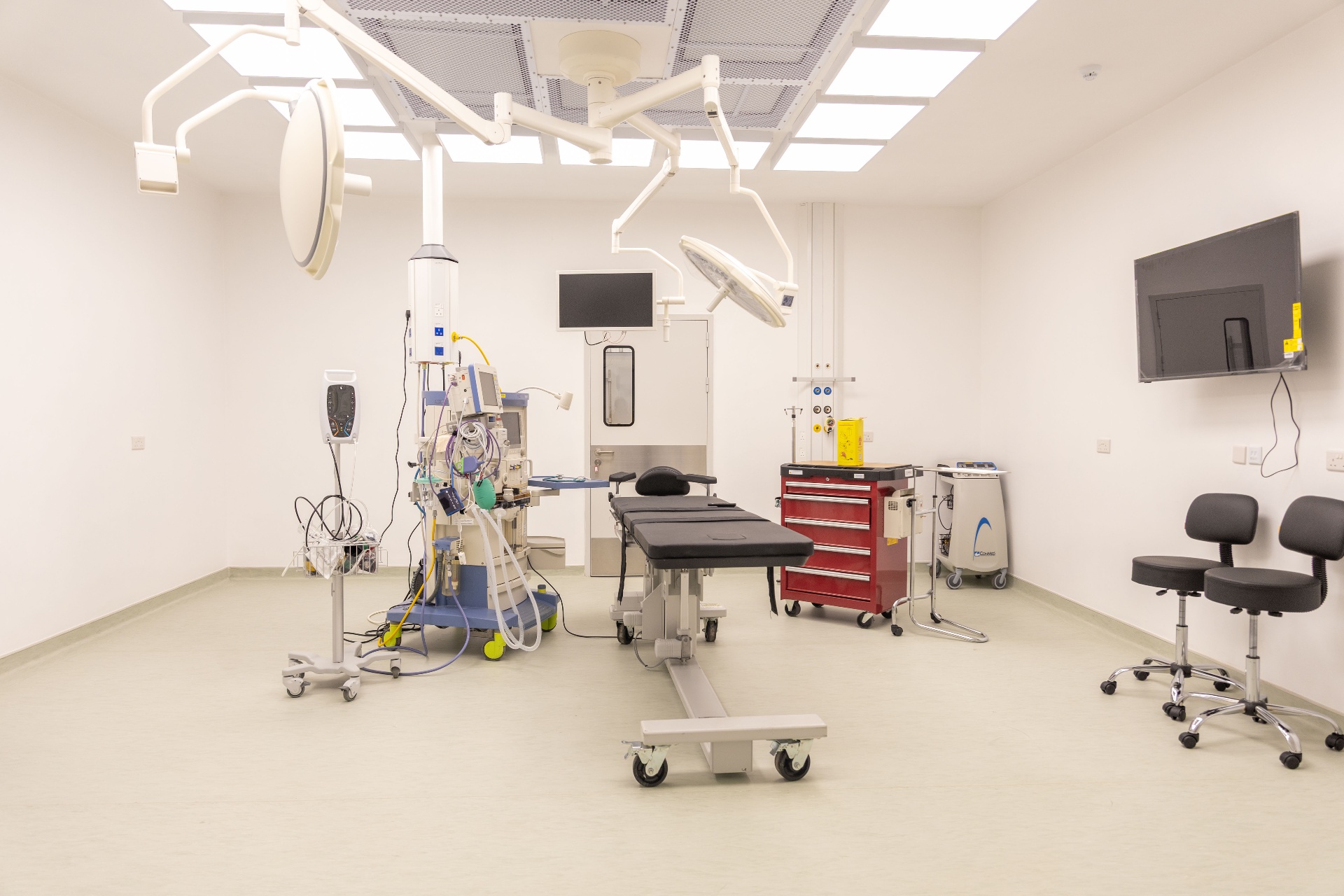
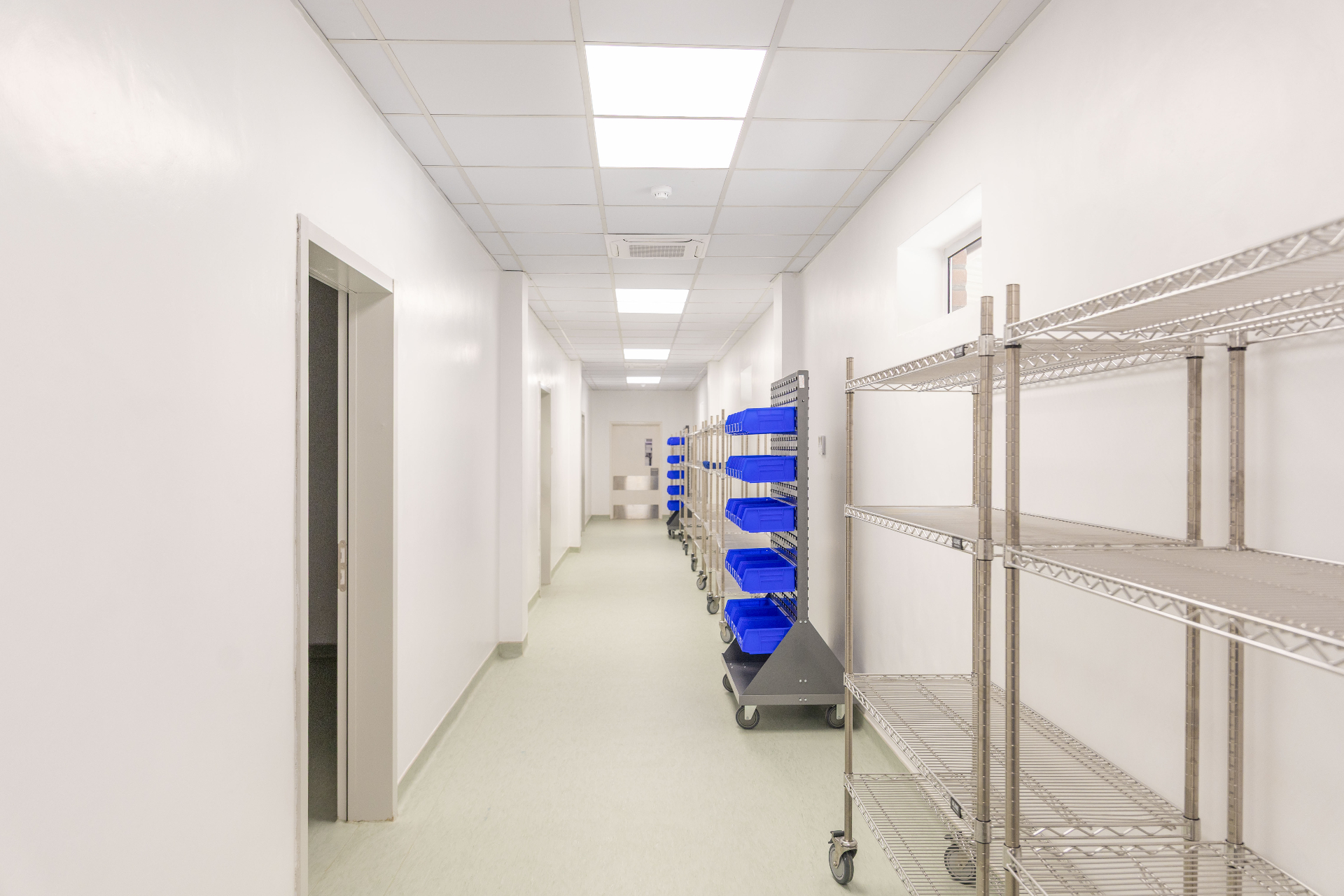
Below are the actual rooms inside CURE Malawi right now, clean, capable, clinical, and below them, the precise blueprint of what your support is changing: every door, wall, and corridor counted, measured, and assigned a treatment.

CURE Malawi recovery ward with hospital beds and monitoring equipment
Recovery Ward
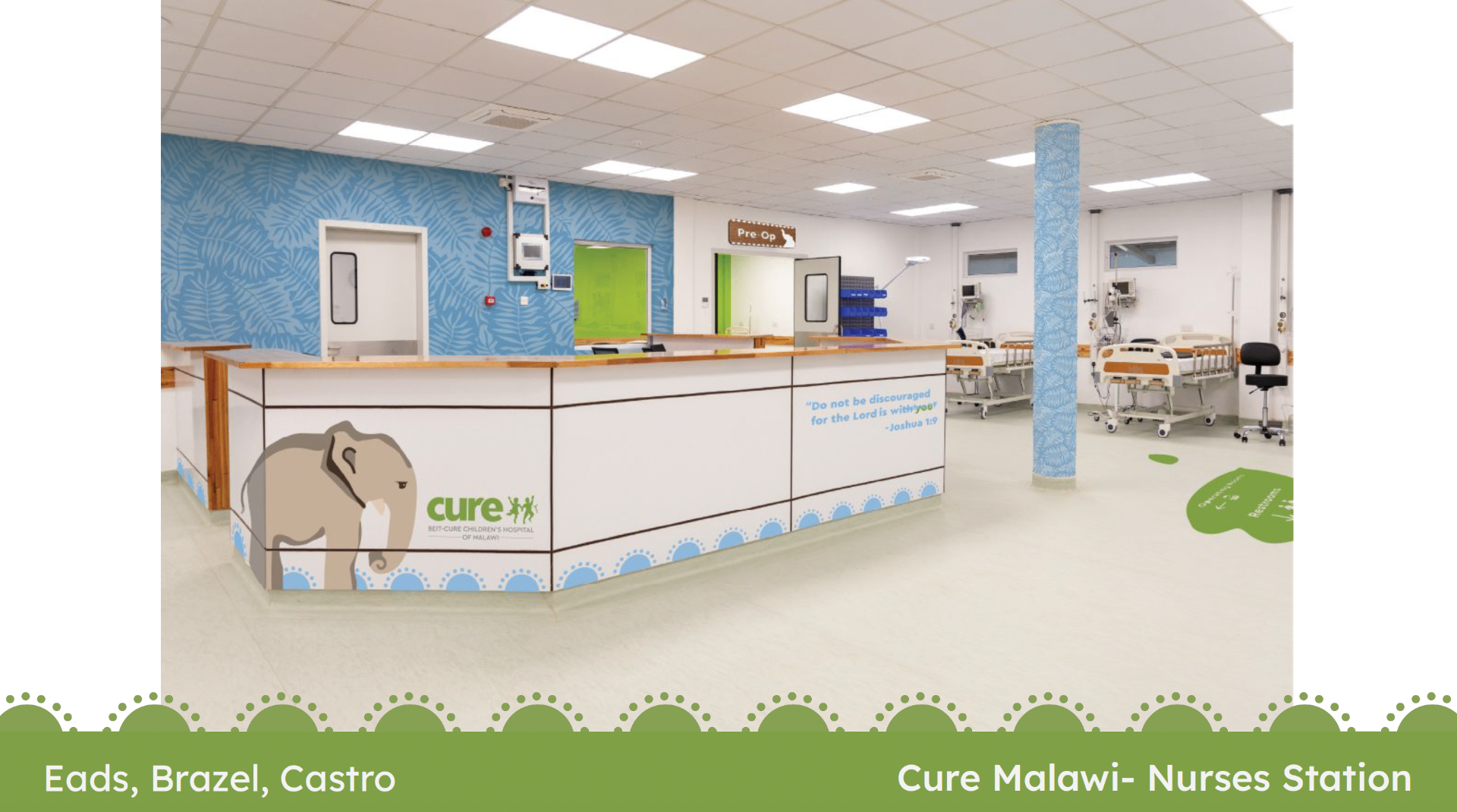
CURE Malawi nurses station with blue and green accent walls
Nurses Station
CURE Malawi pre-op room with empty hospital beds
Pre-Op Room
CURE Malawi operating theatre with surgical lights and anesthesia equipment
Operating Theatre
CURE Malawi corridor with supply carts leading to patient rooms
Corridor & Supply
↓ The Scope · what your support is producing

Every wall, door, and corridor — counted and assigned.

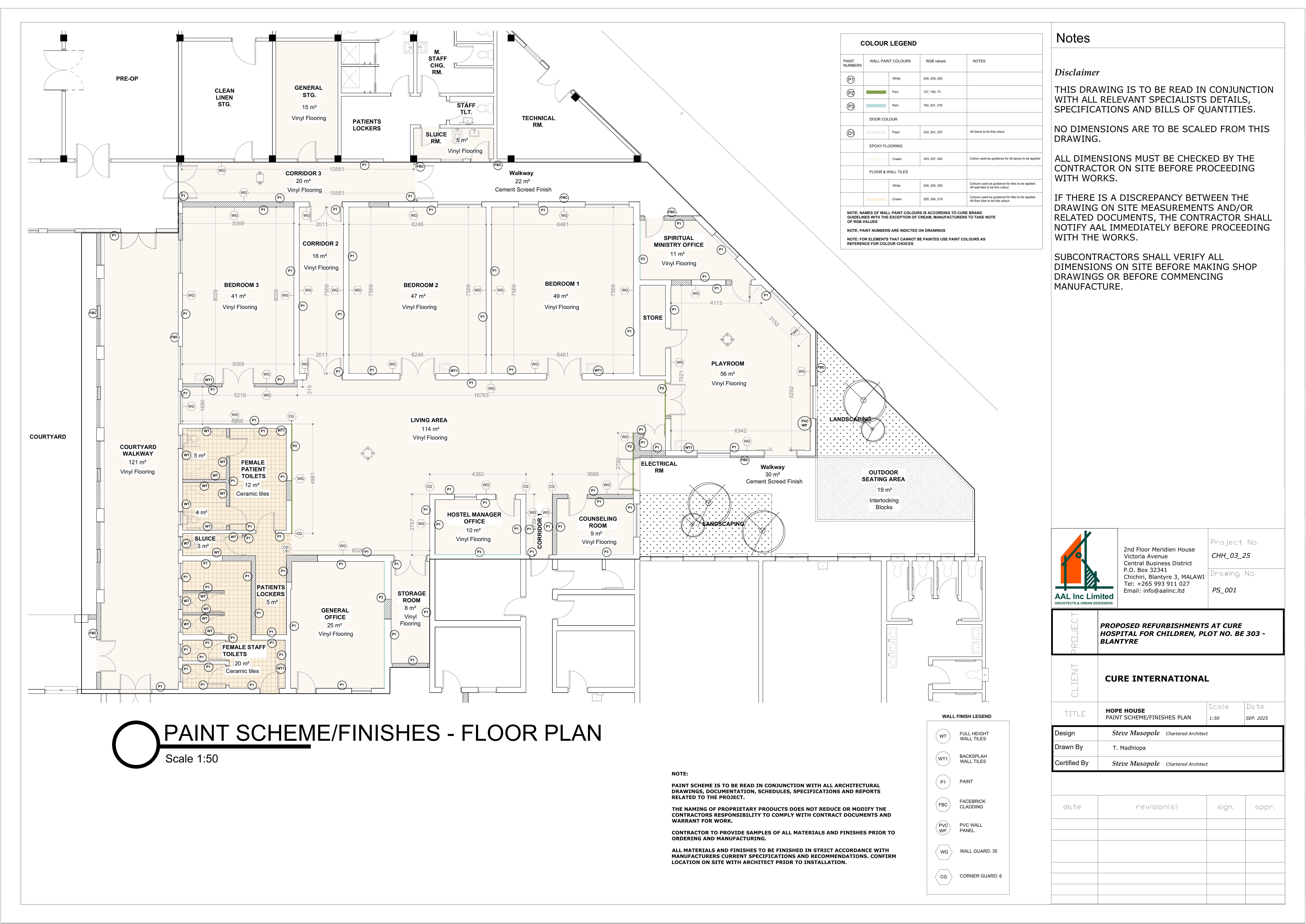
Here is the working blueprint of CURE Malawi's Surgery Department. Every piece on this plan is being designed, produced, and shipped from the United States, then installed in Blantyre starting September 2026, all because of donors like you.

CURE Malawi Surgery Department Paint Scheme & Finishes Floor Plan, showing wall finish zones, paint accent walls and vinyl graphic locations across operating rooms, PACU, pre-op, nurse station, corridors and support spacesClick to enlarge ↗

Surgery Department, Ground Floor Plan, Rev 6, April 2025. Beit-CURE International Hospital, Blantyre, Malawi. Architect: AAL Inc / Steve Musopole.

81
Room Signs
Animal-mascot wayfinding medallions on every door across Entry, Outpatient, Surgical, Wards, and Hope House. 79 confirmed + 2 outpatient TBD.
12
Animal Scene Murals
Hand-carved-style parent-and-child scenes for Pre-Op, PACU, ORs, Procedure Room, Nurse Station, Hope House living area, and corridor C16.
5–6
Scripture Verse Graphics
Lowercase, warmly illustrated verses placed in waiting, pre-op, recovery, and circulation, comfort at the most anxious moments.
13
Pattern Walls
Malawian textile and basketry-inspired vinyl pattern surfaces across corridors, ORs, and support spaces.
13
Paint Accent Walls
CURE-branded paint accents (Rain, Lake, Honey, Pumpkin, Tangerine) coordinated to the graphics in every room.
32
Large-Format Walls
Architecturally quoted vinyl surfaces, every wall measured to the inch across External Corridor, Main Circulation, Pre-Op, PACU, Nurse Station, OR 101/102/103, and Procedure Room.
Total Environmental Wall Treatments
44
12 animal scenes · 5–6 verse graphics · 13 pattern walls · 13 paint accent walls. Plus 81 wayfinding signs across the building. Every piece is being designed, produced, and shipped from the United States, then installed in Blantyre starting September 2026.
The Science

Why this work actually heals.

Show the research behind your gift

Roger Ulrich studied 46 patients recovering from identical gallbladder surgeries. The only difference: the view from their window, trees, or a brick wall. Patients with the nature view left nearly a full day sooner, needed fewer narcotic pain medications, and had fewer complications. His paper in Science has been cited 46,000+ times, the most referenced study in healthcare design history. What a patient sees is not incidental. It is clinical.

20–30%
Anxiety Reduction
Culturally resonant visual art reduces measured anxiety in pediatric settings. Multiple independent studies.
~1 day
Shorter Recovery
Surgery patients with nature views left hospital nearly a full day sooner. Less narcotics. Fewer complications. Ulrich, 1984.
22%
Less Pain Medication
Decrease in pain medication when patients have calming, nature-based visual environments. Replicated in burn studies.
3.4M
Patients · RxART
Immersive art at 39 children's hospitals across North America. The scale is proven. The model exists.
Real-world proof, click any to expand
RxART · 39 Hospitals
Jeff Koons transformed a CT scanner. A child who called it terrifying said: "Now it's fun."
RxART commissions world-class artists, Jeff Koons, Takashi Murakami, Derrick Adams, to create immersive installations in pediatric hospitals. At Children's Hospital of Orange County, Rob Pruitt wrapped a CT scanner in playful maritime imagery. A girl who required annual scans and called the machine terrifying said after: "Now it was fun." RxART has reached 3.4 million patients. The model is proven. It just hasn't reached the hospitals that need it most. Until now.
CHOP · Philadelphia
A mural became a diagnostic tool. "I'm not sure we'd have that moment if the walls were white."
Children's Hospital of Philadelphia's "Picture This!" program placed interactive murals in exam rooms. During one visit, a girl began identifying animals in the mural, revealing cognitive milestones her mother had never noticed. Dr. Erkoboni: "I said, 'Mom, look at this smart little girl you're building.' I'm not sure we'd have had that moment if the walls were white." Art doesn't just comfort patients. It opens space for connection that a sterile room never could.
Chelsea & Westminster · London
16 of 19 ER clinicians confirmed measurably less child anxiety when artwork was present.
Research at Chelsea & Westminster Hospital found women undergoing procedures felt significantly less anxious in decorated rooms, with evidence of shorter labour times. In the pediatric ER, 16 of 19 clinicians confirmed child patients showed measurably less anxiety when artwork was present. Trained medical professionals, paid to observe and measure, confirming with clinical eyes what the environment was doing to their patients' bodies.
Cortisol & Stress Response
Art engagement and nature imagery lower cortisol, the primary stress hormone, in hospitalized children. Lower cortisol supports immune function, reduces inflammation, and improves the body's ability to heal. For children entering a hospital for the first time, this is not aesthetic. It is physiological. Source: COSACOSA Healing Art Project, National Endowment for the Arts.
Positive Psychology & Distraction Analgesia
Patients engaged with a positive visual stimulus attend less to their pain. Animals to count, parent-child scenes to follow, details to find, all activate the brain's reward systems and suppress the fear-pain response. The effect is strongest in children. And strongest when imagery is culturally familiar, when it feels like home.
Cultural Resonance, The Key Variable
Generic "calming" imagery provides some benefit. But imagery rooted in a patient's own culture provides dramatically more. A Malawian child seeing Lake Malawi, baobab trees, and a mother elephant playing with her child is not just distracted. They feel recognized. That psychological shift, from frightened outsider to seen human being, changes everything.
The Gap This Project Closes
Johns Hopkins commissioned 500 artworks from 70+ artists for their children's center. Boston Children's has full-time music therapists and a recording studio. Cincinnati Children's fills every corridor with meaning. These institutions have extraordinary resources. CURE Malawi serves children who've traveled days to reach a hospital for the first time. The gap is not in aspiration. It is in resources. This project is about closing it.
Why this matters

Three numbers that frame everything your support touches.

The science is settled. The need is real. The cost is remarkably low. Here is the proof, in the only language that leaves no doubt.

46,000+
Ulrich 1984 · Science Journal
Times the landmark study proving nature heals has been cited. The most referenced paper in healthcare design history — and the evidence base every design decision on this project stands on.
2,500+
CURE Malawi · Annual
Surgeries performed every year at CURE Malawi, free to patients. Each one life-changing. Each one made possible by donors like you.
$1,800
CURE International
Average cost per surgery to donors — not to patients. One of the most impactful uses of charitable dollars anywhere in the world.

Keep going. Next, see exactly where your dollars are going, phase by phase, partner by partner.

The Work

Every decision. Every phase.
This is what your investment built.

One strategic brand agency. A print partner with 116 years of excellence. Visual storyteller. Two universities. All working toward a room that tells a child: you are safe here.

0
Origin
April 2024
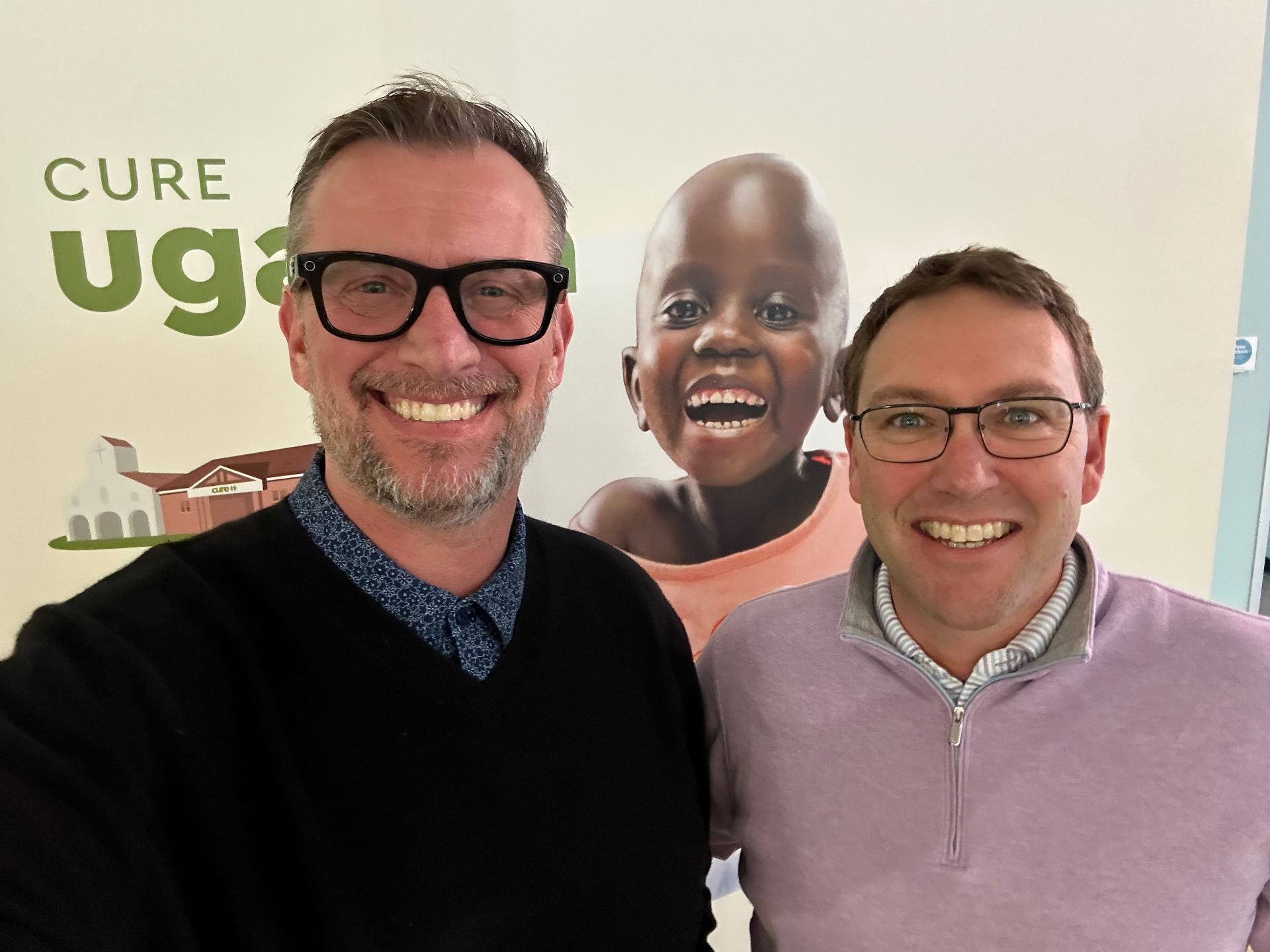
The Conversation, at CURE Headquarters

Justin Ahrens of Rule29 met with Justin Narducci, CEO of CURE International, at CURE's headquarters. Over that first conversation, the two started talking about the dream of enhancing the environments where CURE serves — spaces for healing, for community, and for genuine human connection. No deck, no scope, no budget. Just a shared belief that the rooms a child walks into can matter as much as the care they receive there, and a willingness to find out what that could look like inside a CURE hospital.

Everything in the timeline below — the Bradley discovery work, the Kent State research, the Malawi cultural deep-dive, the hand-carved animal system, the wayfinding, the press-ready files now headed to Blantyre — traces back to that one meeting.

Rule29CURE International
Justin Ahrens of Rule29 with Justin Narducci, CEO of CURE International, at CURE Headquarters, April 2024
Justin Ahrens (Rule29) with Justin Narducci (CEO, CURE International) at CURE HQ
I
Complete
Spring 2025
Kent State, Phase 1: Research & Evidence Base

Kent State's graduate design program delivered a rigorous evidence review of environmental design in pediatric healthcare. Conclusion: nature-based, culturally resonant imagery provides the highest measurable therapeutic value. This research became the scientific backbone of every creative decision, ensuring nothing was arbitrary.

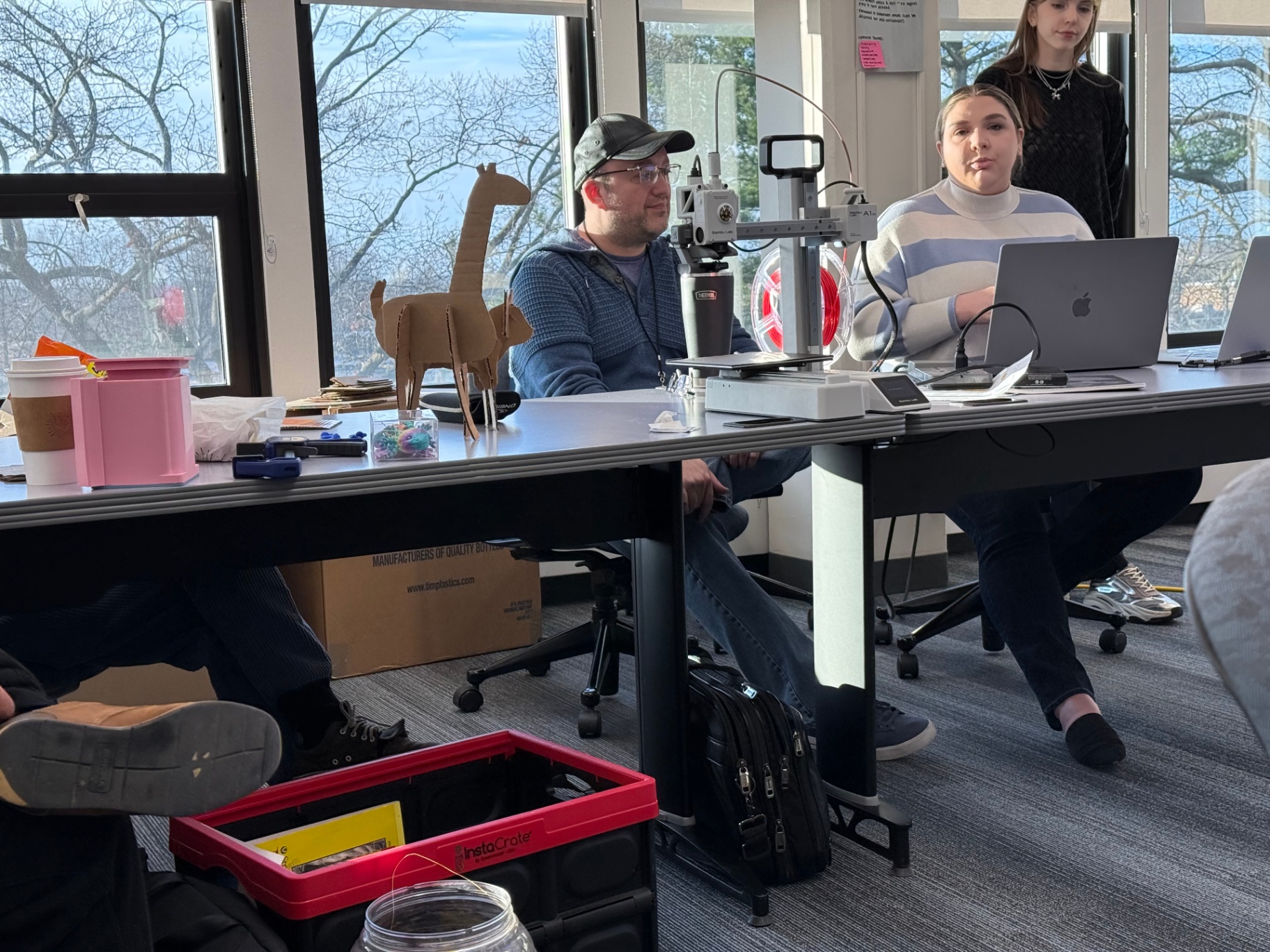
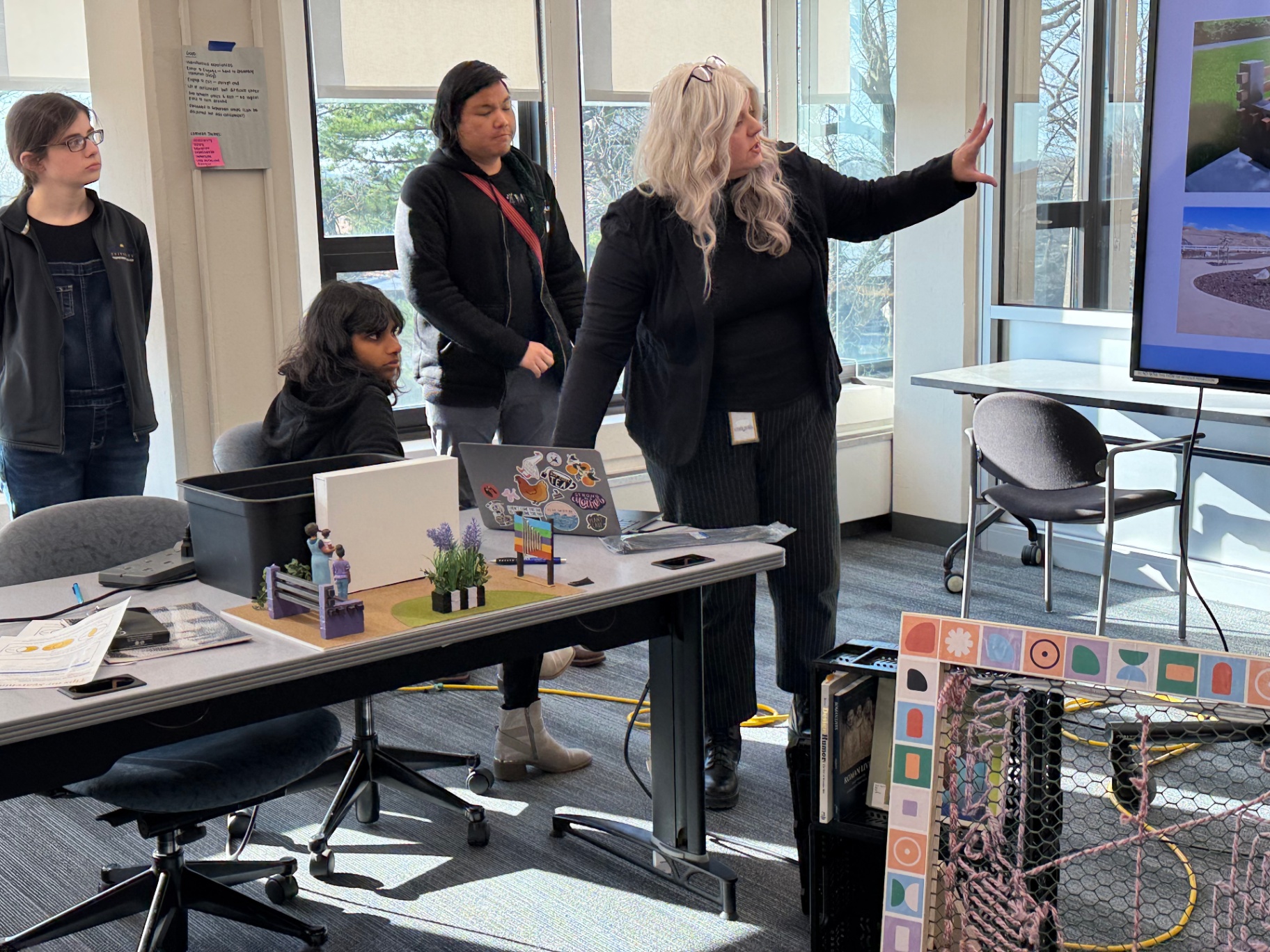
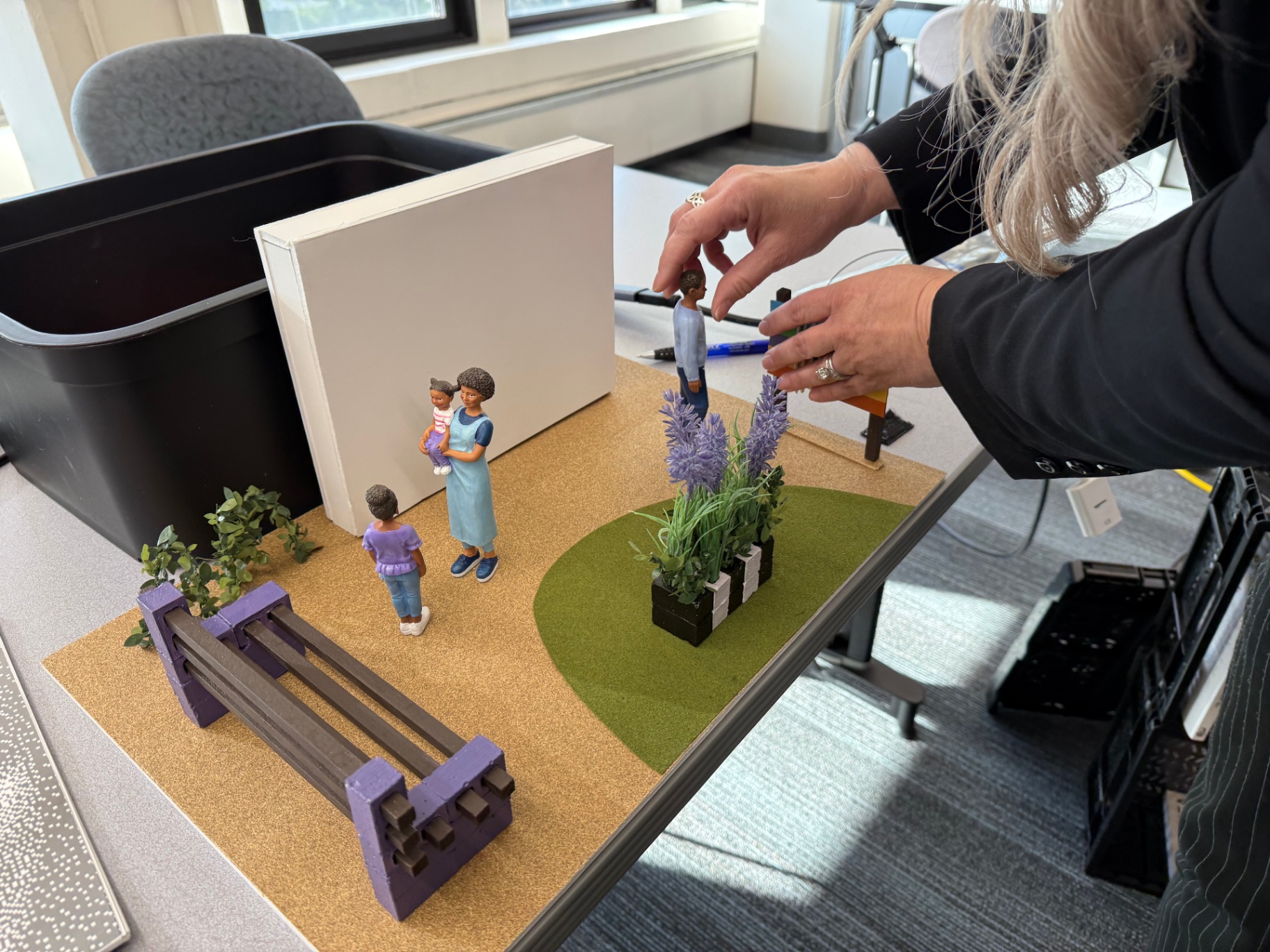
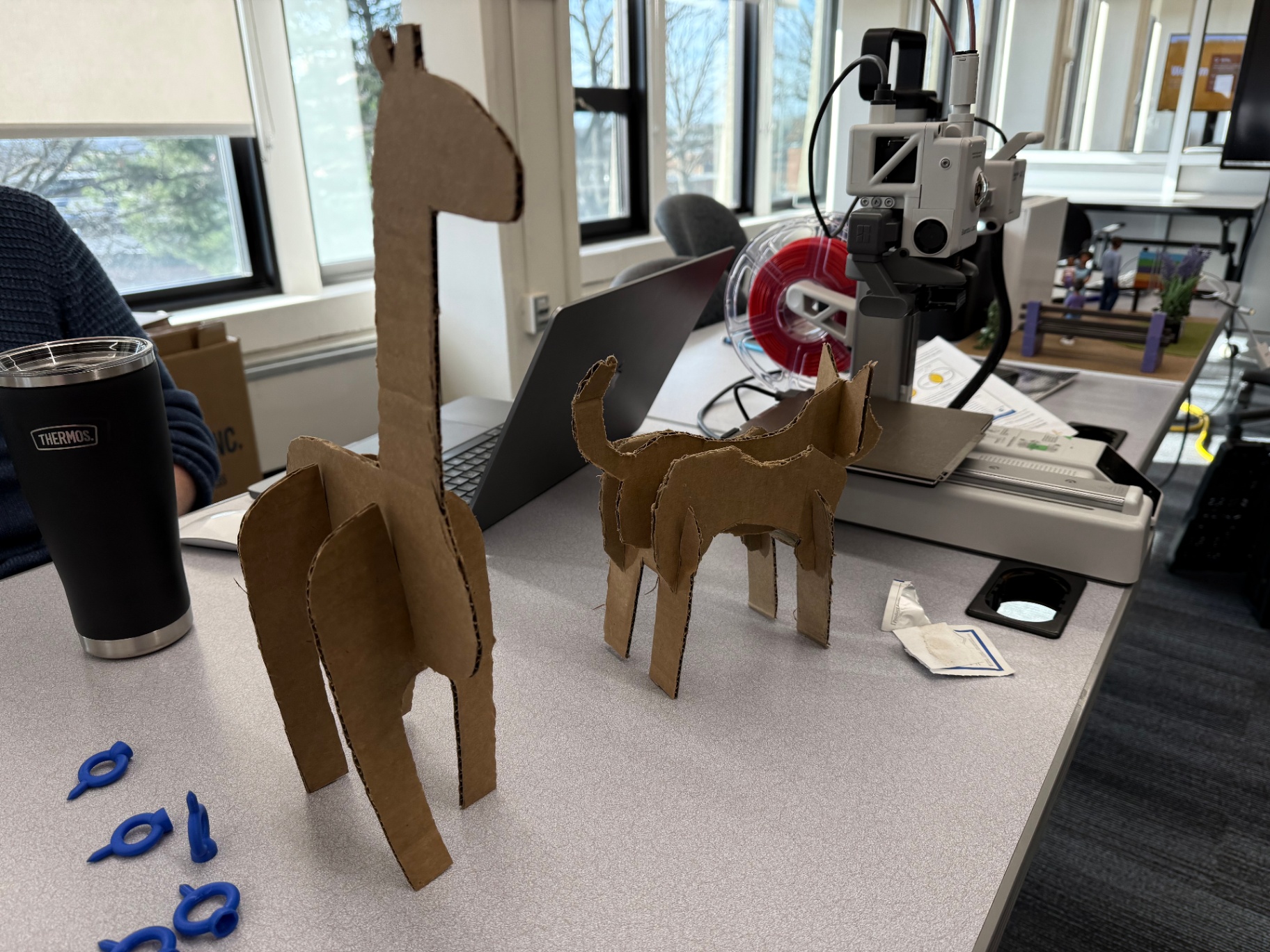
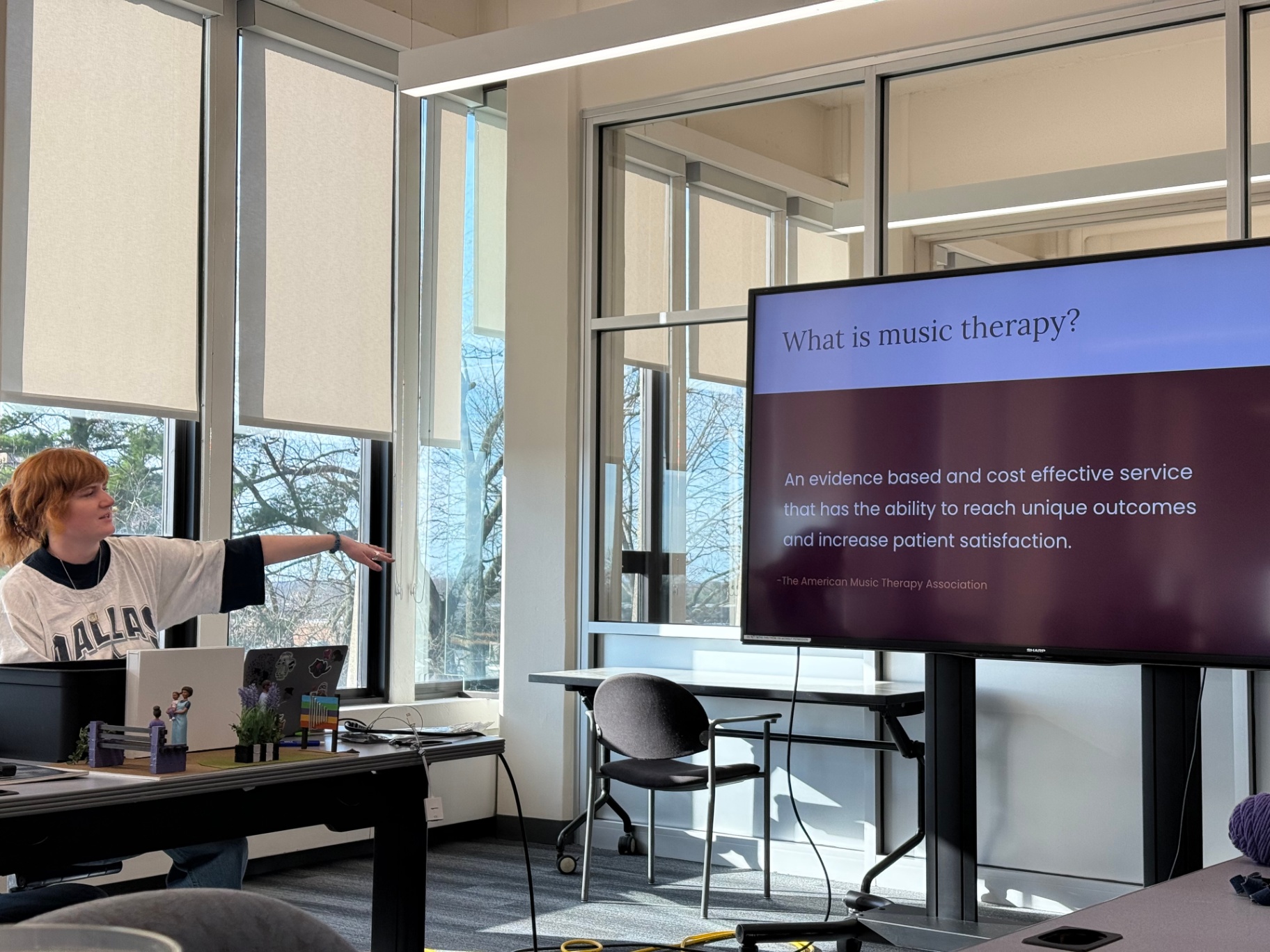
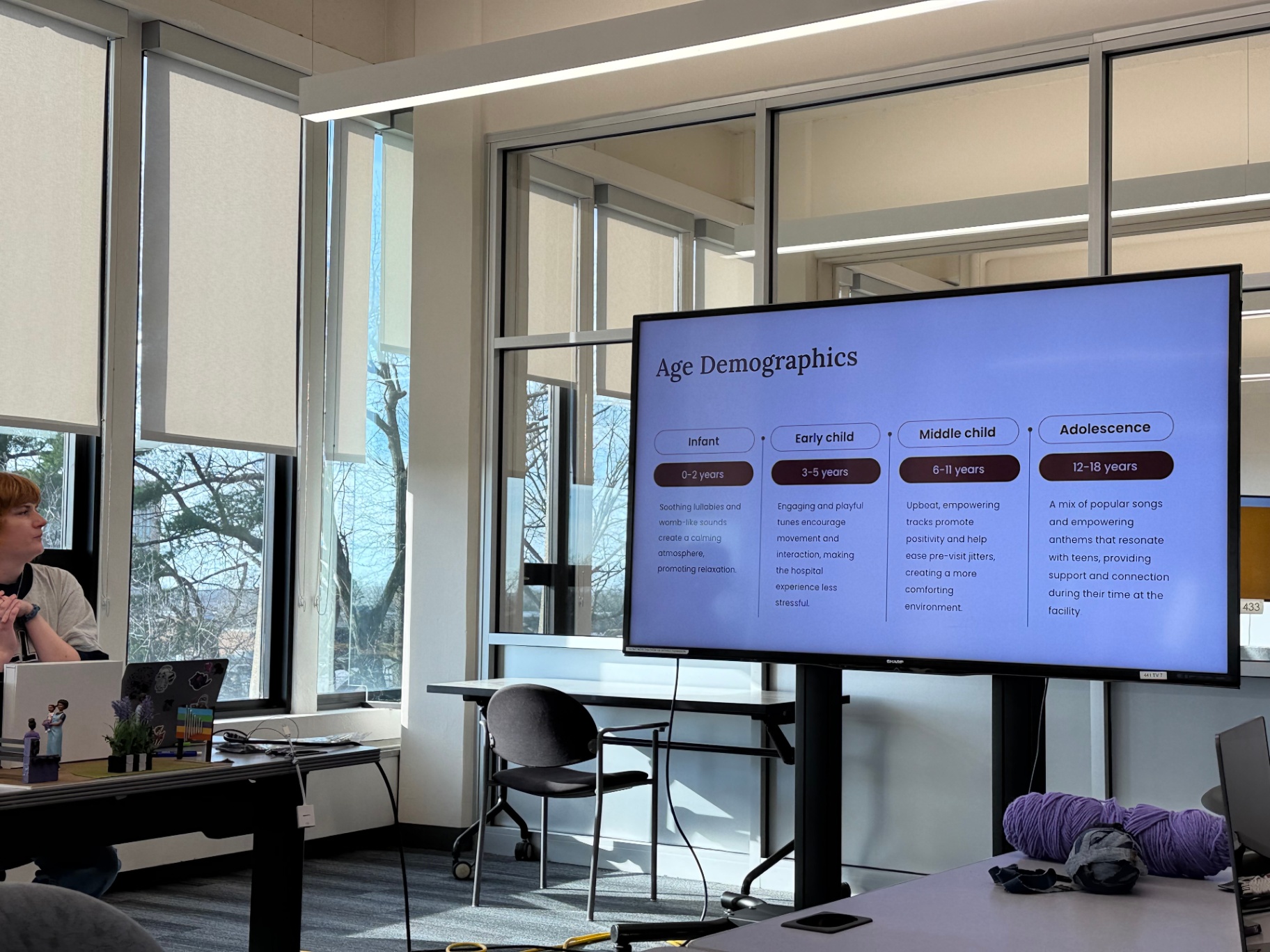
Kent State explored Malawi culture in depth, everything from music therapy to art therapy to how to redesign the spaces themselves. Students built physical models, ran research, and presented a spectrum of ideas: art projects made from local materials, ways to include local artisans, and spaces shaped by music, art, and play. The work opened up the possibility of how healing could happen through many different lenses, not just one.

Kent State University
Kent State students presenting 3D-printed prototypes and cardboard animal models
Prototyping with local materials
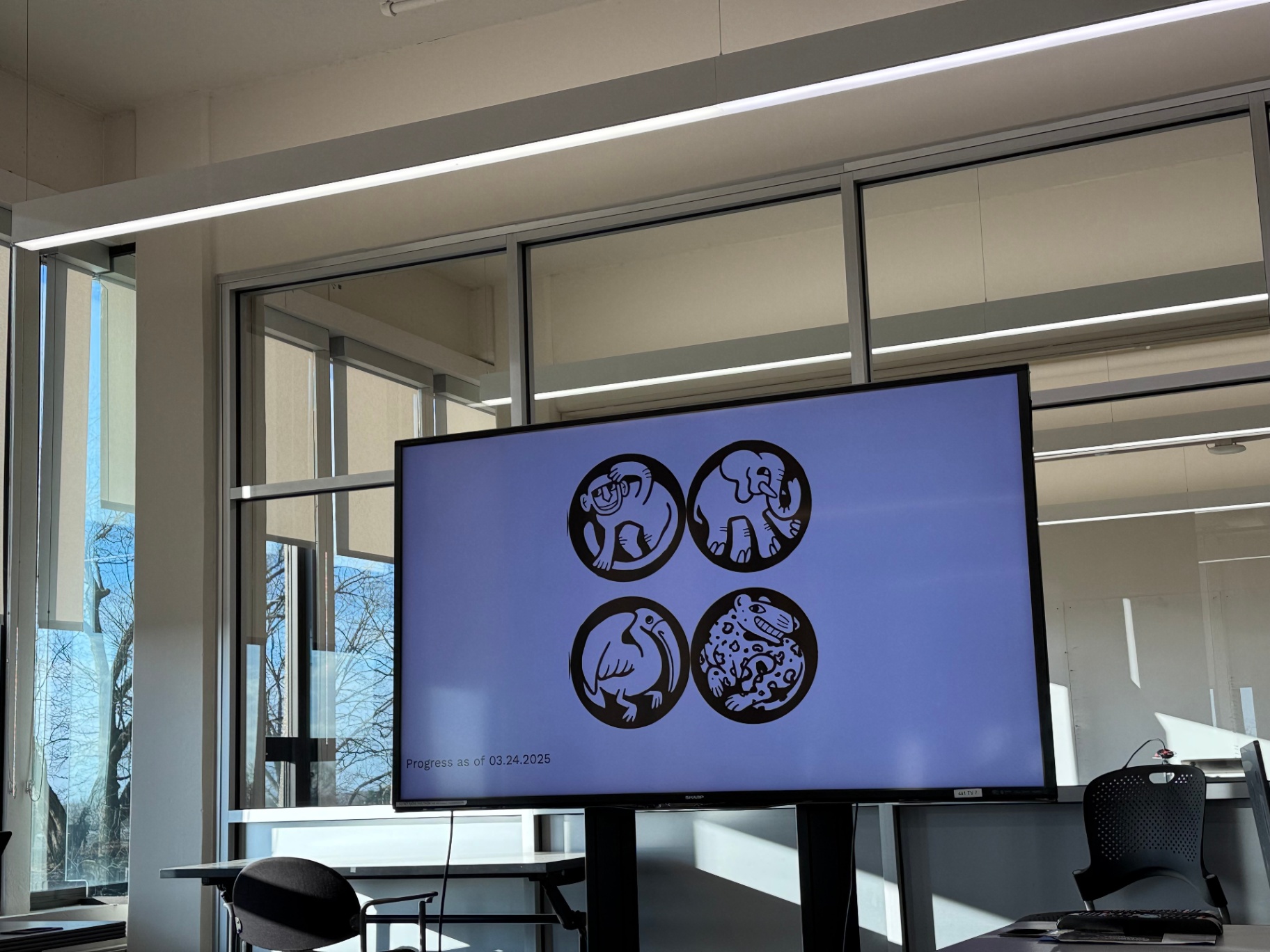
Animal medallion icon system explored by Kent State
Animal medallion icon studies
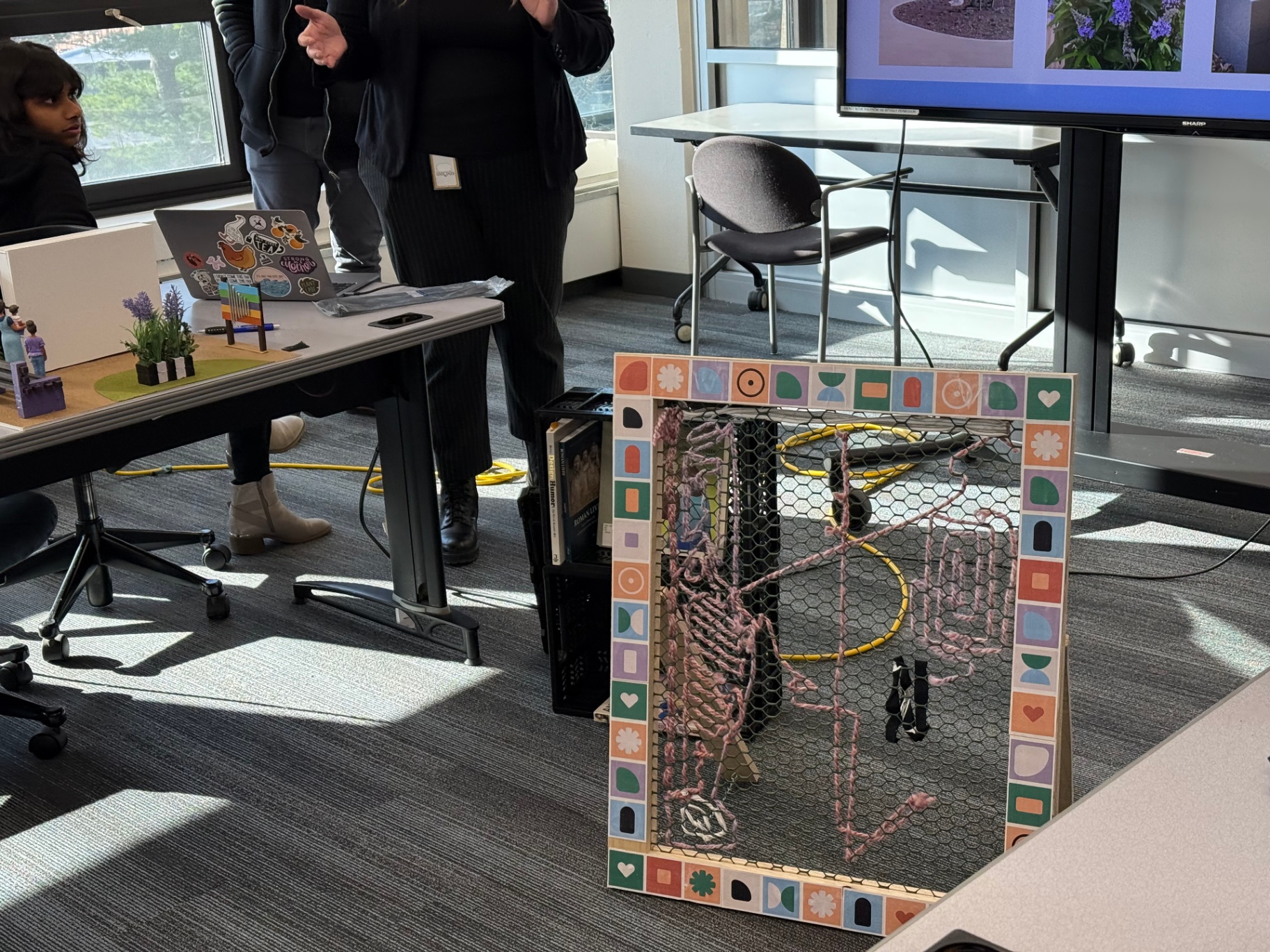
Mixed-media artwork using chicken wire, yarn, and patterned border tiles
Art therapy material studies
Kent State student presenting space and environment concepts
Space redesign concepts
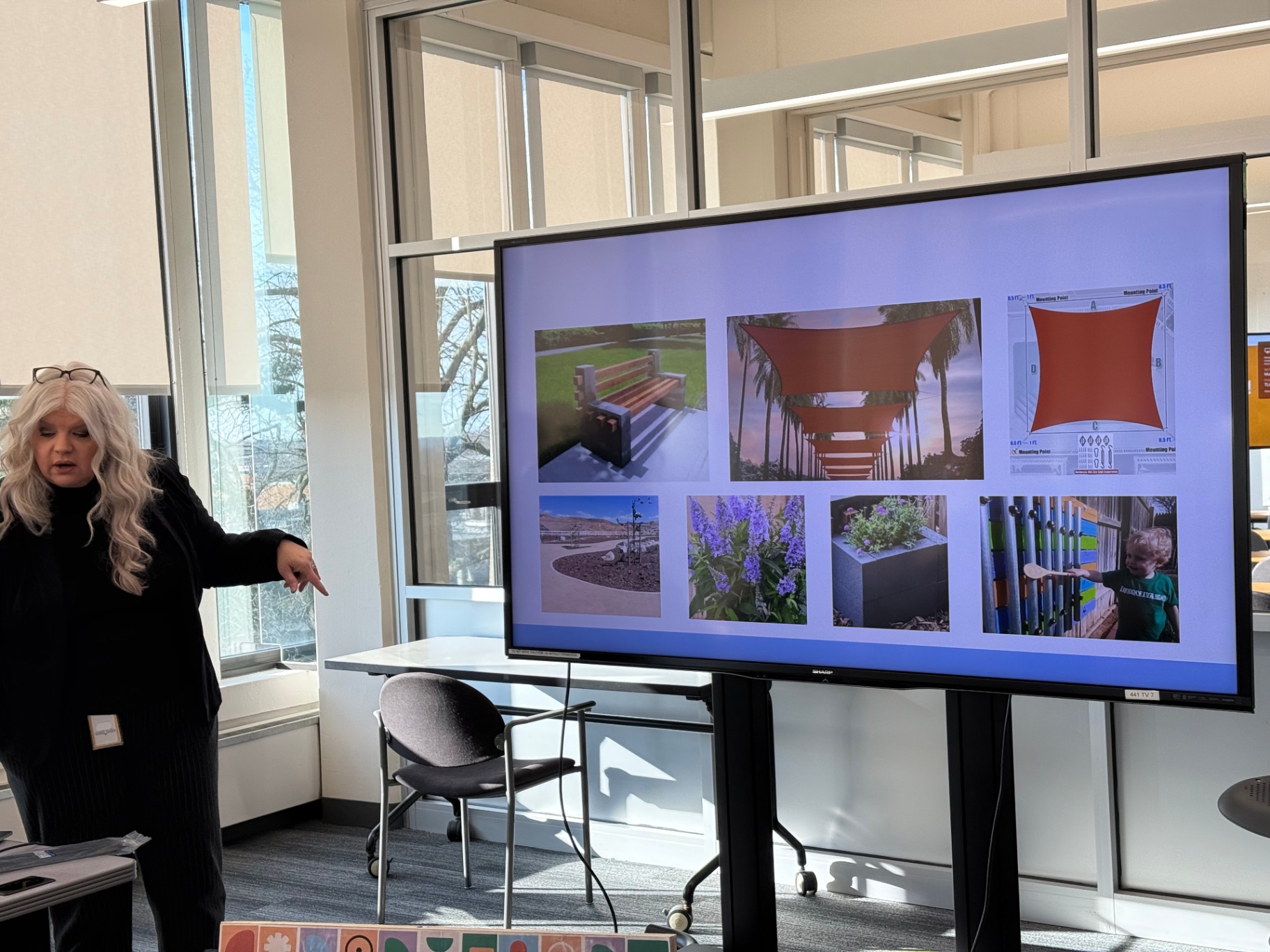
Reference board of benches, shade sails, planters and sensory walls
Outdoor & sensory references
Scale model of a healing courtyard with figures, planters and seating
Healing courtyard model
Cardboard giraffe and dog figures cut and assembled by students
Local-material figures
Slide explaining what music therapy is, cited from the American Music Therapy Association
Music therapy research
Age demographics slide breaking music therapy across infant, early child, middle child and adolescence
Age-tailored therapy
II
Complete
Fall 2025
Rule29 Initial Research & Moodboard for CURE: Calming Malawian Landscapes

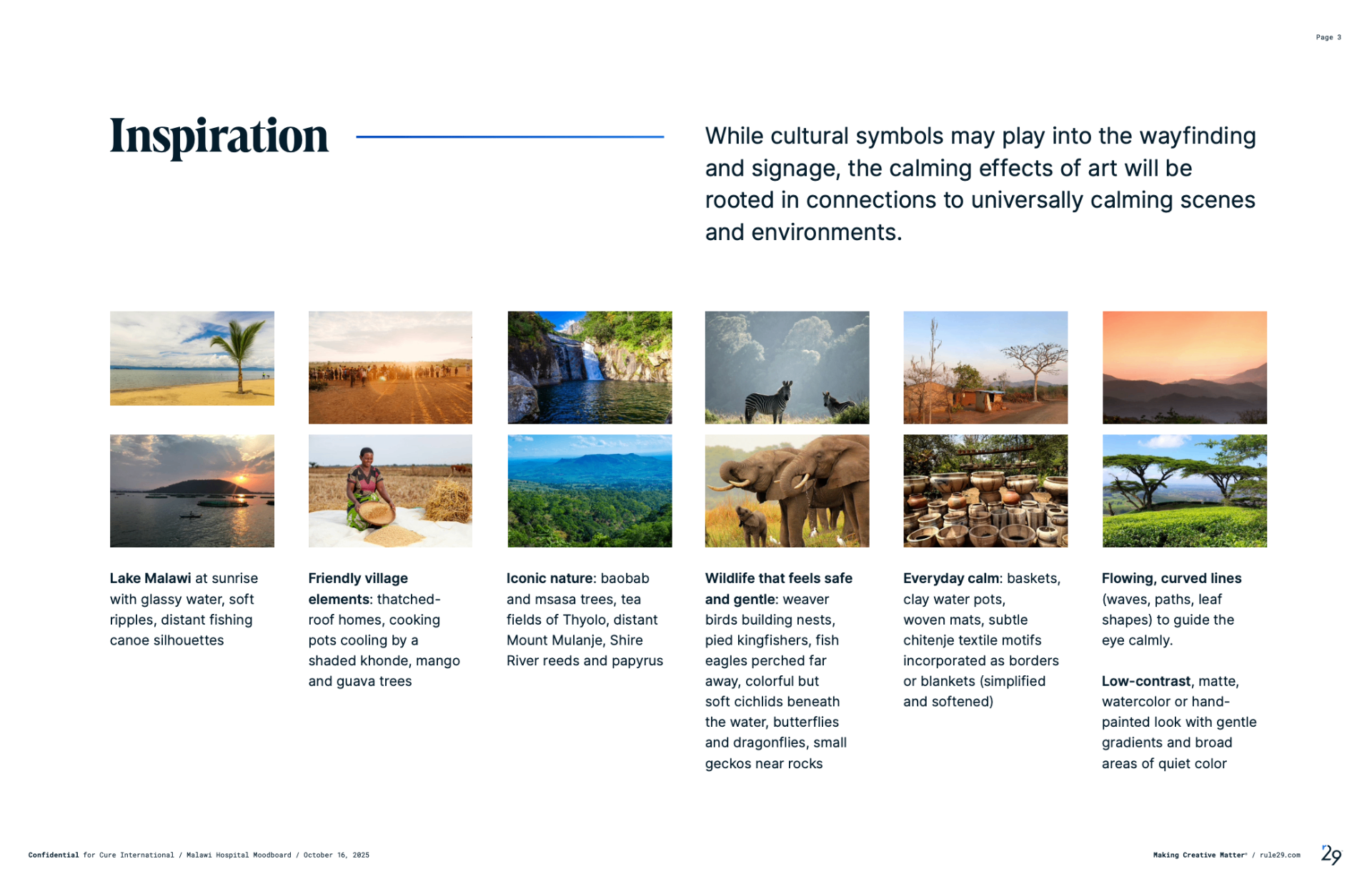
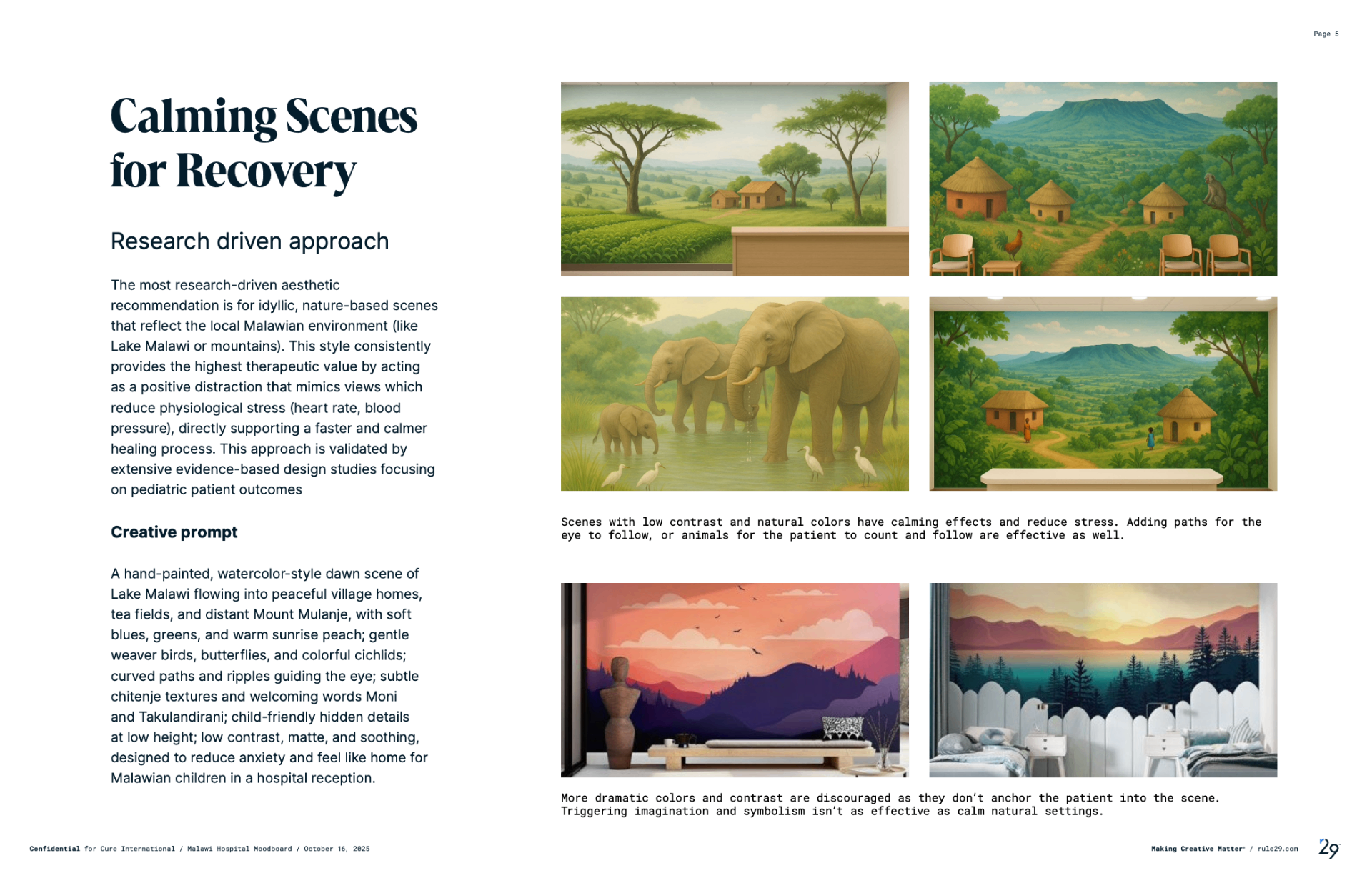
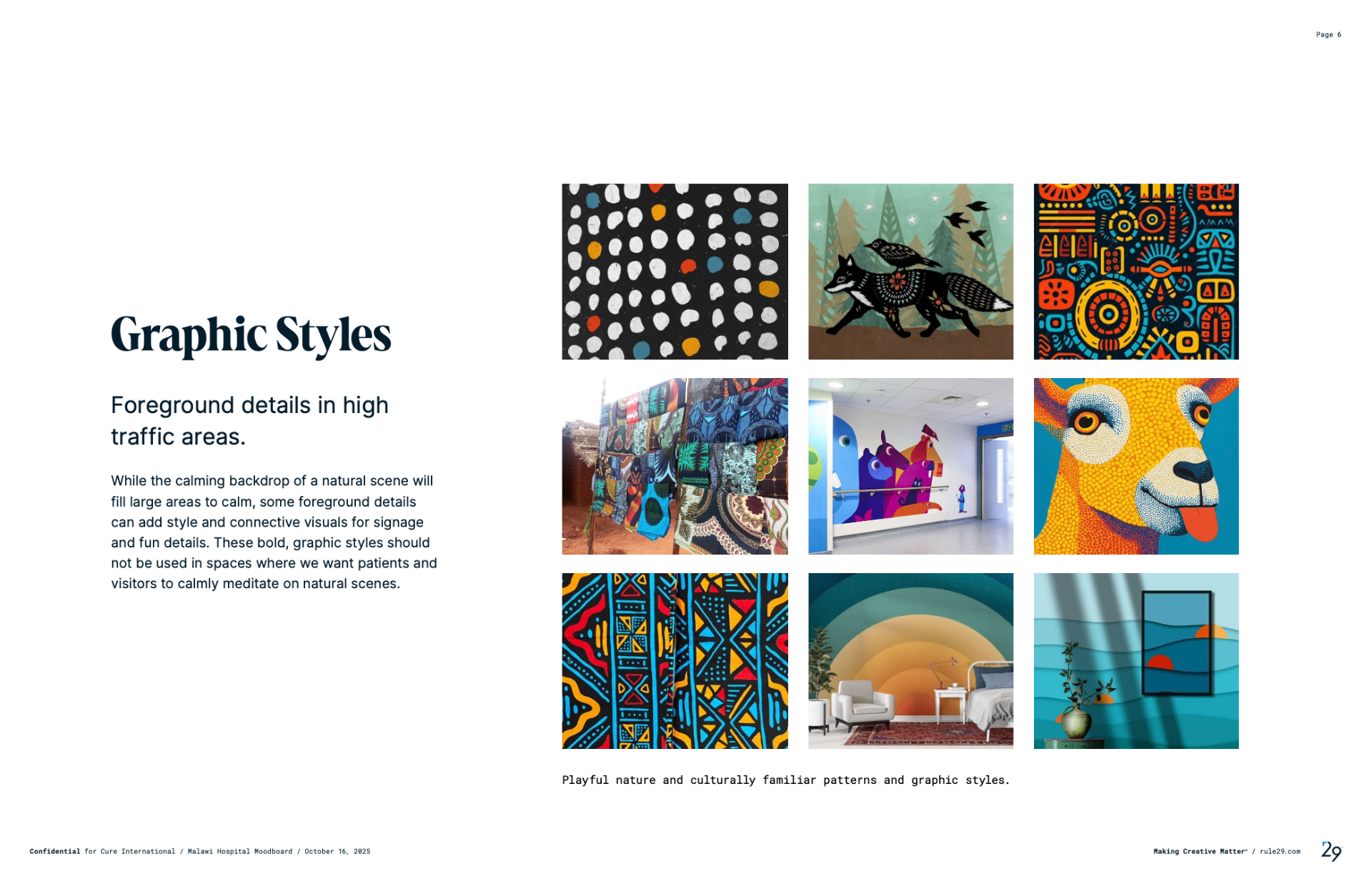
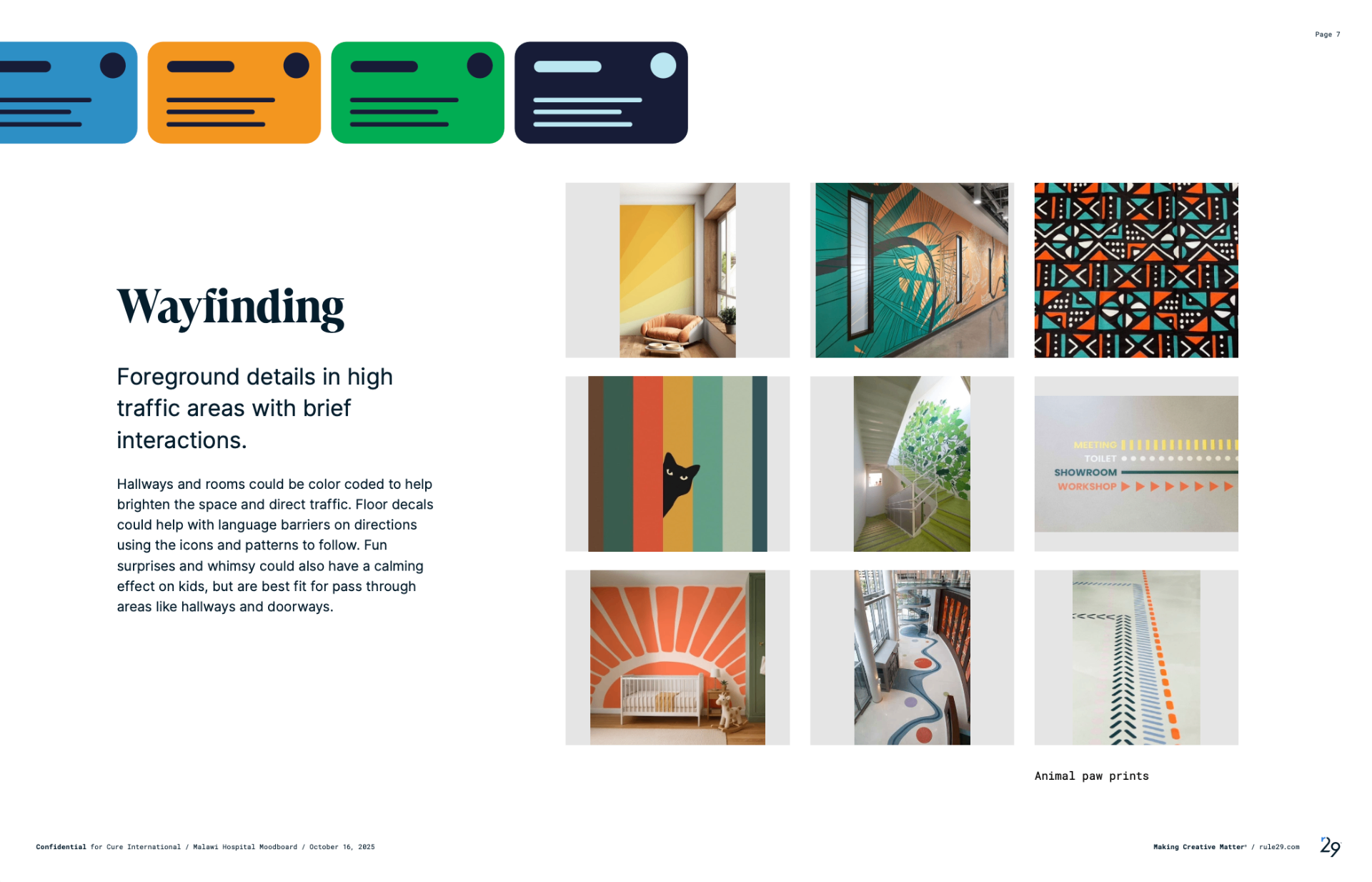
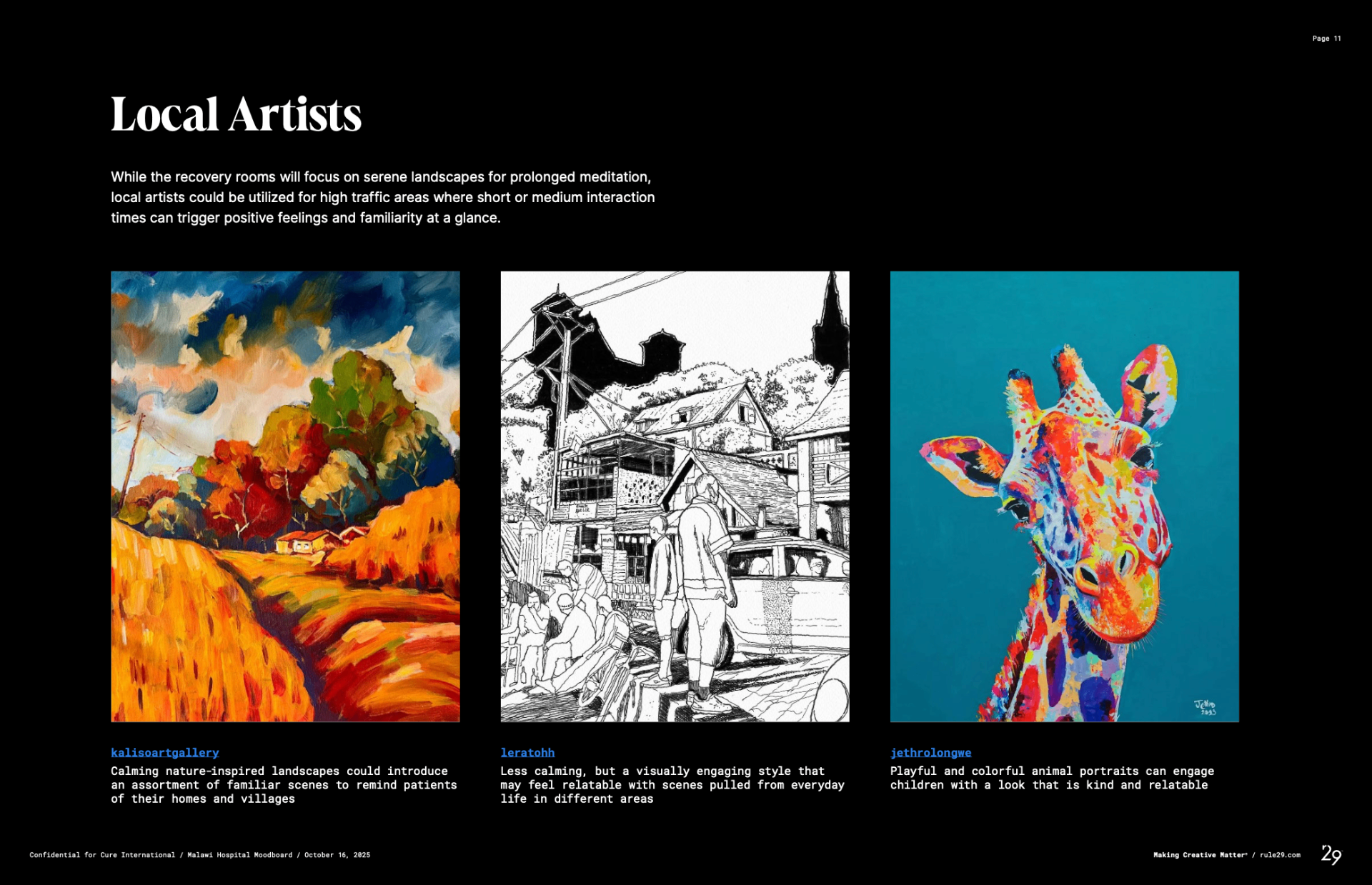
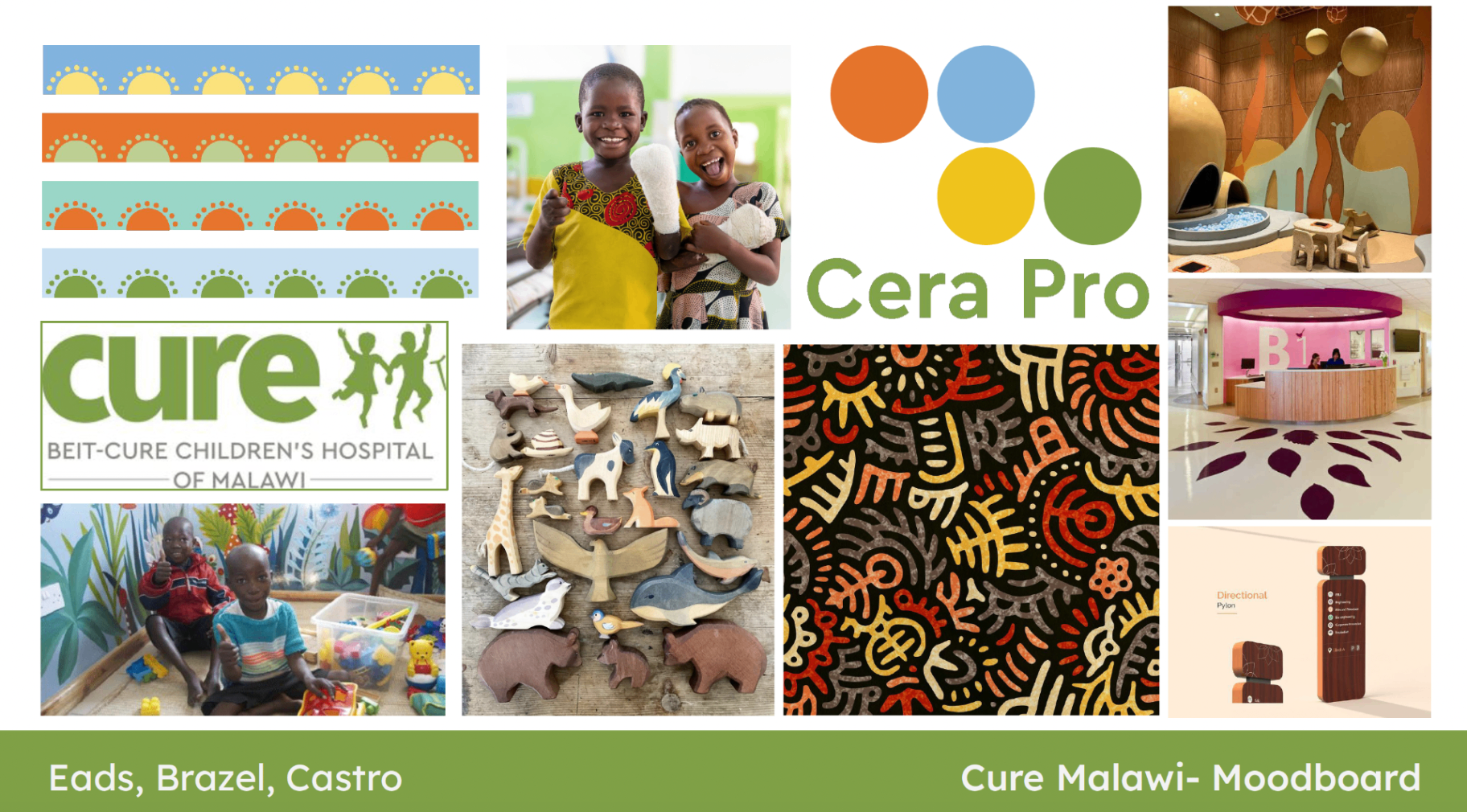
Alongside the university work, Rule29 partnered with CURE International to build the foundational creative research that was shared with both schools: a Malawi Hospital Moodboard exploring calming scenes, local inspiration, graphic styles, wayfinding color systems, patterns, and local artists. The document established the visual and strategic ground, why nature-based imagery heals, how Malawian flag colors could code spaces, where local pattern and craft belong, and which artists could be partners.

The first creative direction out of this work: watercolor-style murals of Lake Malawi at sunrise, baobab trees, tea fields of Thyolo, and distant Mount Mulanje. Low-contrast, matte, hand-painted, designed for prolonged patient meditation. Research-validated. CURE International responded that they wanted to go deeper into Malawian cultural life, and this is the research package that informed both Kent State and Bradley as their work progressed.

Rule29CURE International
Inspiration board of Lake Malawi, villages, wildlife and curved natural forms
Inspiration: nature & culture
Calming Scenes for Recovery, watercolor mural concepts of Malawian landscapes
Calming scenes for recovery
Graphic Styles, foreground patterns and bold motifs for high traffic areas
Graphic styles for high-traffic
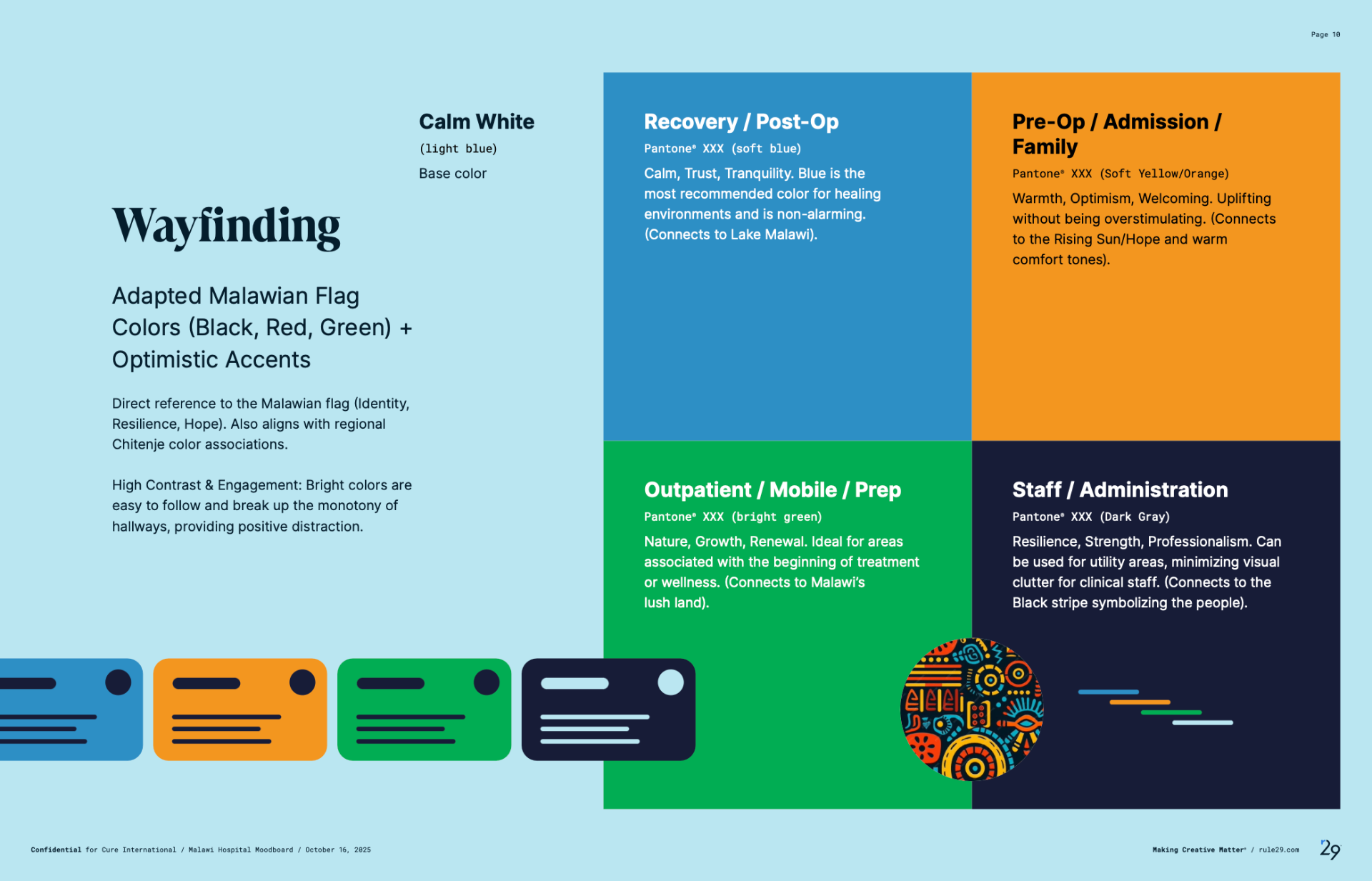
Wayfinding signage shapes in blue, orange, green and navy
Wayfinding language
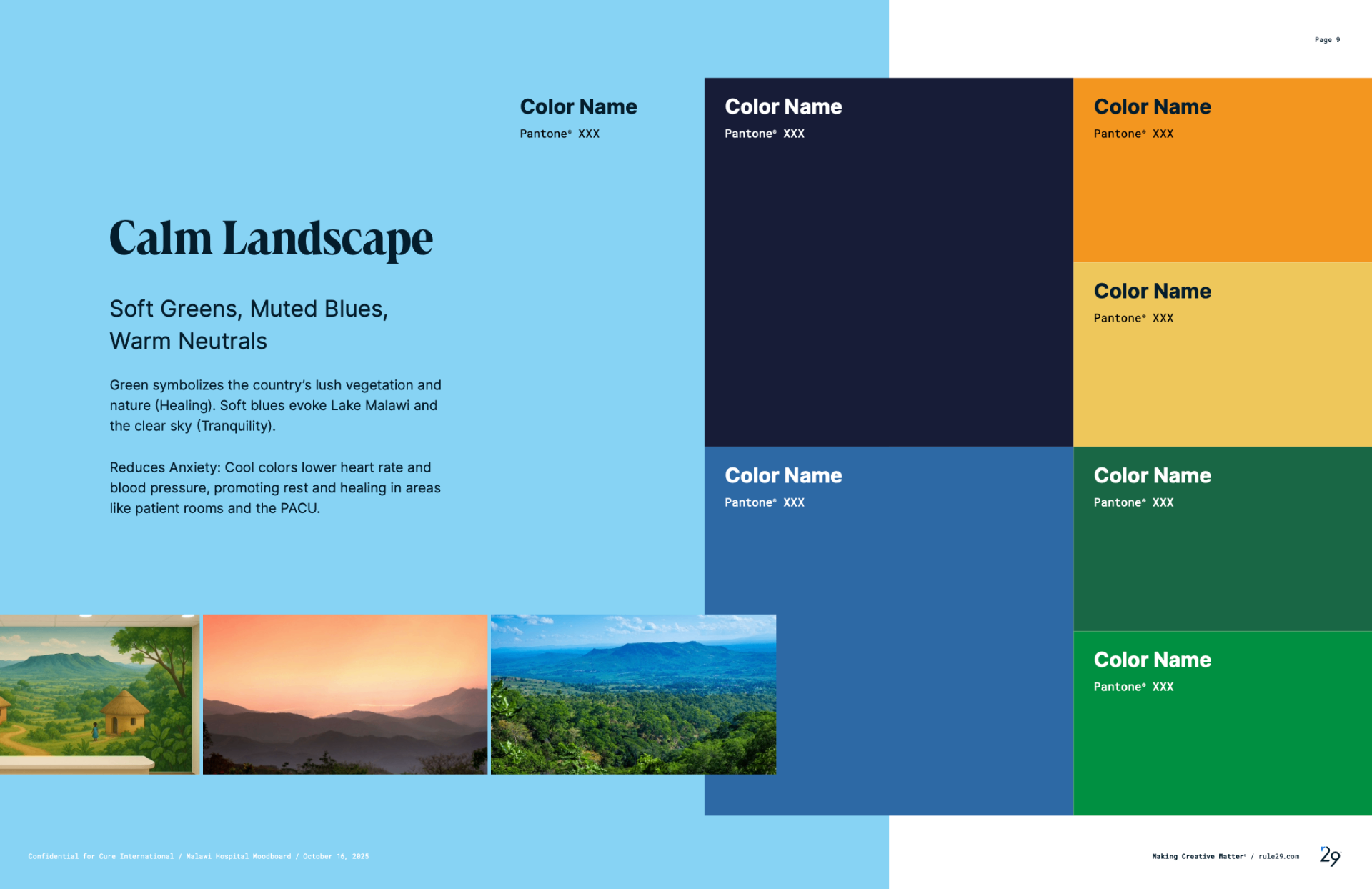
Calm Landscape color study with soft greens, muted blues and warm neutrals
Calm landscape palette
Wayfinding system based on adapted Malawian flag colors with zone meanings
Color-coded zones
Local artists feature: kalisoartgallery, leratohh and jethrolongwe
Local artist directions
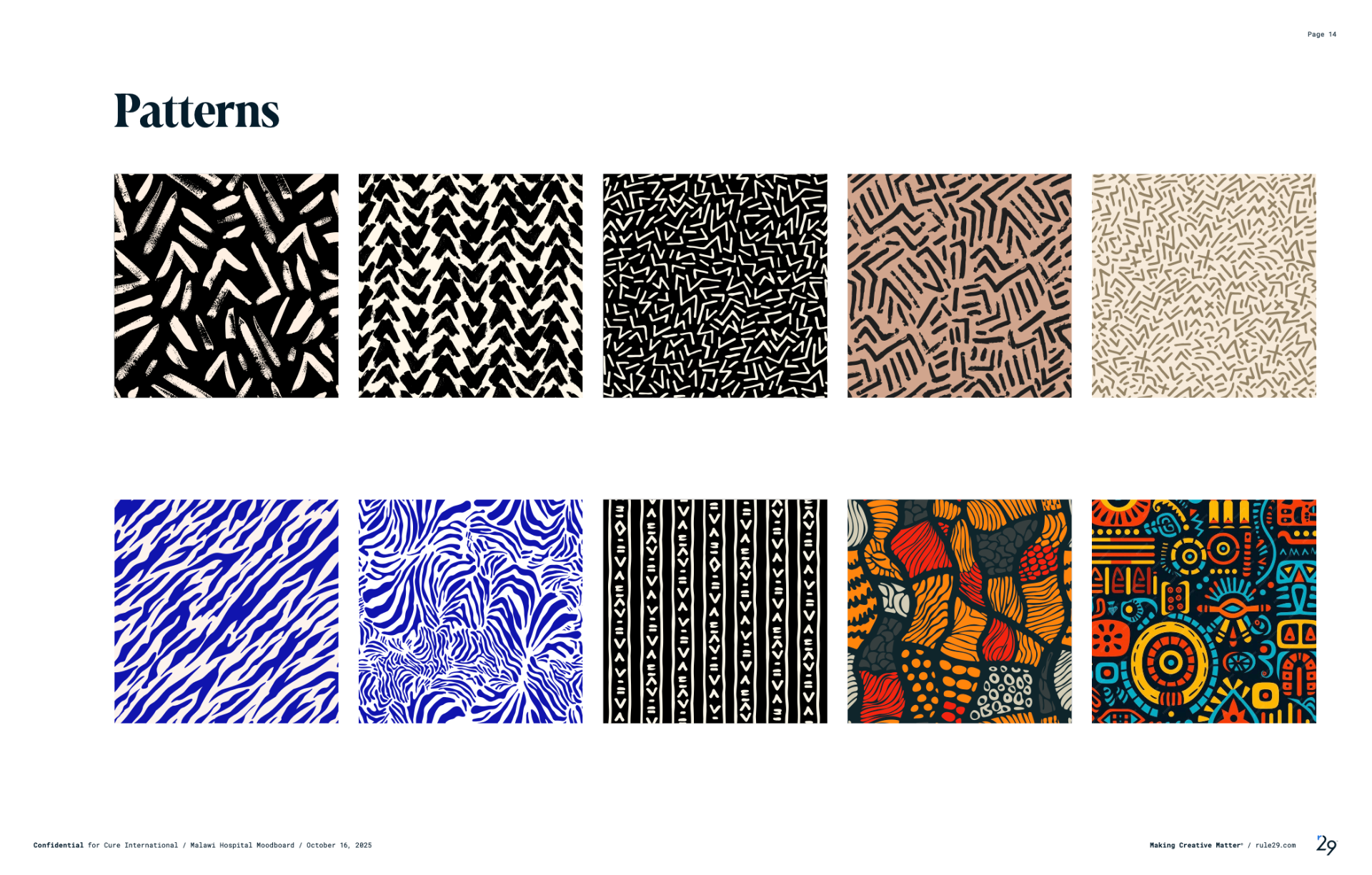
Pattern library of African-inspired textile and print motifs
Pattern library
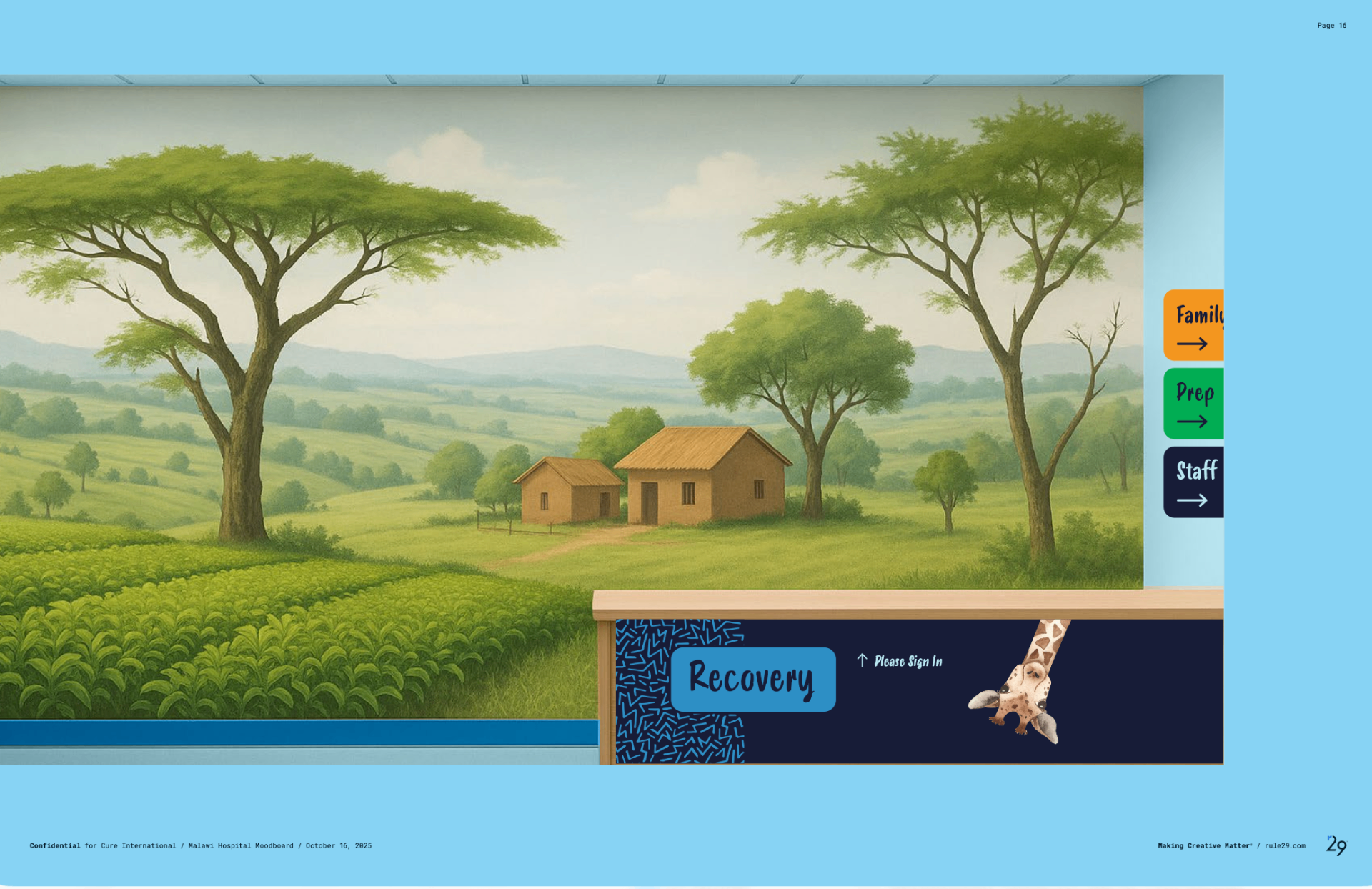
Reception render with savanna mural, wayfinding tags and patterned counter
Reception render concept
III
Complete
Fall 2025
Bradley University, Discovery & Ideation

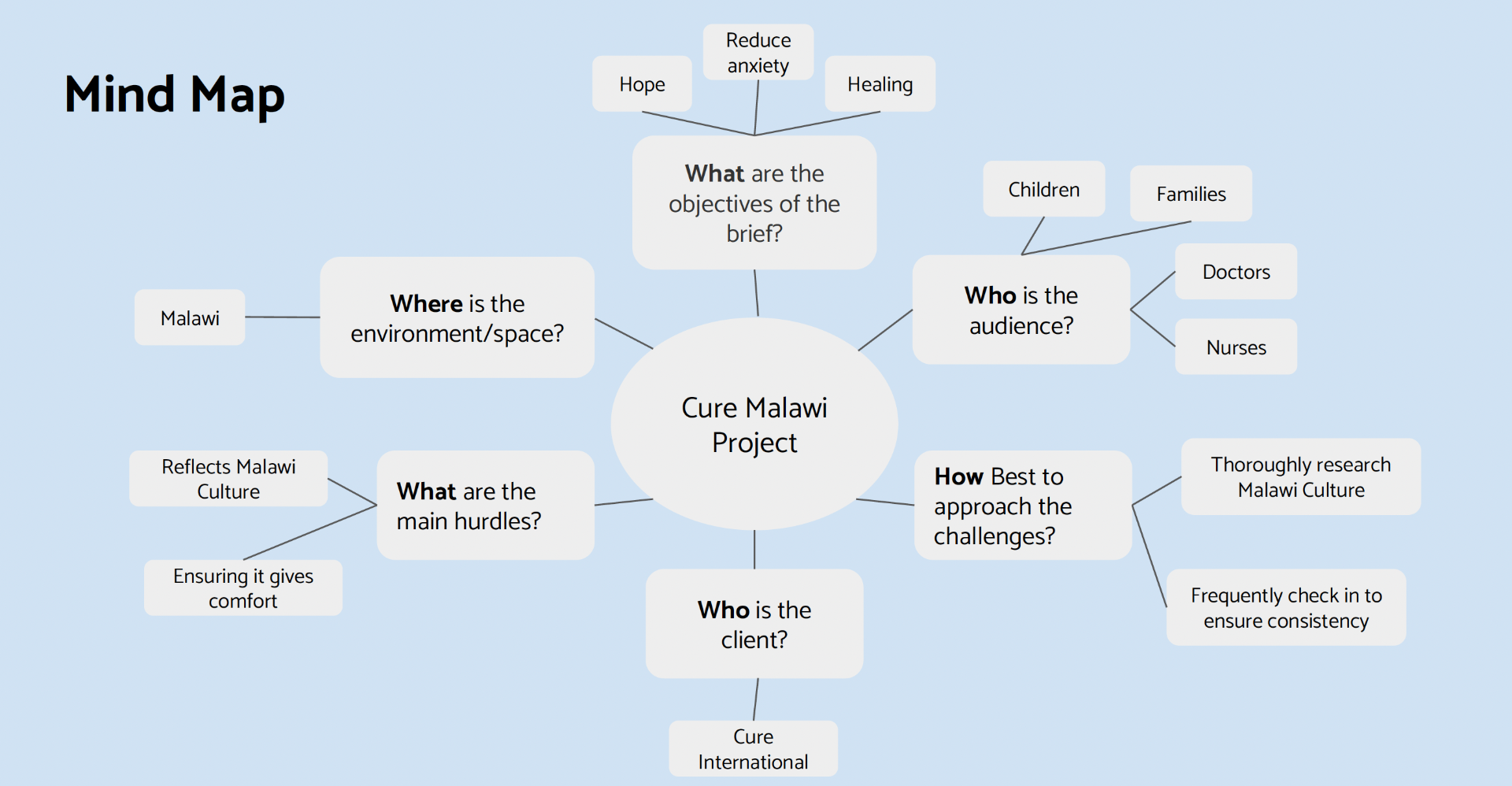
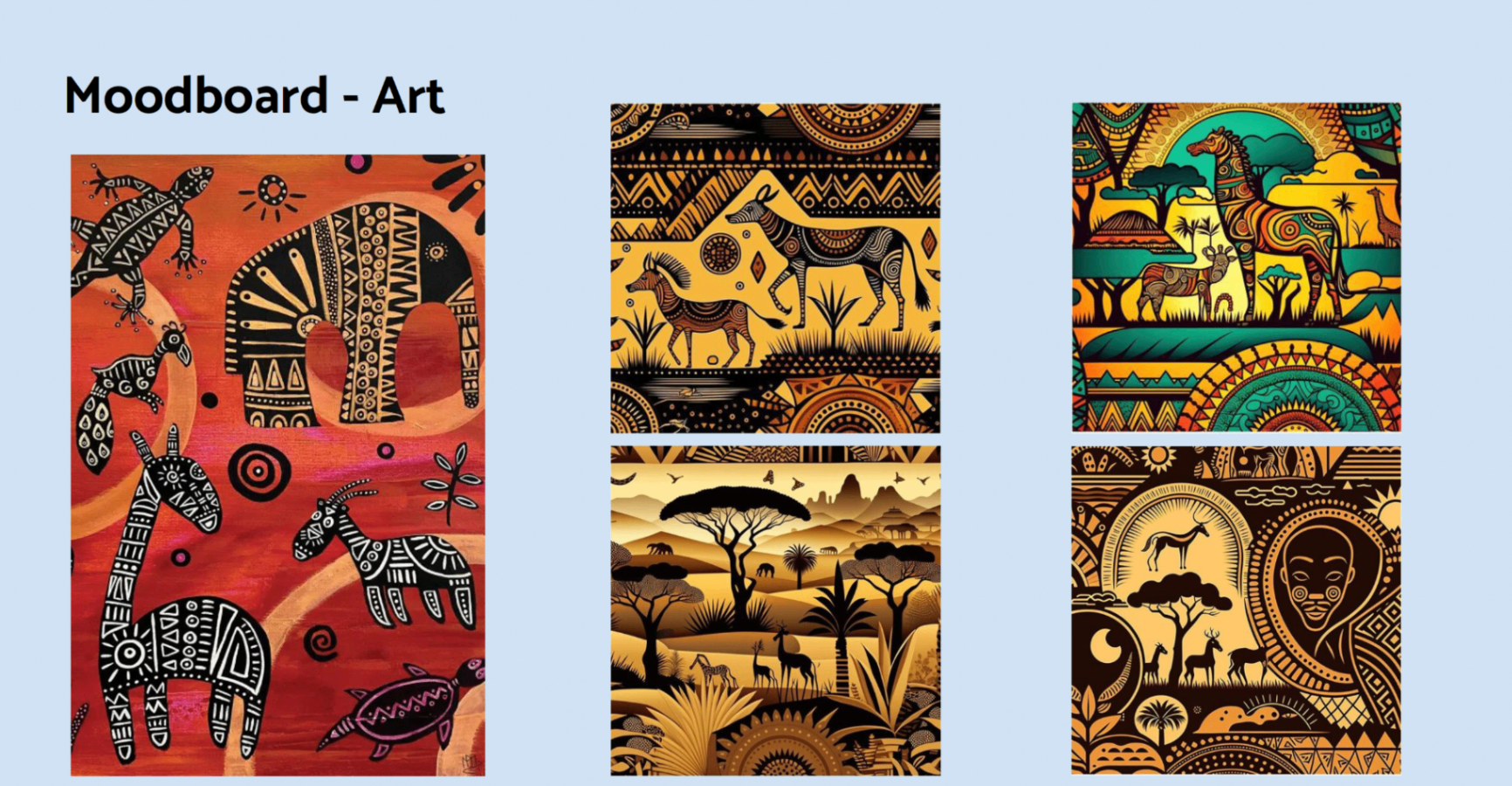
A Bradley design class took the research Kent State had completed, the moodboard work Rule29 had done, and information provided by CURE, and started visualizing what some of those possibilities could look like, mood boards, wayfinding studies, room renders, and illustration directions you can see below. This was another step that helped the team explore options for what healing-centered design inside a CURE hospital could become.

One of the takeaways from Bradley's work was the inspiration to explore the animals more as wood carvings, an idea that later grew into the hand-carved animal system Rule29 locked in during Phase IV.

Bradley University
Bradley mind map
Mind map
Bradley art moodboard
Art moodboard
Bradley color & type mood board
Color & type mood board
Bradley CURE Malawi moodboard
CURE Malawi moodboard
Bradley animal illustration designs
Animal illustration designs
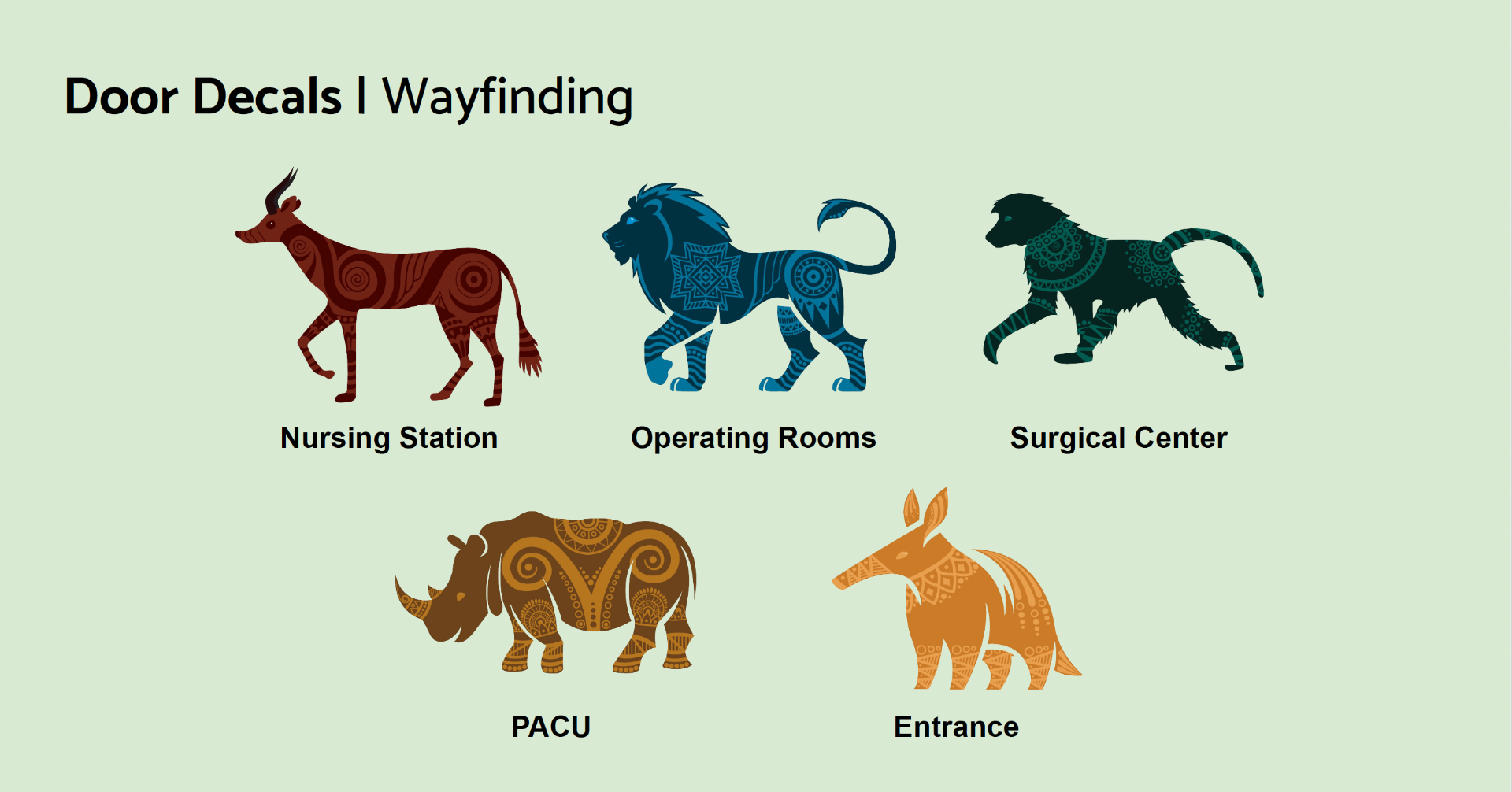
Bradley door decals & wayfinding
Door decals & wayfinding
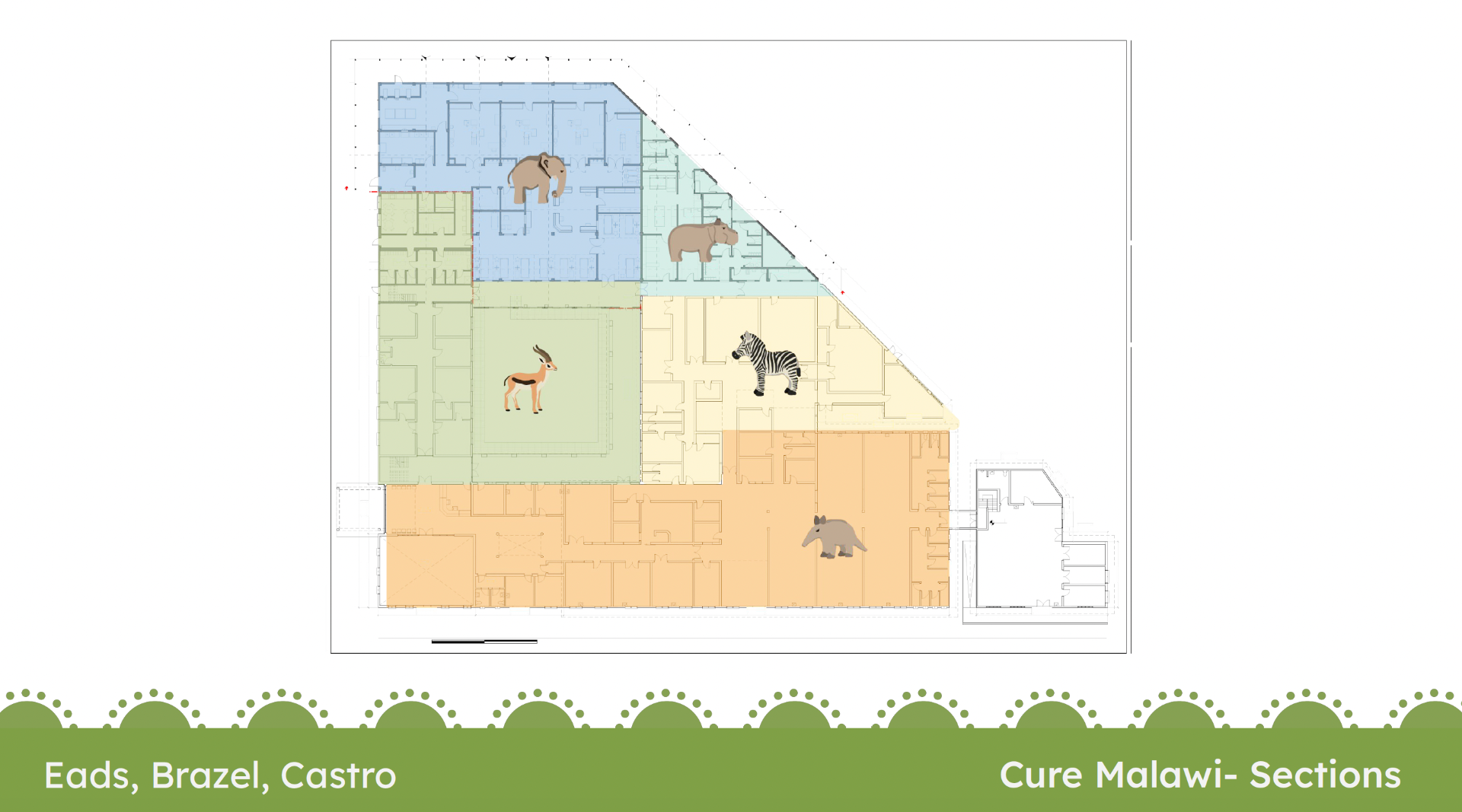
Bradley hospital sections plan
Hospital sections plan
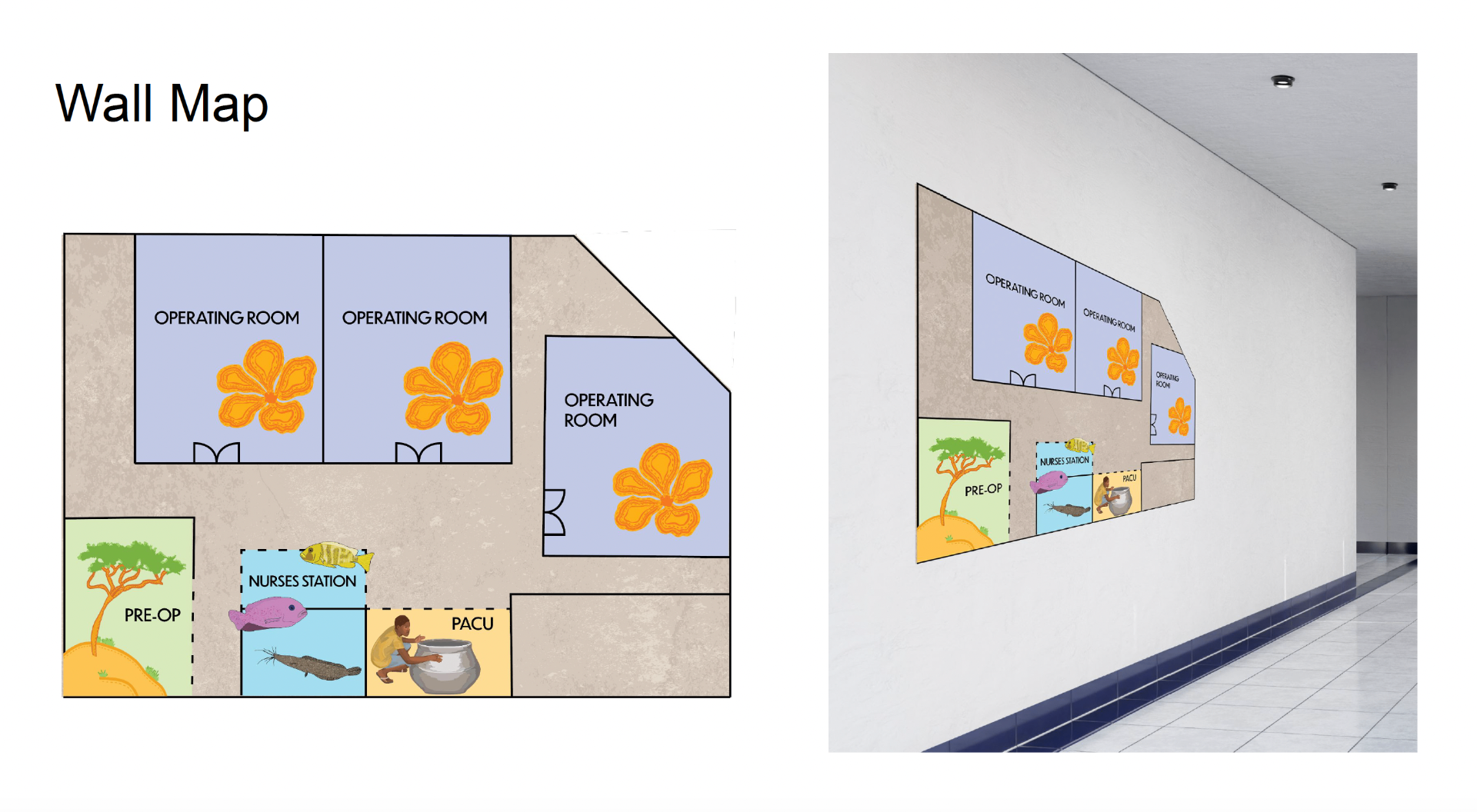
Bradley wall map concept
Wall map concept
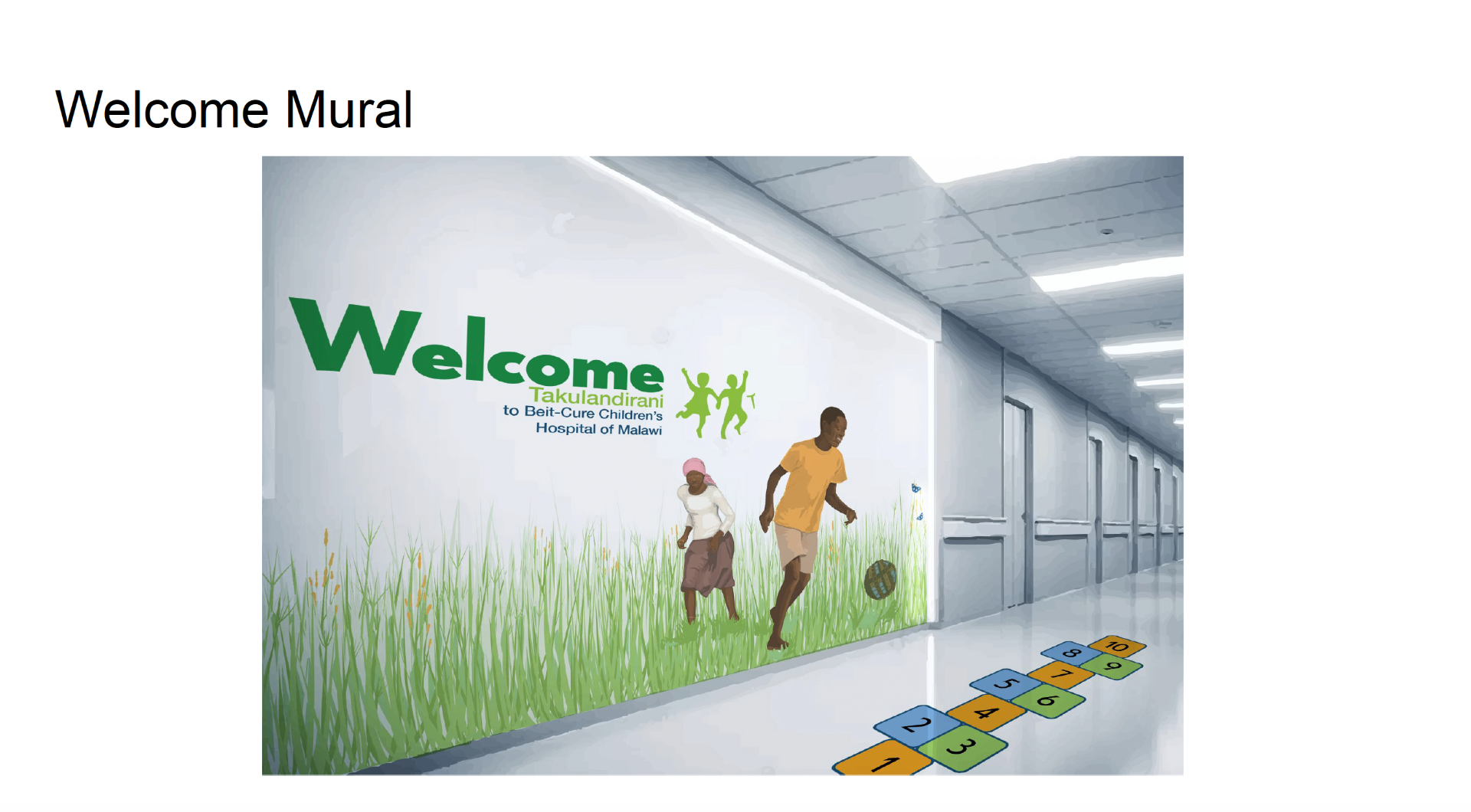
Bradley welcome mural concept
Welcome mural concept
Bradley nurses station render
Nurses station render
IV
Complete
Late 2025
Kent State, Initial Design Recommendations

From the research, Kent State delivered a first set of visual directions, an animal icon system rooted in CURE branding, mural studies exploring background/midground/foreground depth with woodblock-styled animals, and three wall pattern concepts drawn from Malawian textiles and native flora. These early recommendations set the visual vocabulary the project would later refine.

Kent State University
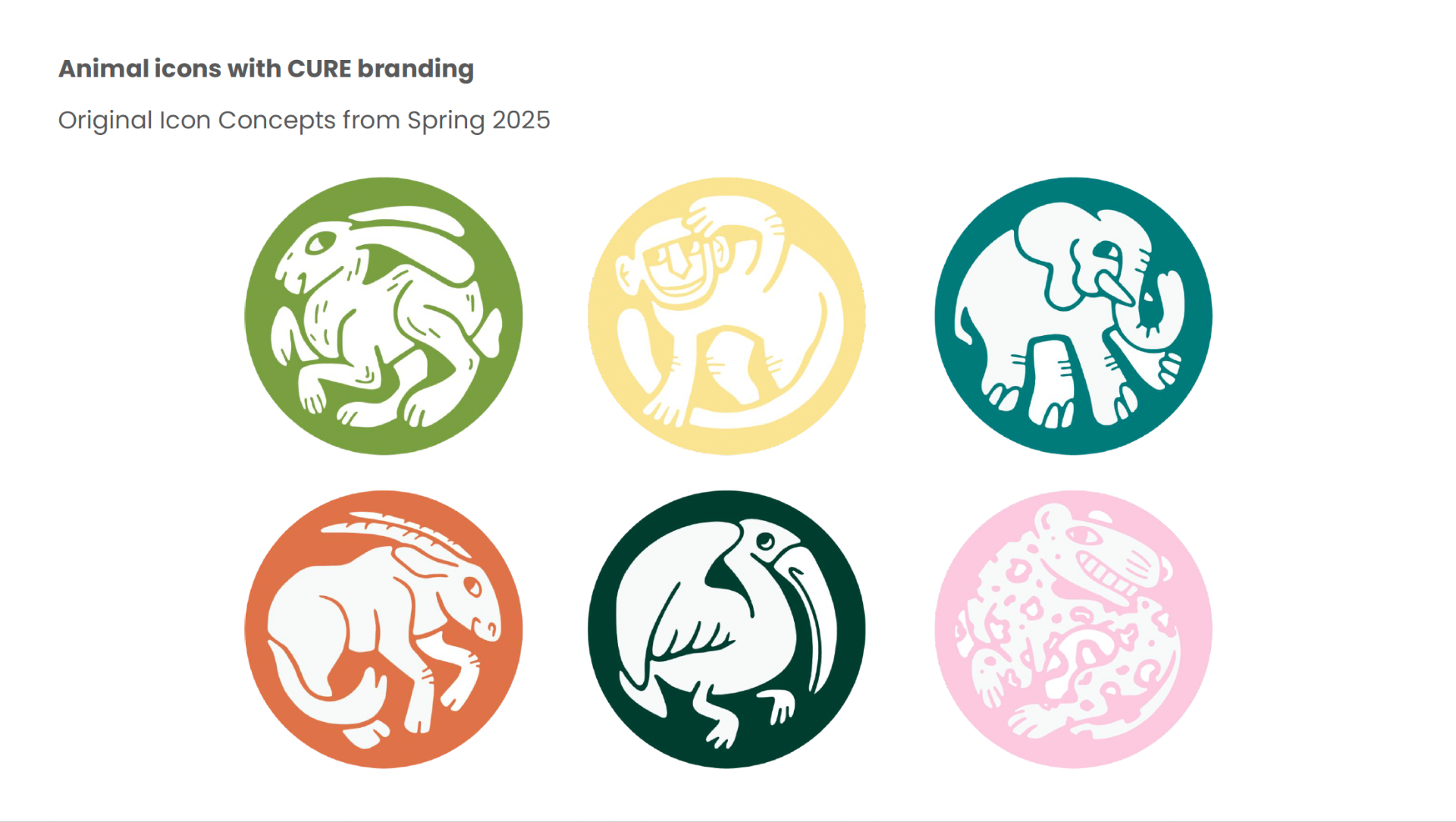
Six animal icons in colored circles with CURE branding
Animal icons with CURE branding
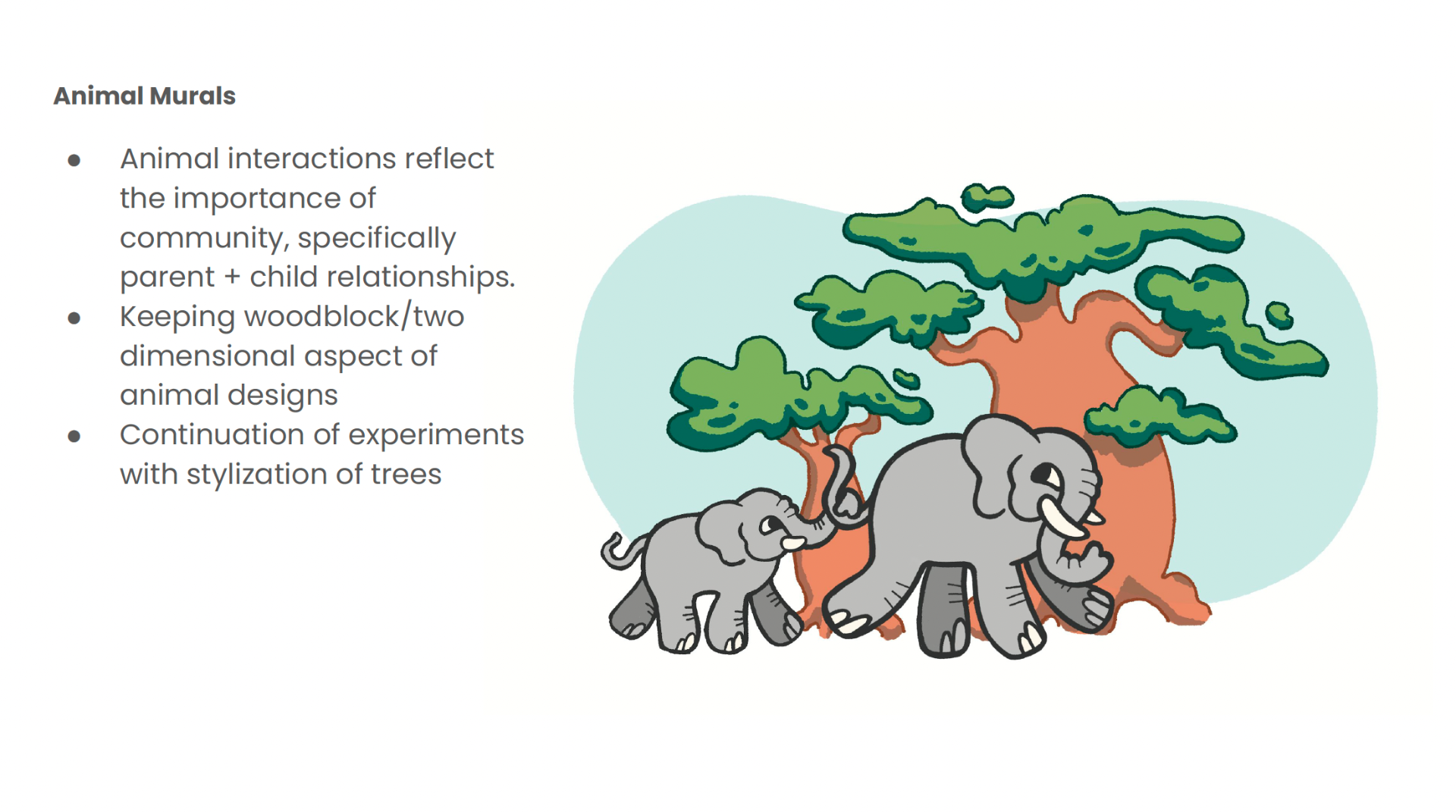
Animal mural concept with elephants and stylized baobab tree
Animal murals, community
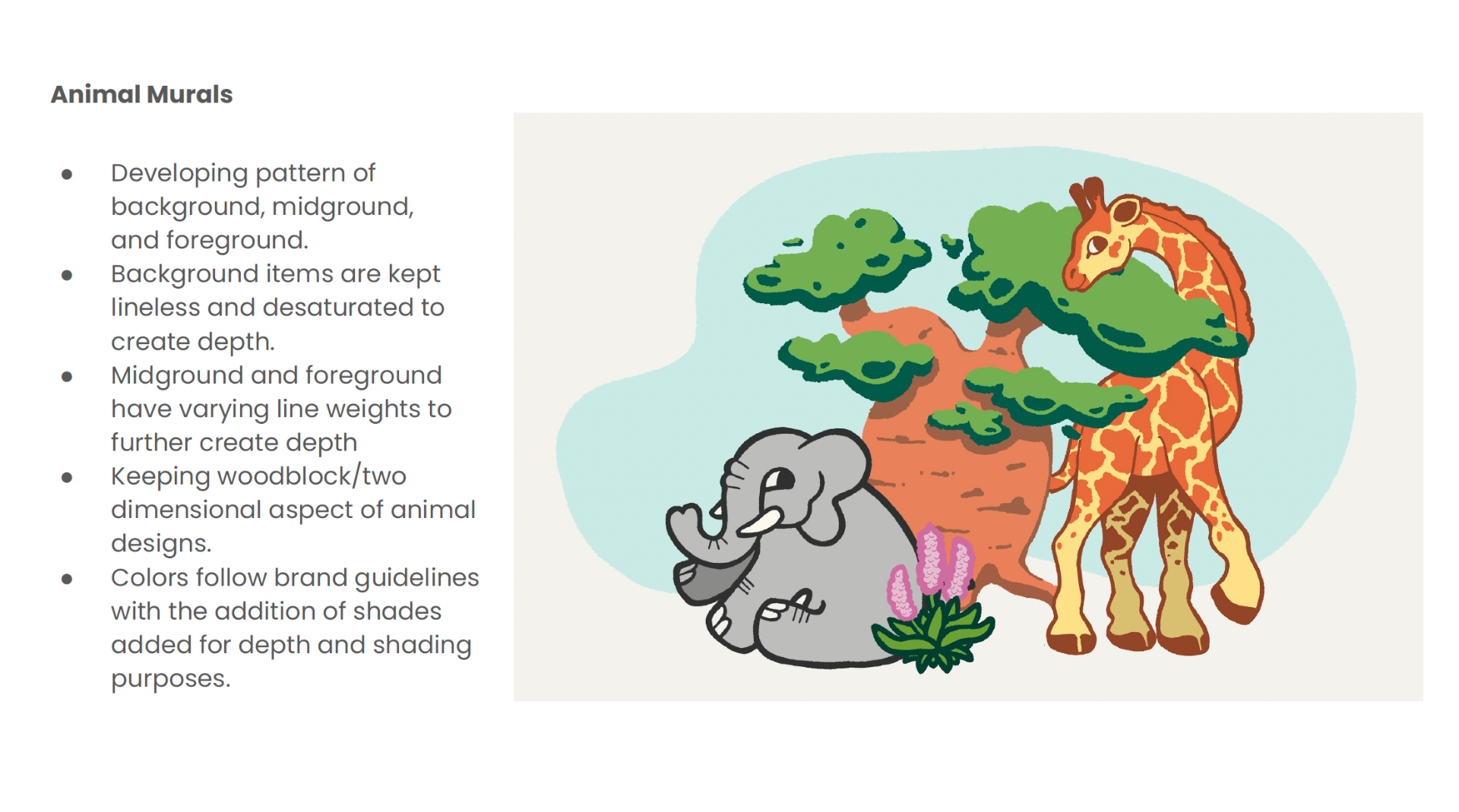
Animal mural with giraffe, elephant and baobab using layered depth
Animal murals, depth study
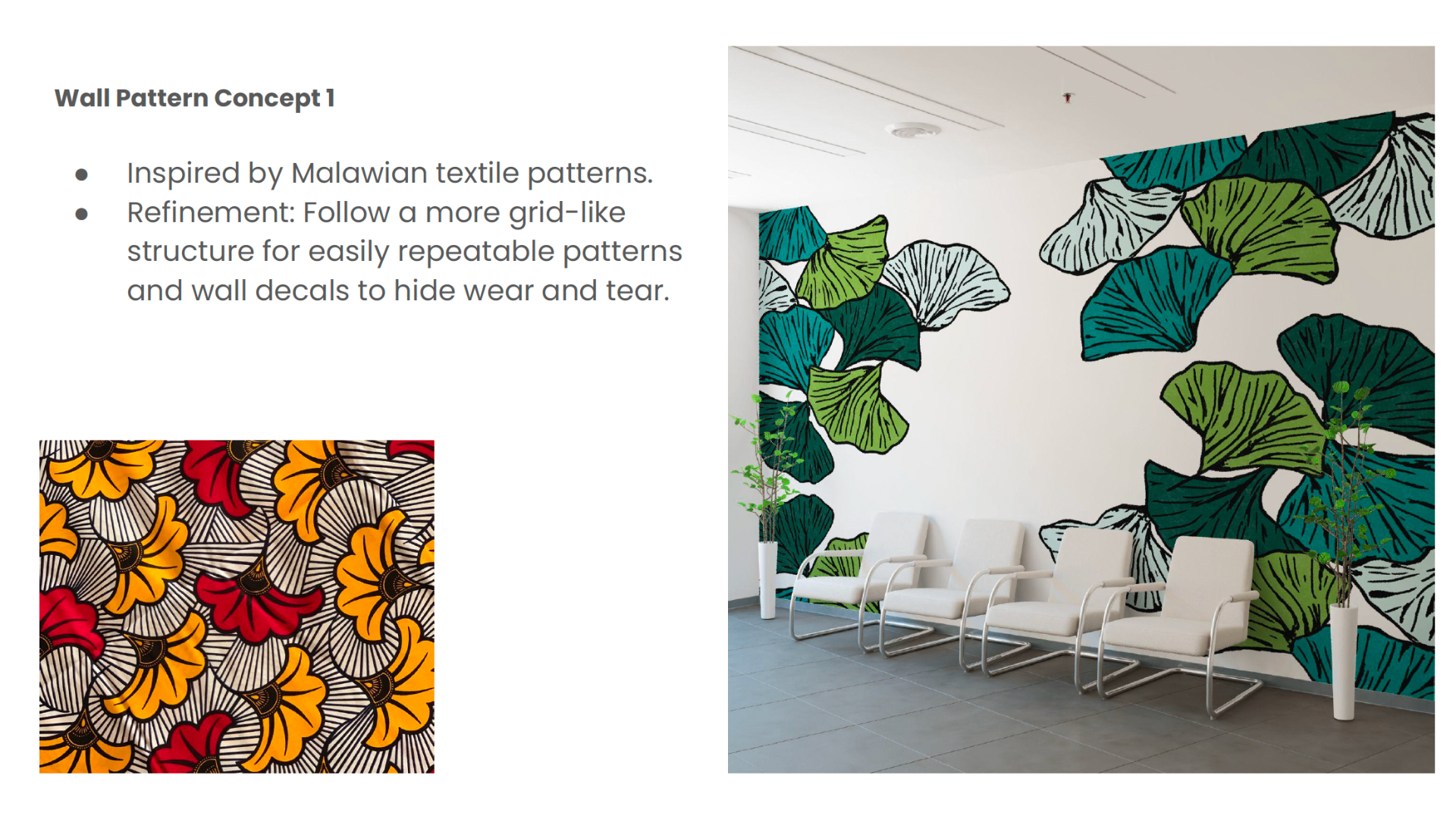
Wall pattern concept inspired by Malawian textiles, ginkgo-like leaves
Wall pattern concept 1
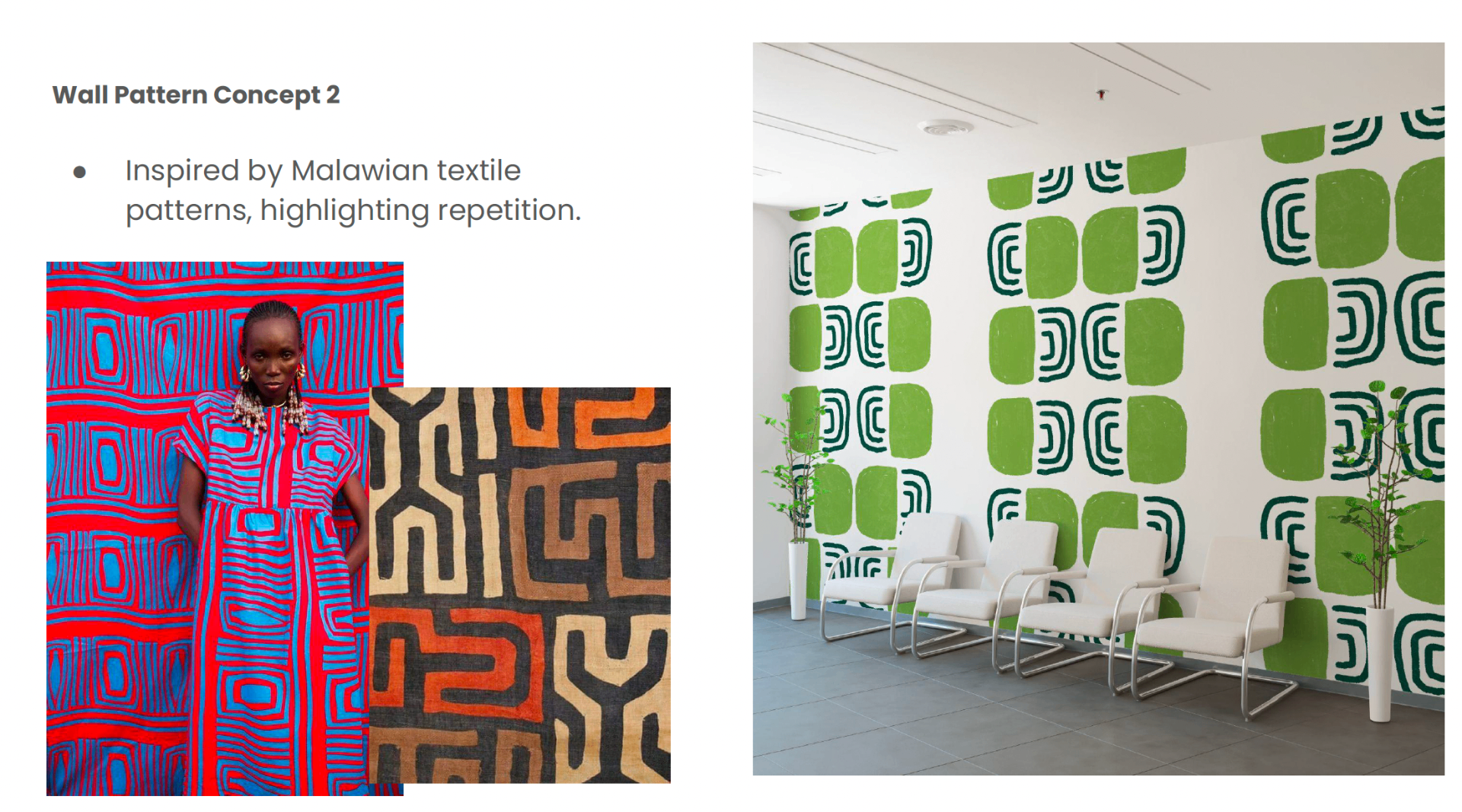
Wall pattern concept 2 with repeating green shapes inspired by Malawian textiles
Wall pattern concept 2
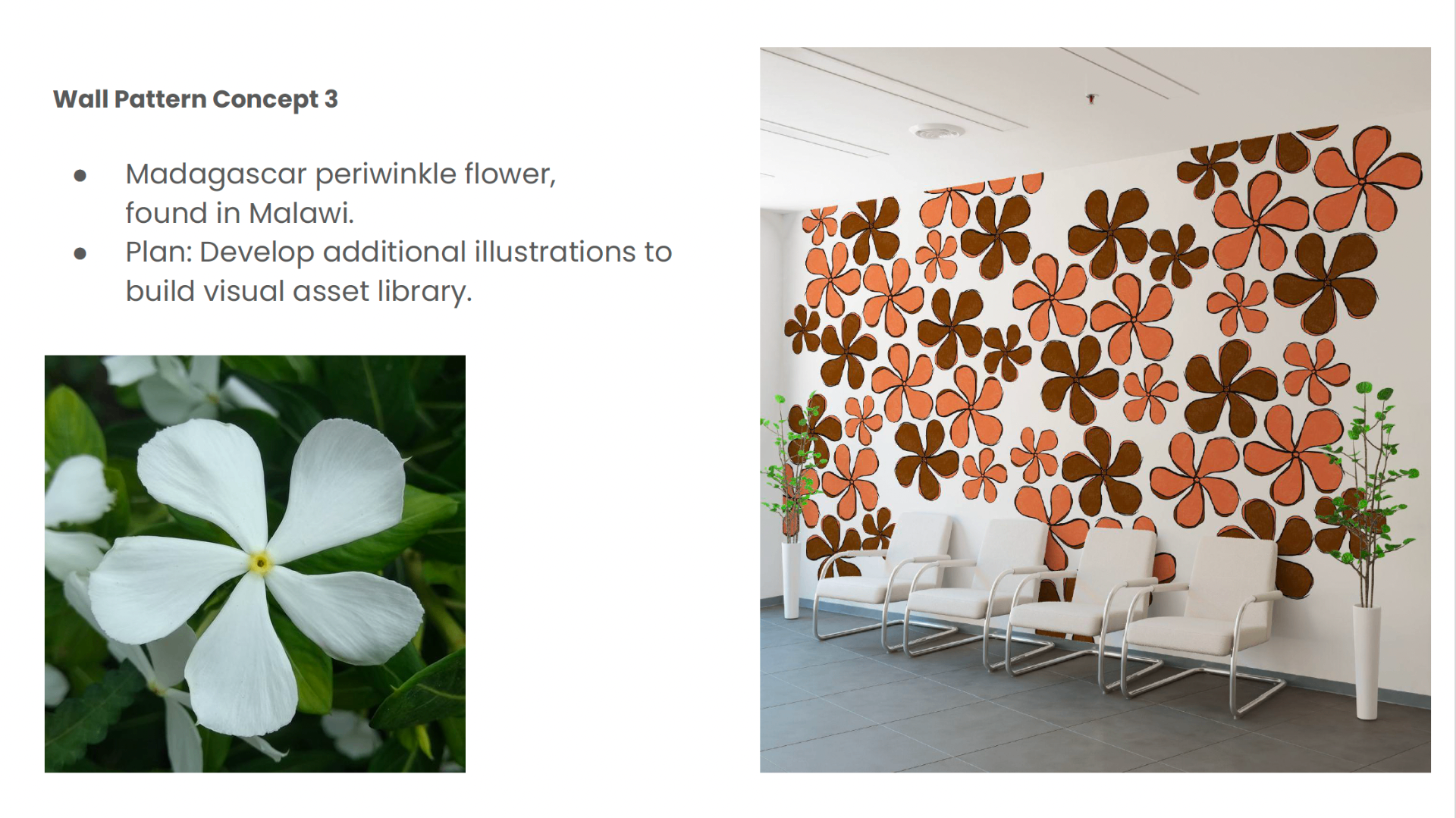
Wall pattern concept 3 with Madagascar periwinkle flowers
Wall pattern concept 3
V
Complete
January 2026
Rule29 Malawi Hospital Moodboard

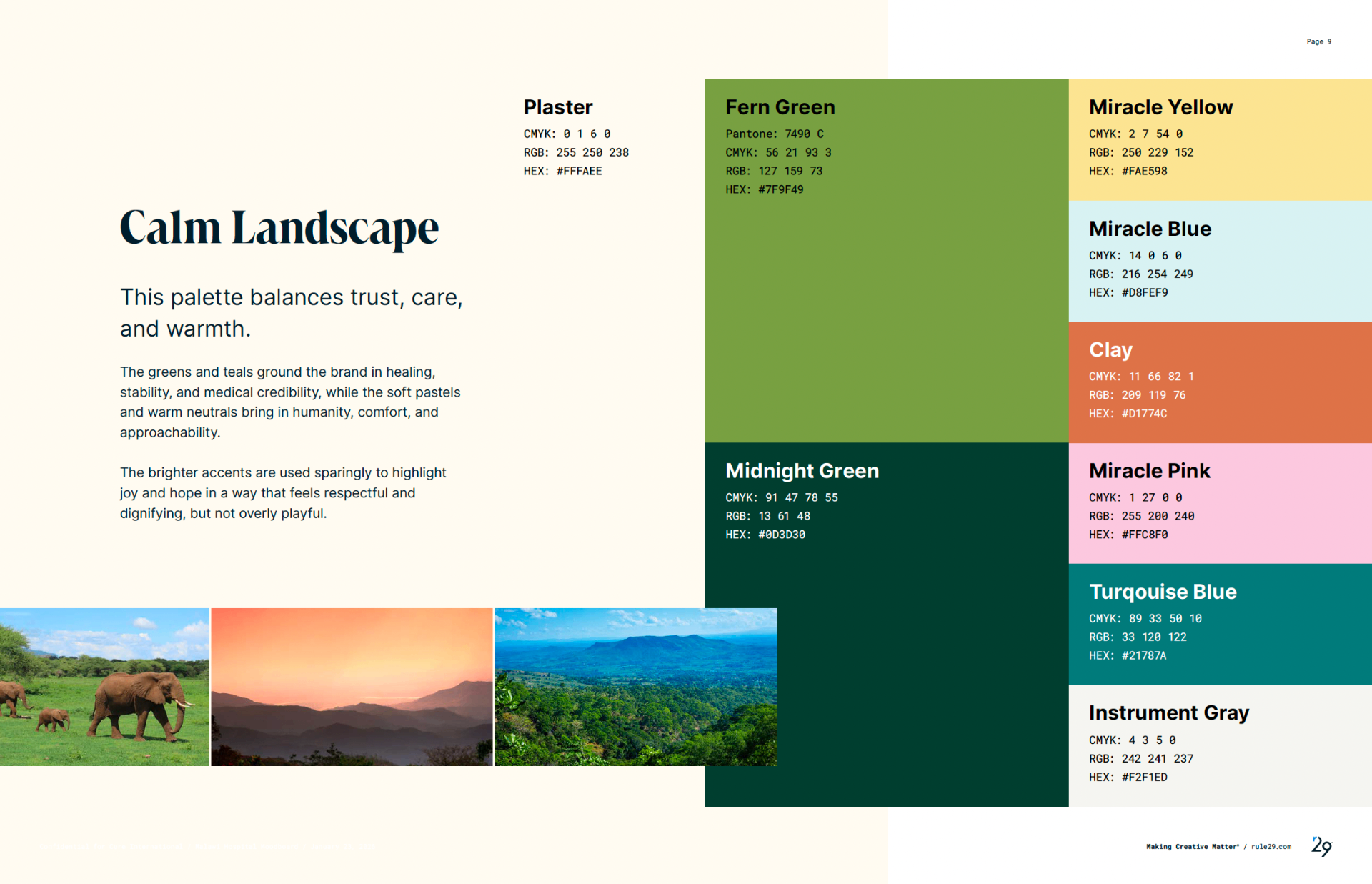
Taking the inspiration from Kent State, Rule29 started digging deeper into the wood carve idea and exploring more iconography. The result was a full Malawi Hospital Moodboard for CURE International, anchoring the calming effect of art in hand carved wooden toys derived from local animals and landscapes, locking a Calm Landscape palette, building a soft, hand-drawn icon and pattern system, and applying it room by room across the entranceway, waiting and pre-op, recovery, and wayfinding. Here's what showed up.

Rule29CURE International
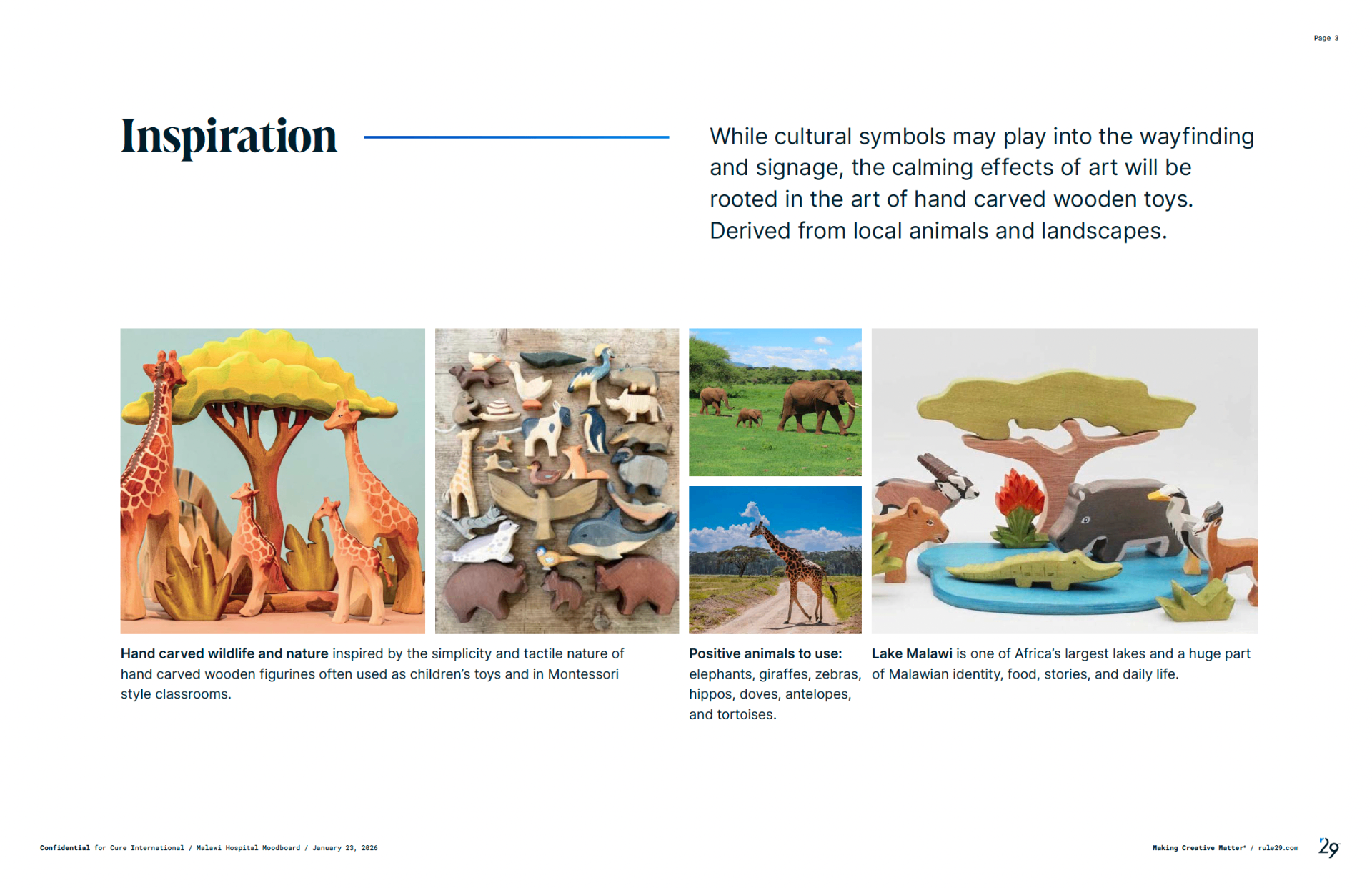
Inspiration page with hand carved wildlife, wooden figurines, elephants, giraffes, and Lake Malawi scene
Inspiration: hand carved wildlife
Calm Landscape palette with Plaster, Fern Green, Midnight Green, Miracle Yellow, Miracle Blue, Clay, Miracle Pink, Turquoise Blue, Instrument Gray
Calm Landscape palette
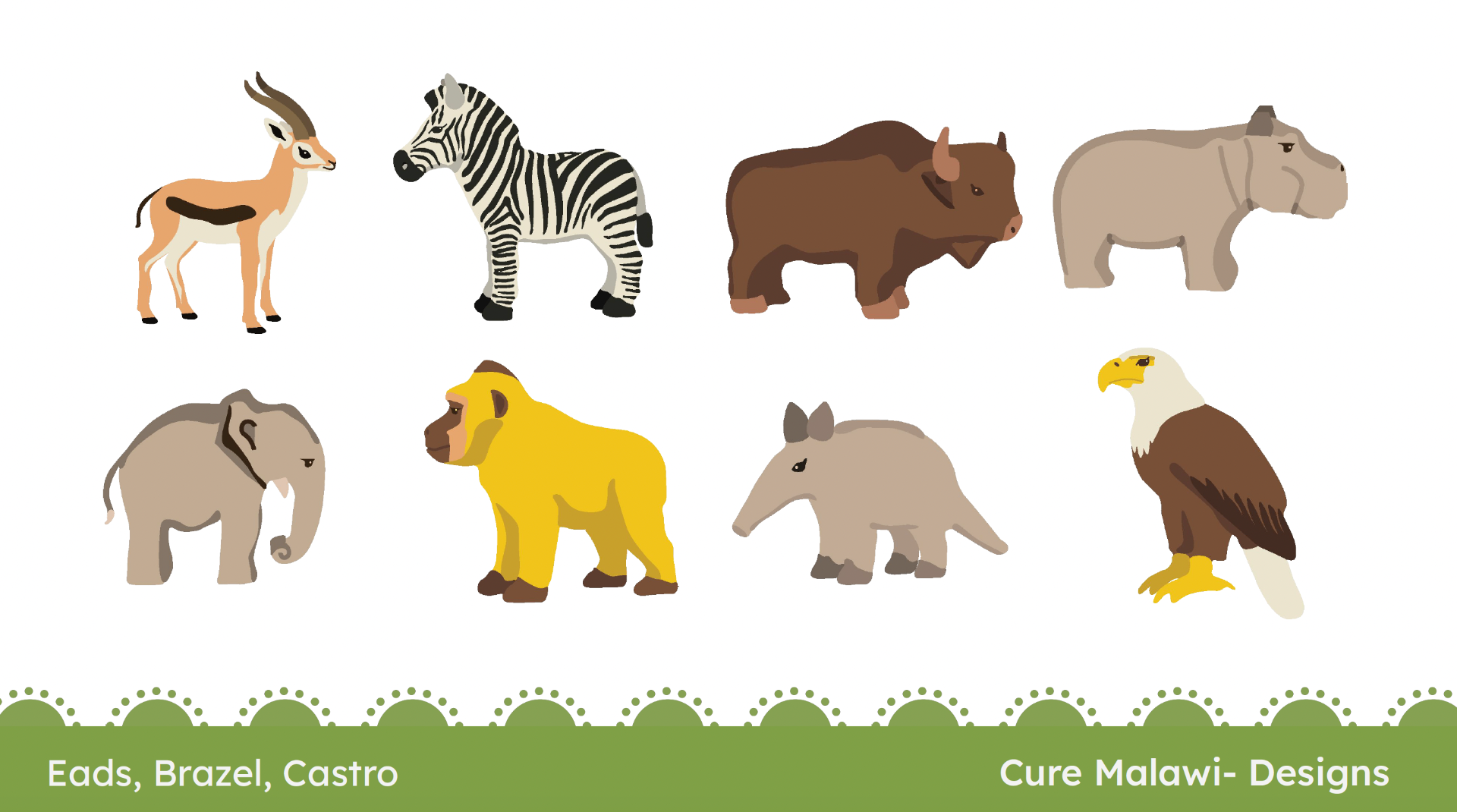
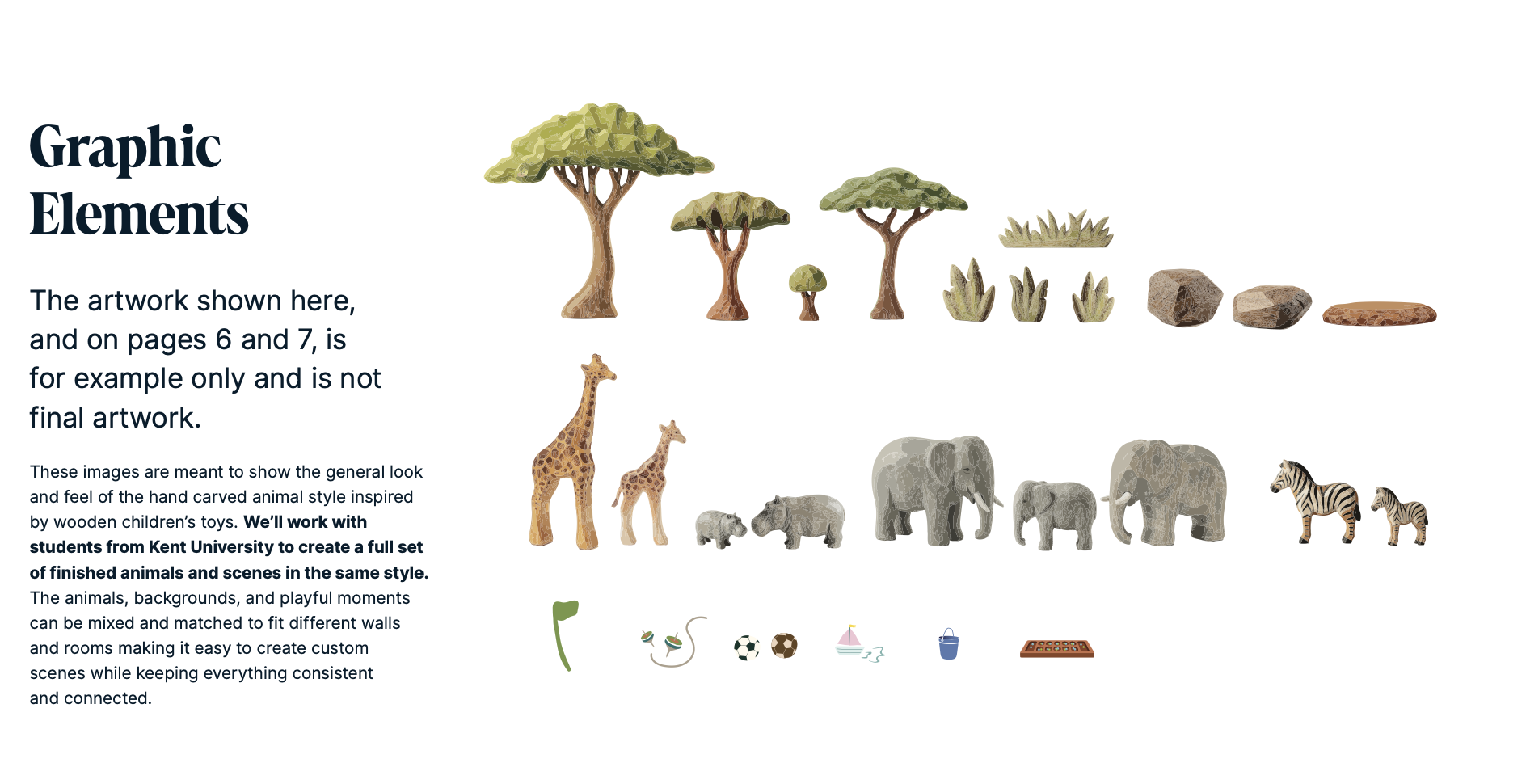
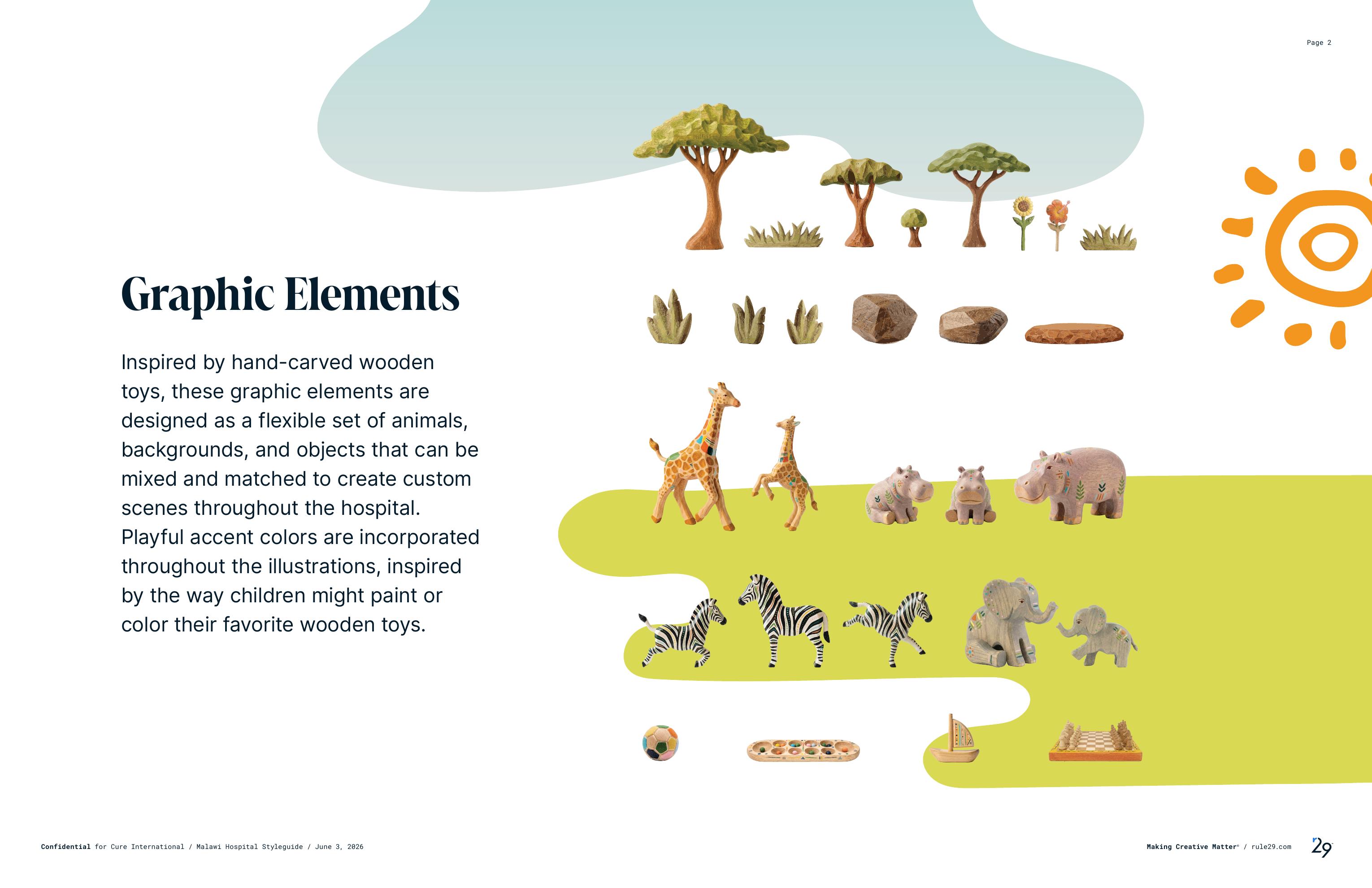
Graphic Elements page showing hand carved tree, plant, rock, giraffe, hippo, elephant and zebra figurines plus playful objects
Graphic elements library
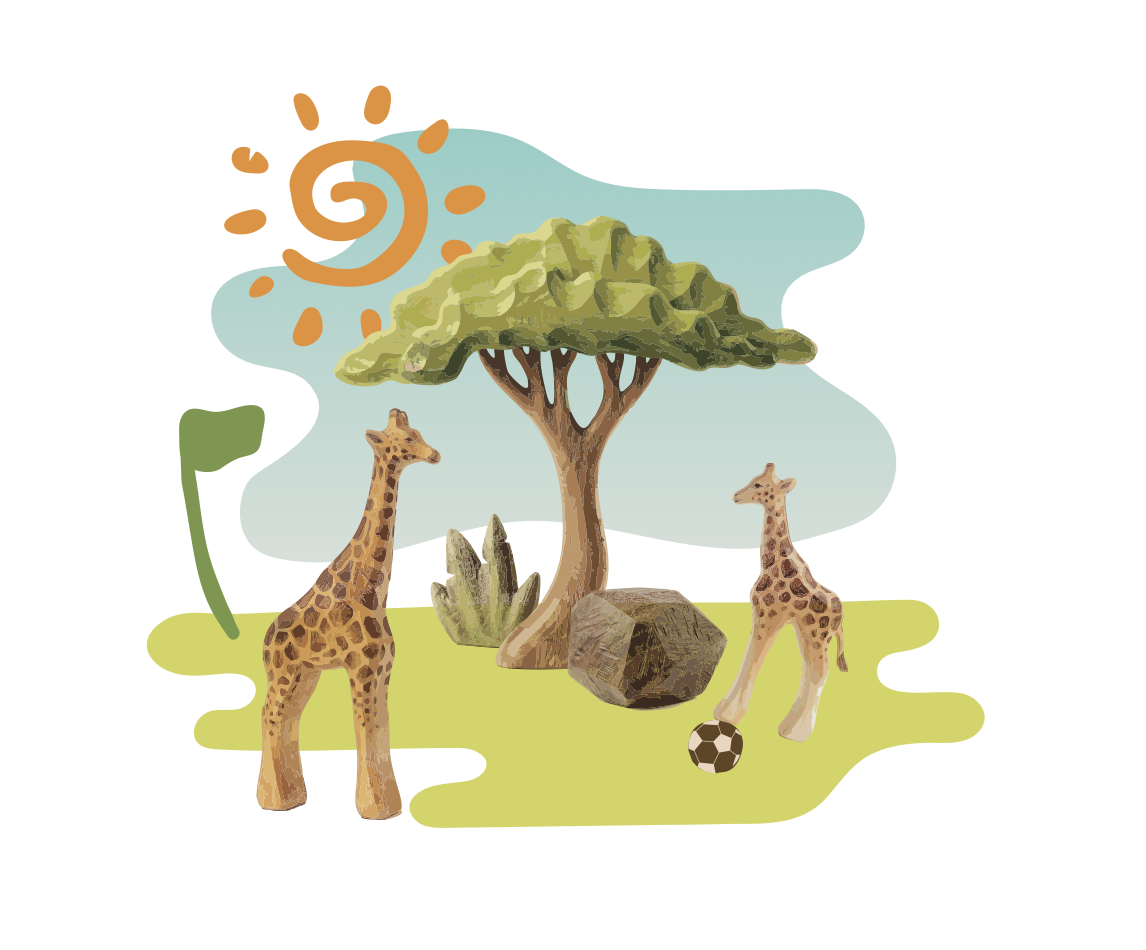
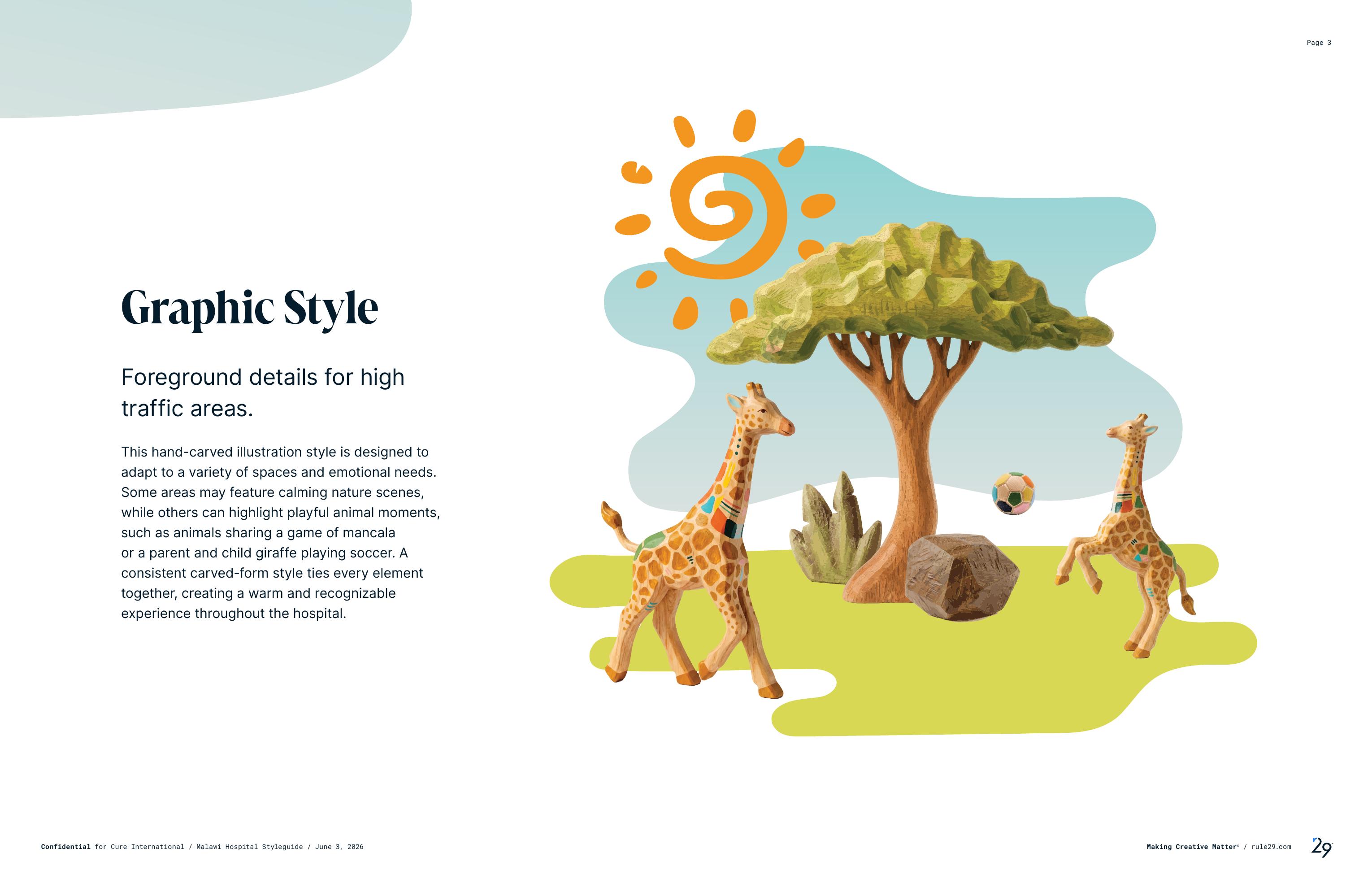
Sample scene with two carved giraffes under an acacia tree, sun, rock and soccer ball on a green plain
Sample scene composition
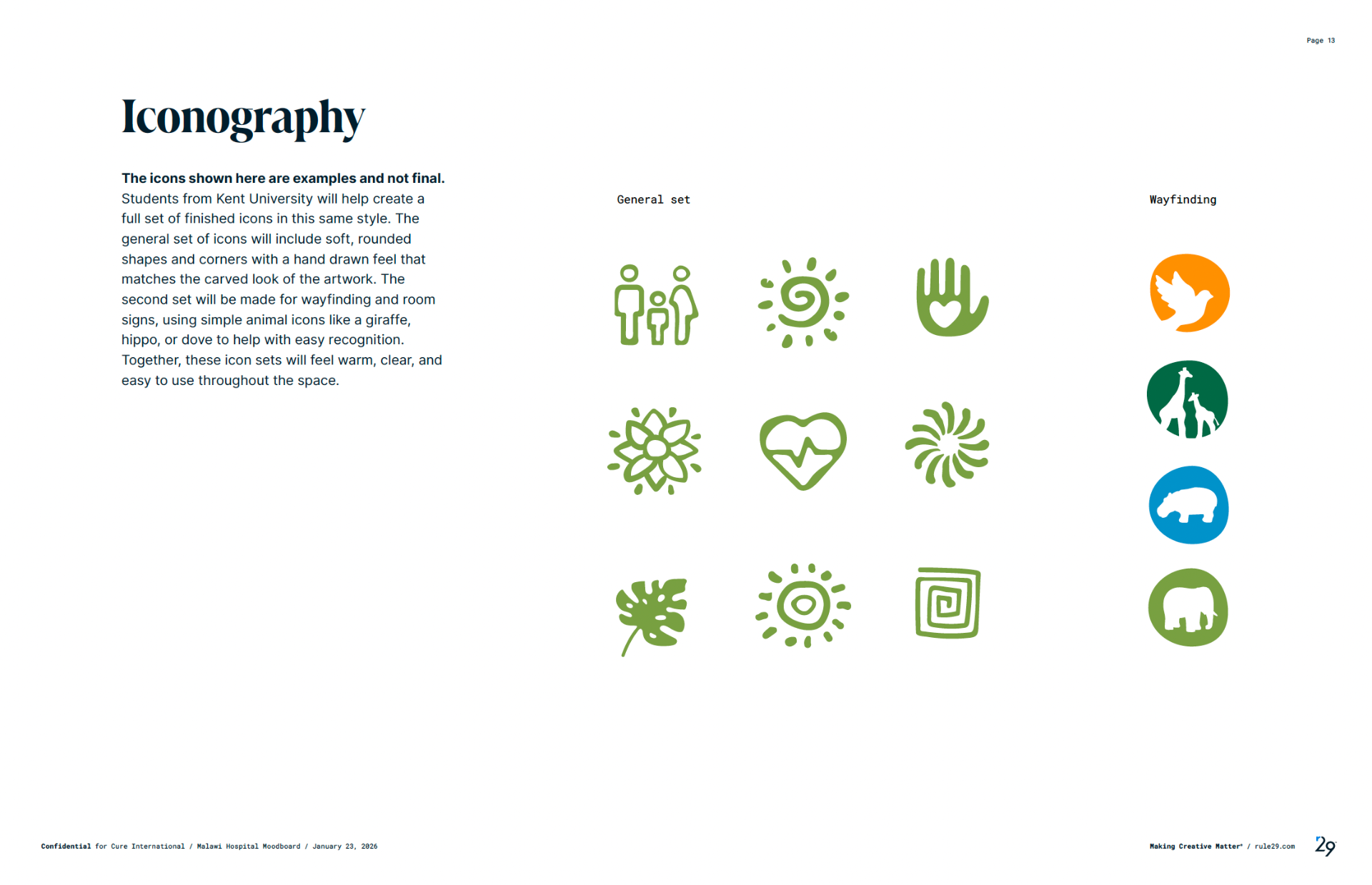
Iconography page with a general icon set in green and a wayfinding set of animal medallions
Iconography: general & wayfinding
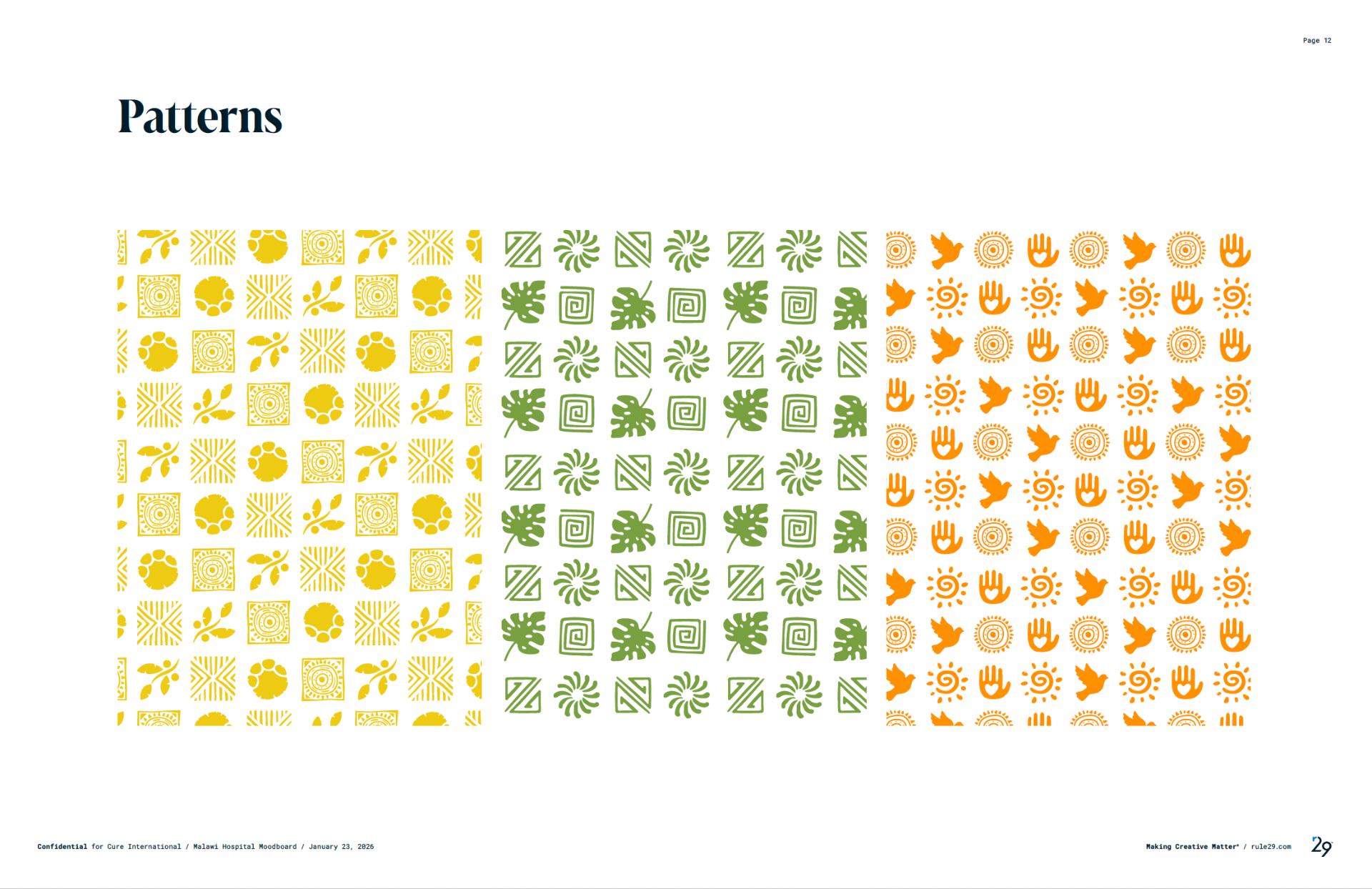
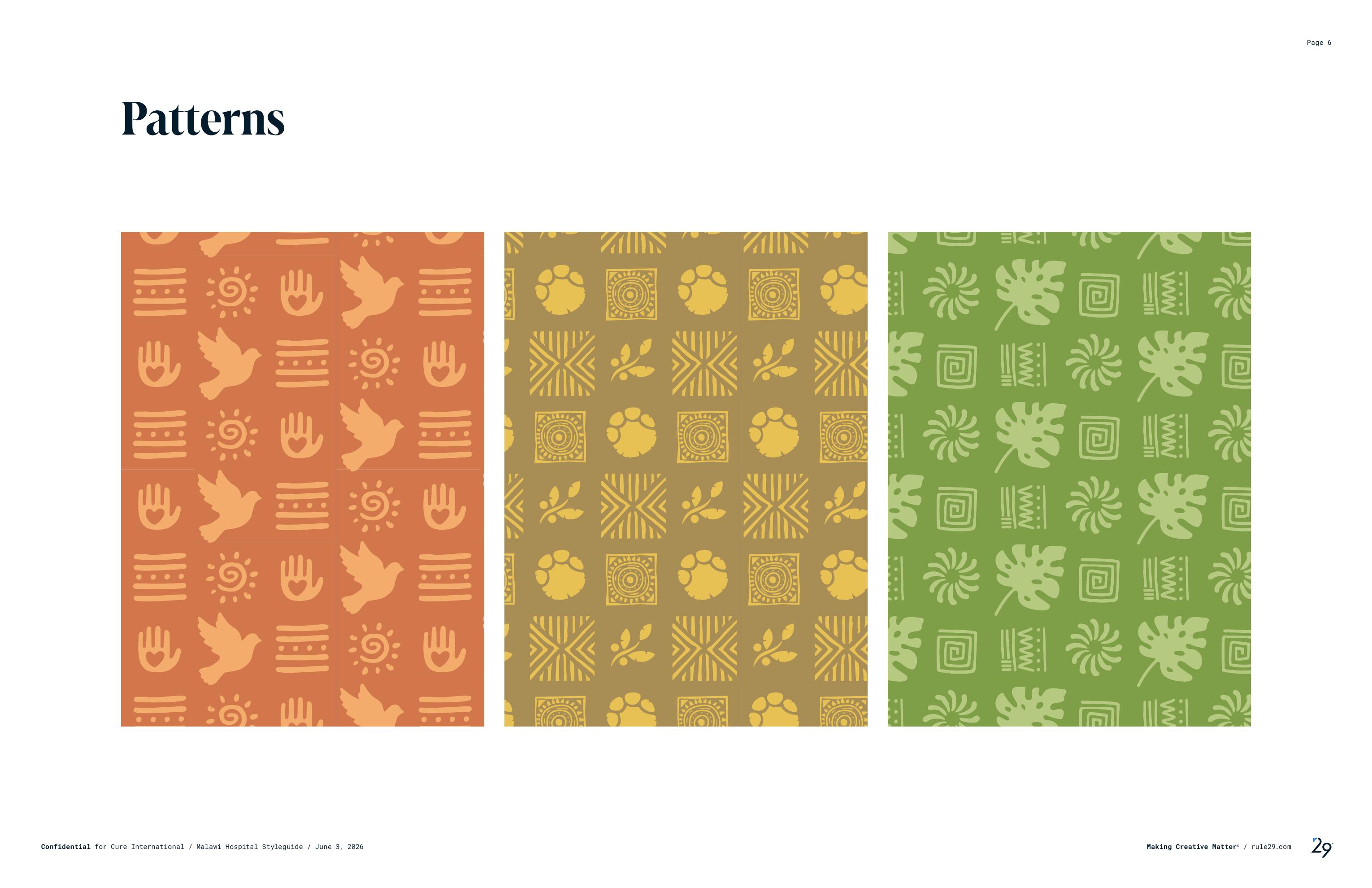
Three pattern grids: yellow textile motifs, green leaf and spiral, orange dove and sun
Pattern system
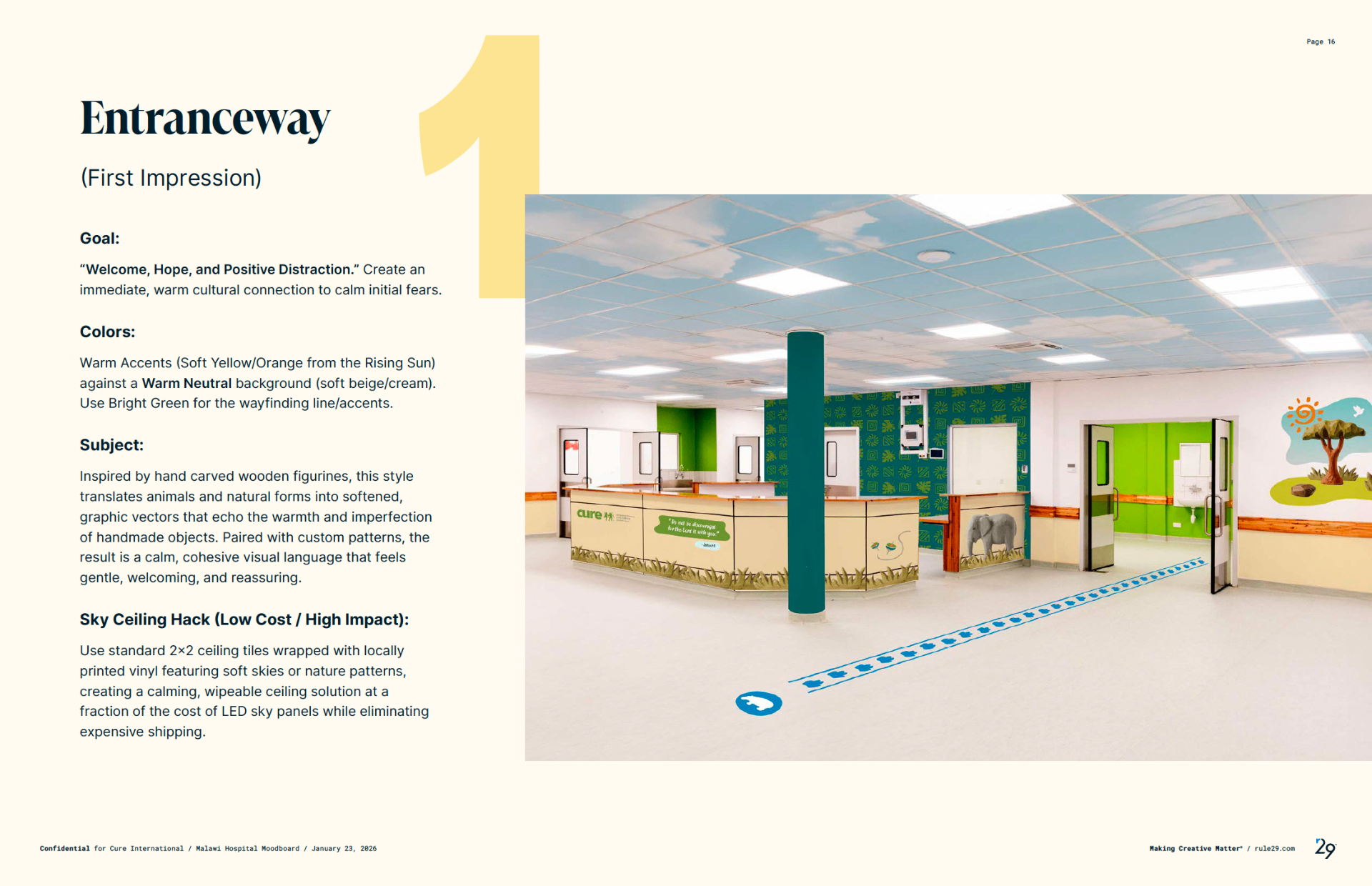
Entranceway render with sky ceiling tiles, patterned green wall, savanna mural and blue floor decals
Entranceway, first impression
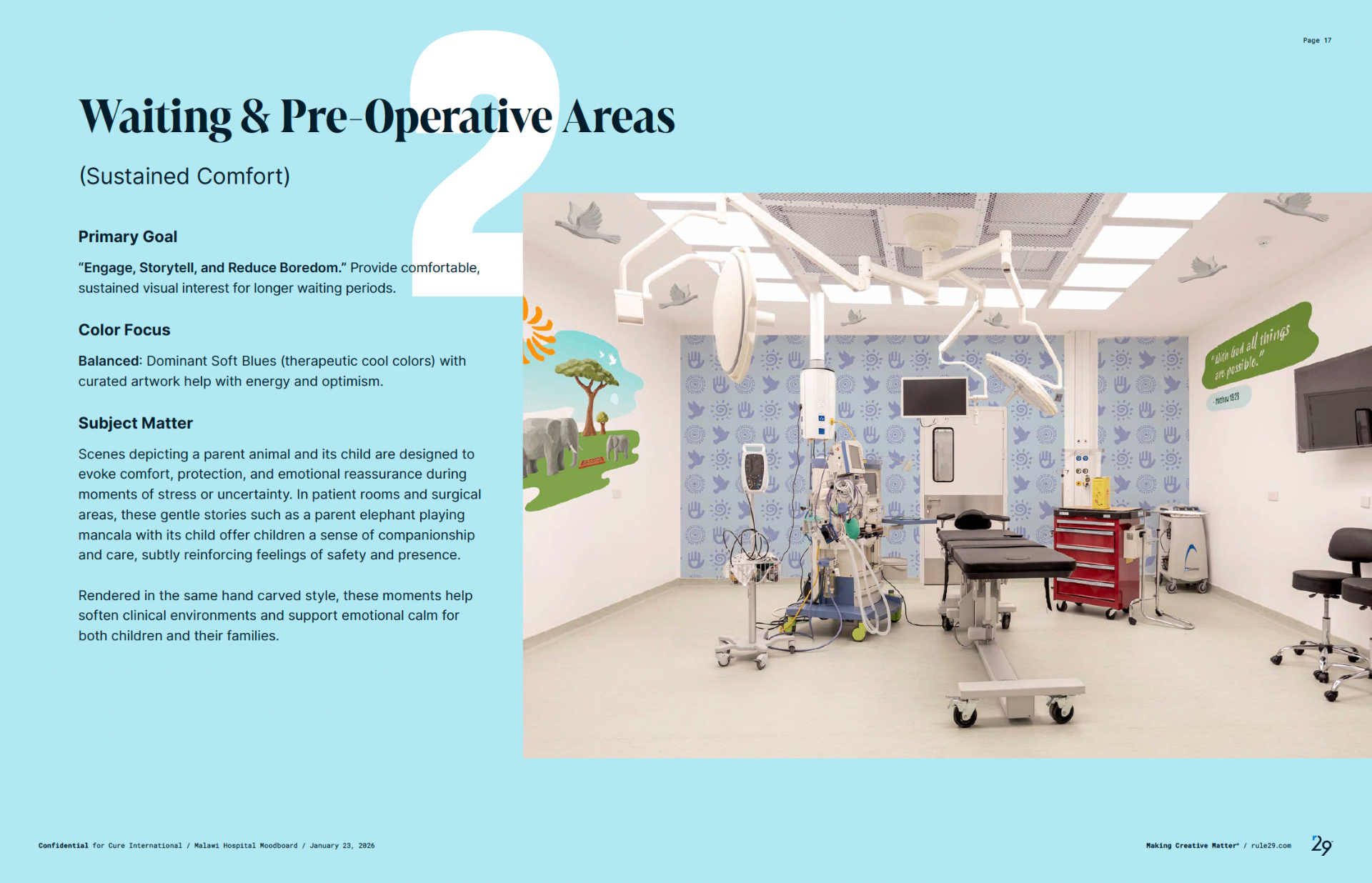
Waiting and pre-operative area with elephant family mural and dove pattern wall
Waiting & pre-operative
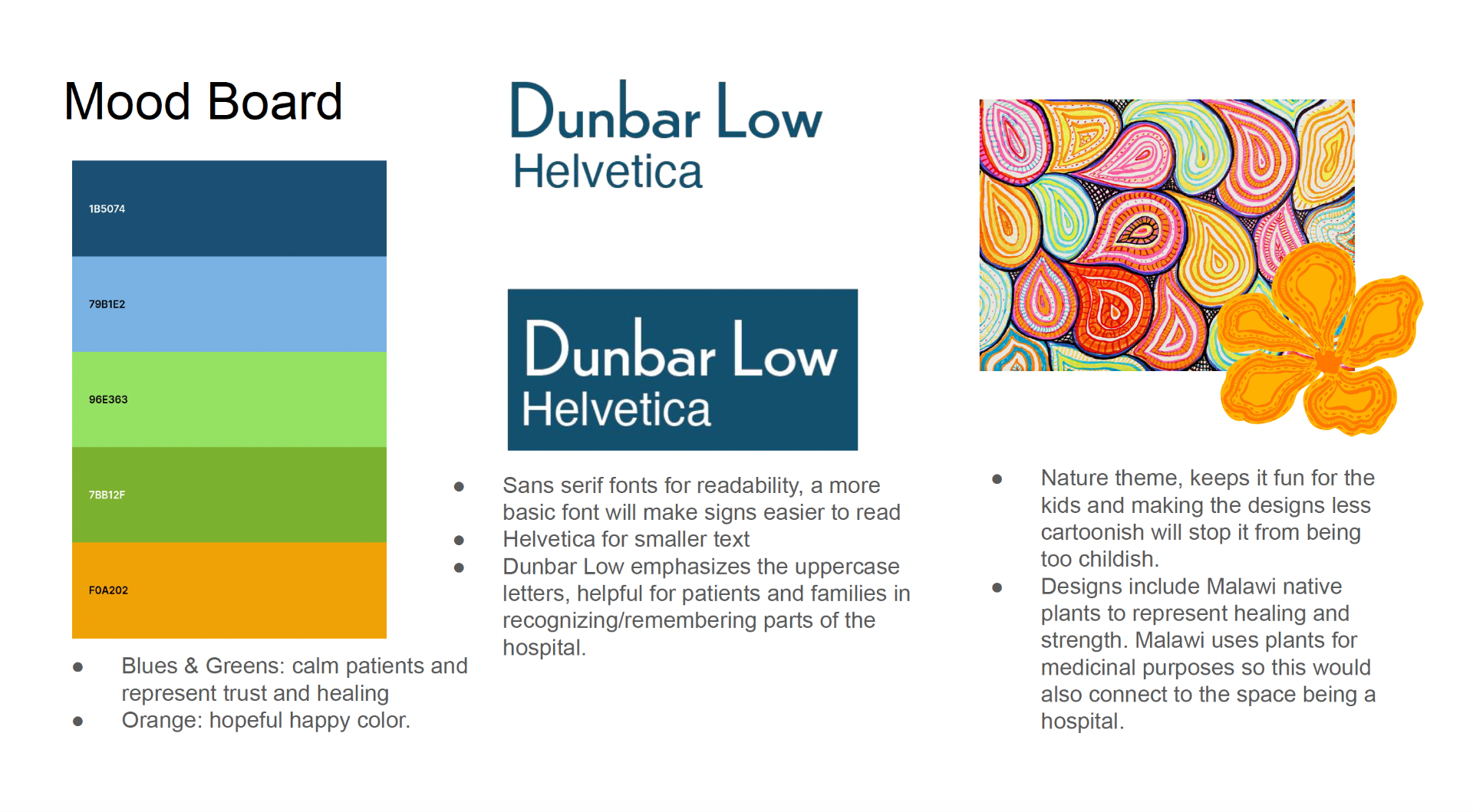
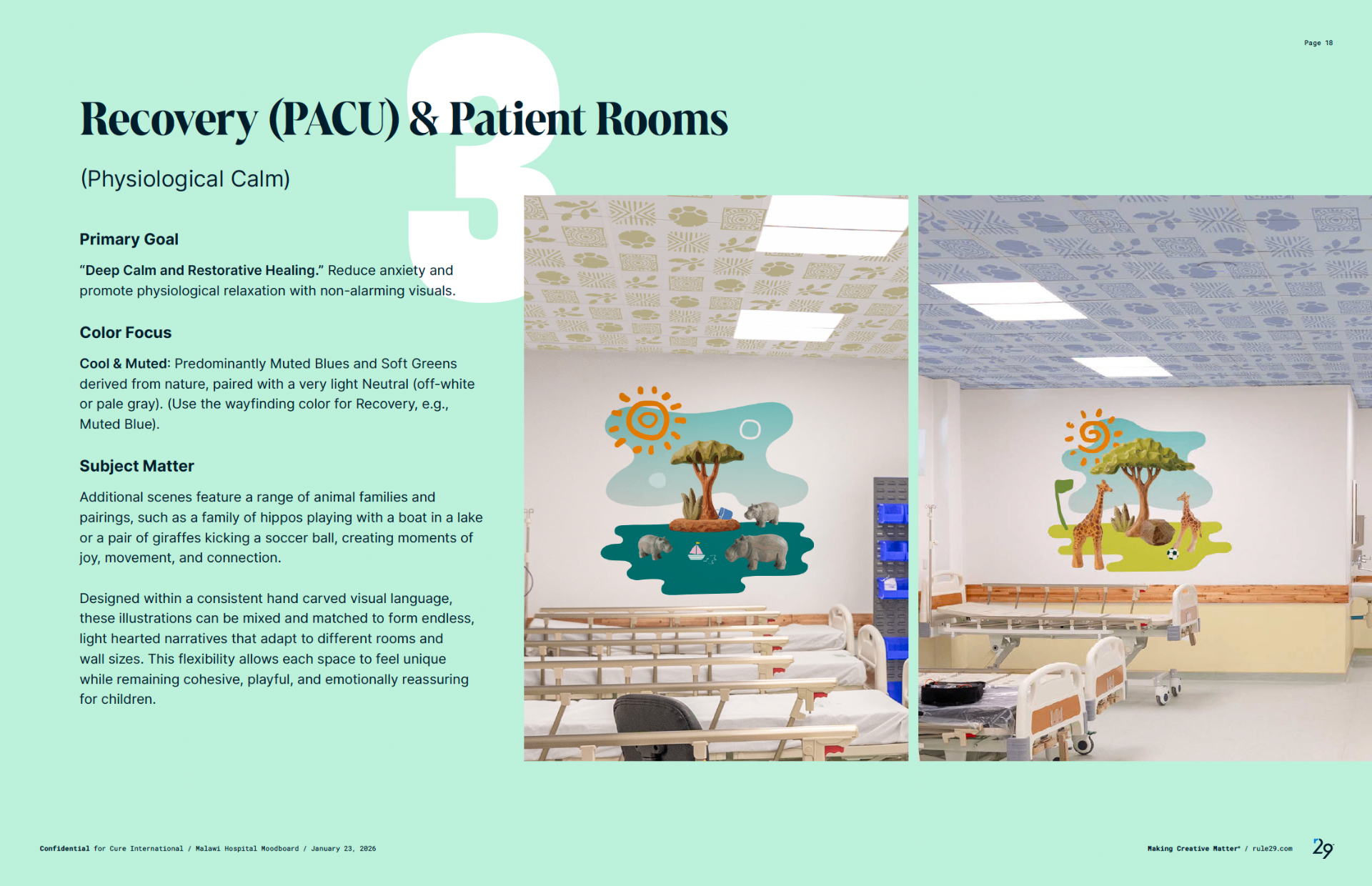
Recovery and patient room renders with hippo and giraffe family murals and patterned ceiling tiles
Recovery & patient rooms
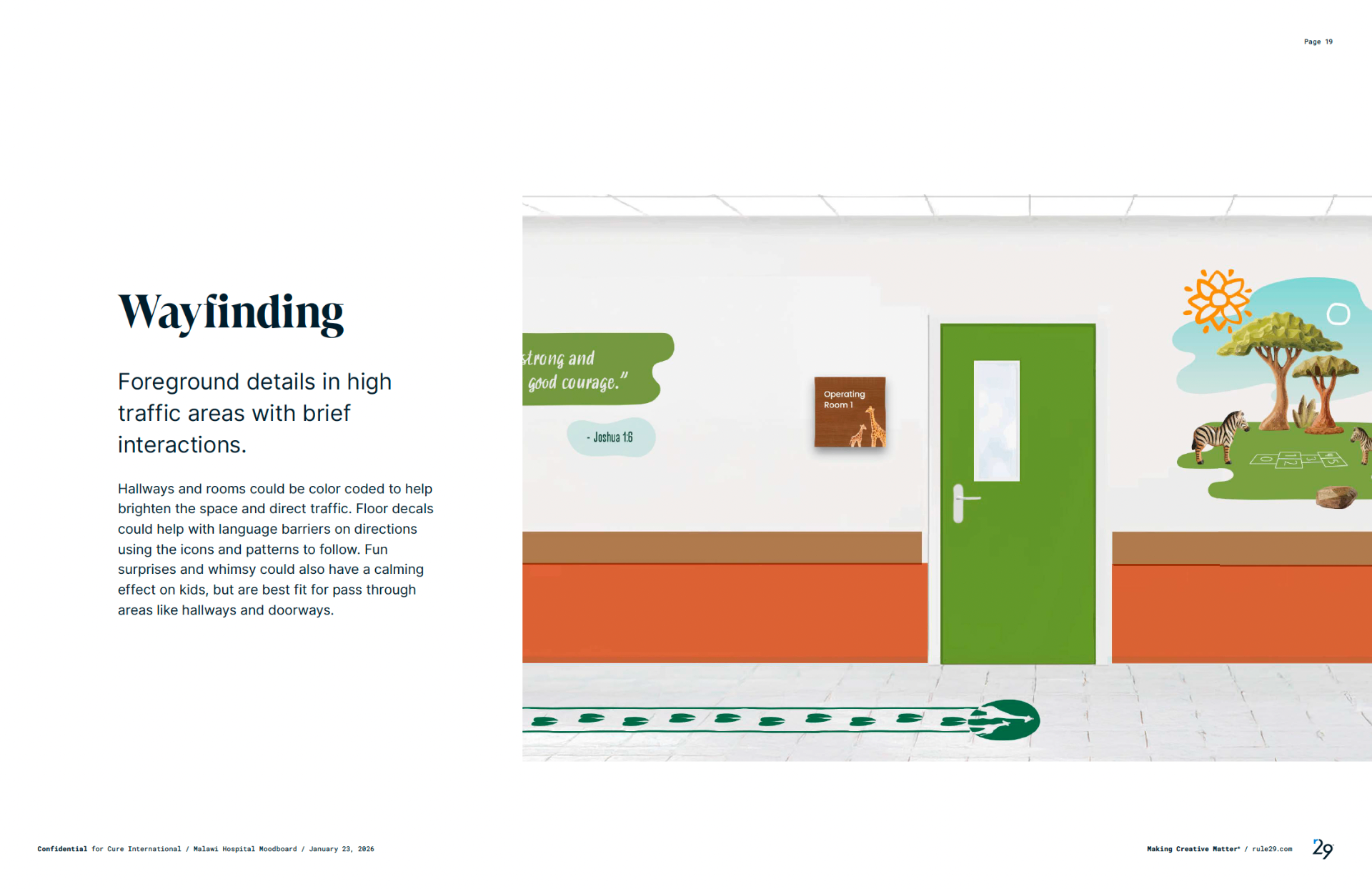
Wayfinding hallway render with green door, room sign, savanna mural and floor decal trail
Wayfinding in high-traffic areas
VI
Complete
May 2026
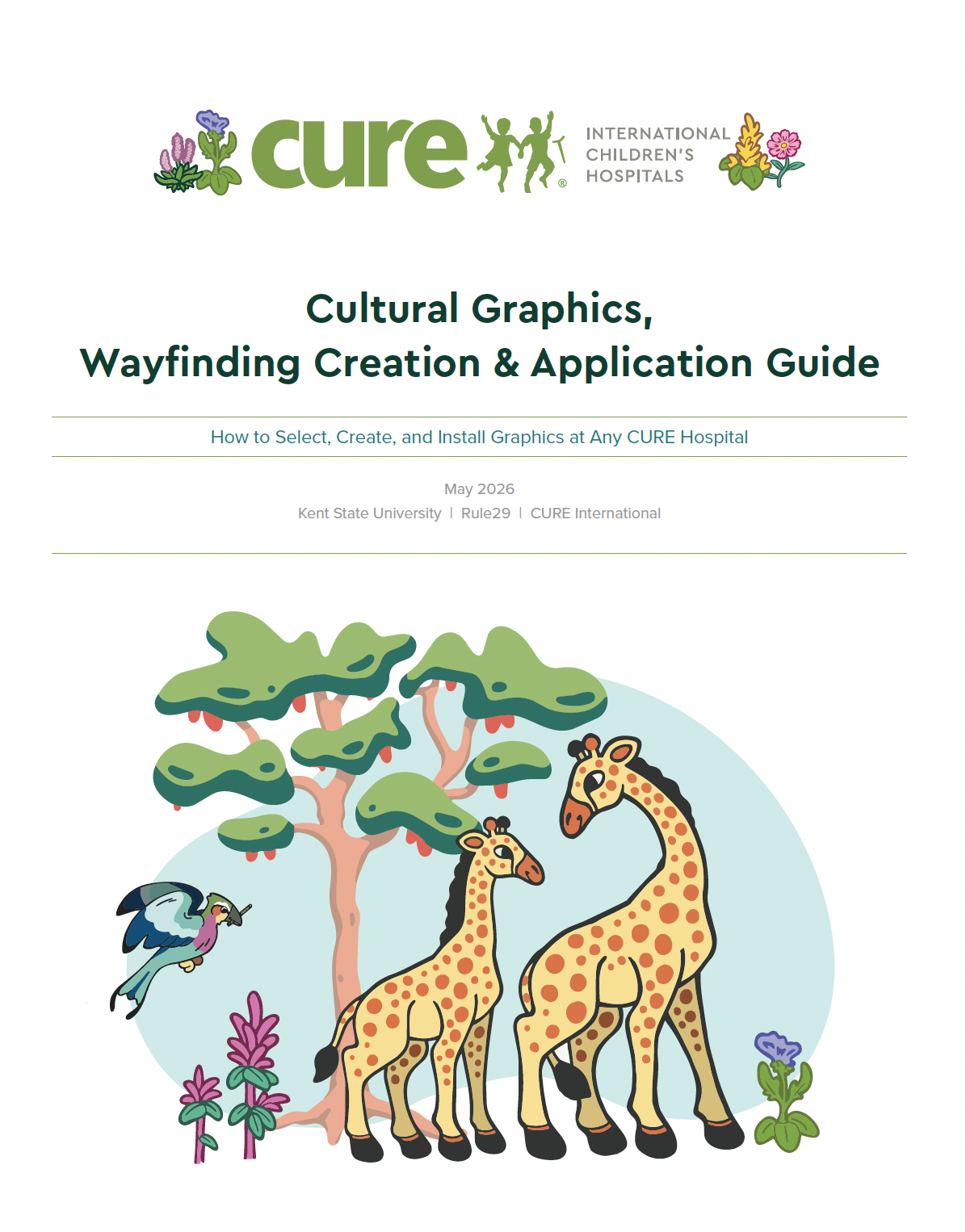
Kent State, Cultural Graphics, Wayfinding Creation & Application Guide

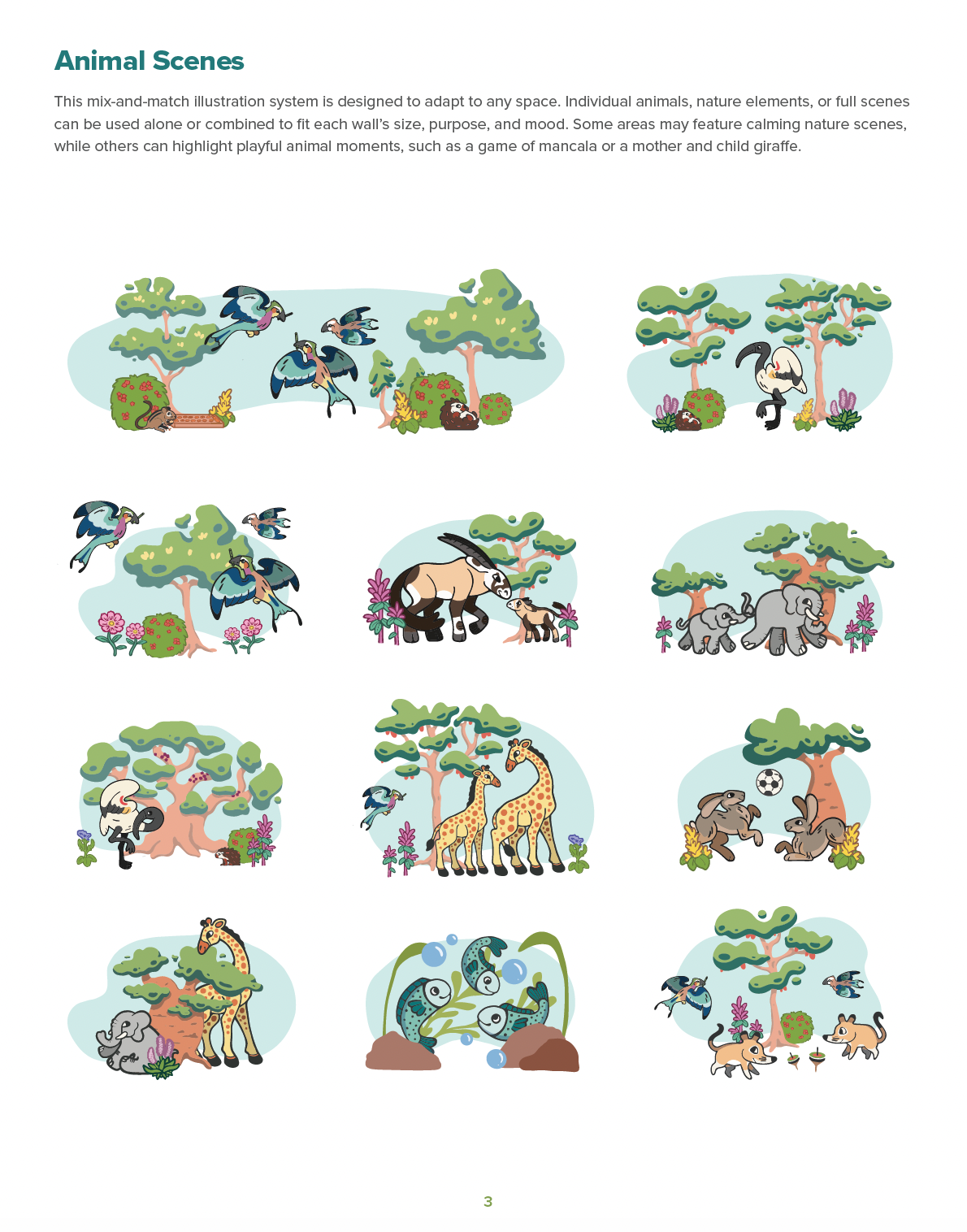
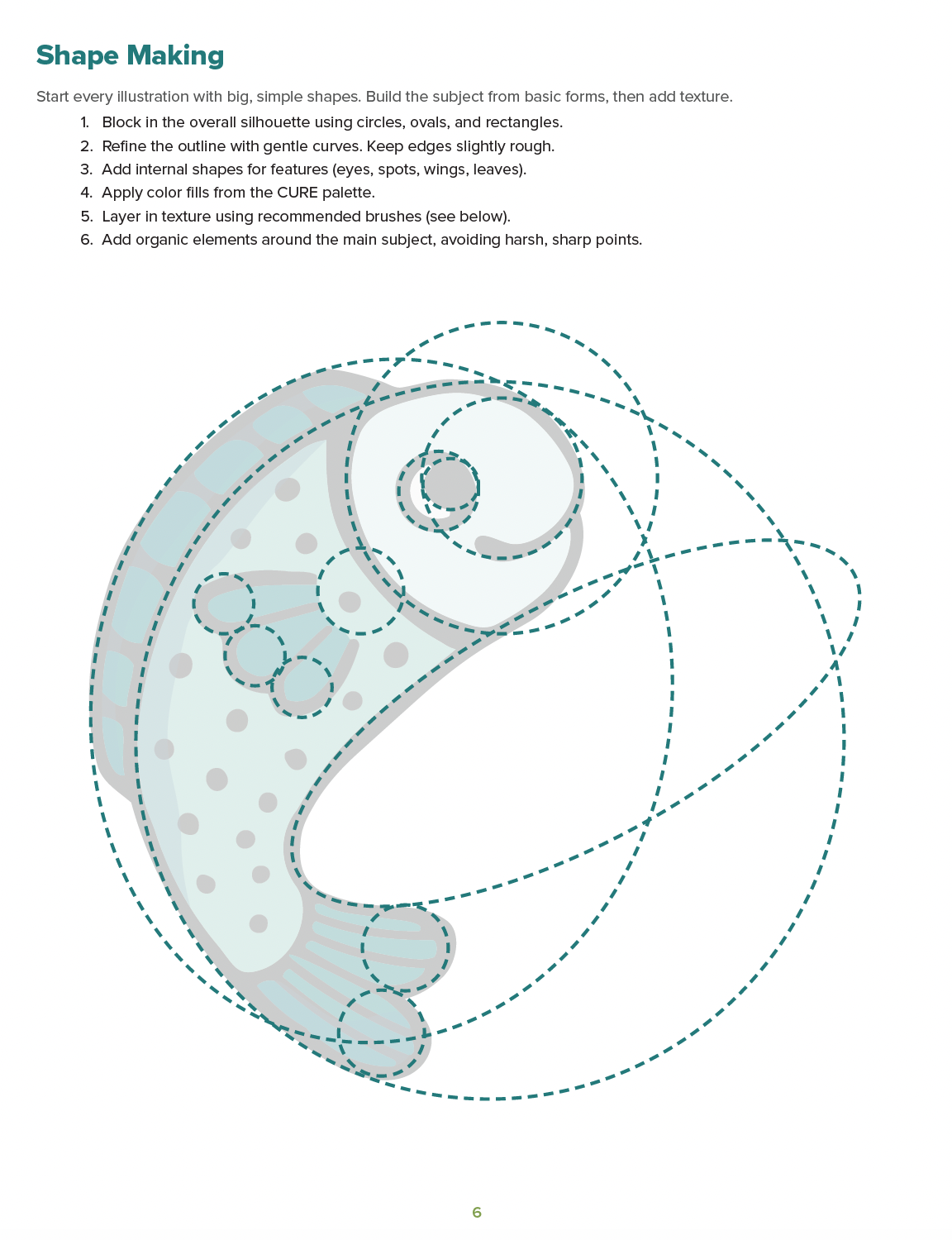
Kent State went and finished their process of developing illustrations and icons for the entire hospital along the look they had developed, packaged as a full Cultural Graphics, Wayfinding Creation & Application Guide that could be extended to other CURE hospitals. The deliverable covered an animal scene illustration system, a plant and pattern library, a wayfinding medallion kit with production specs, environmental Bible verses, finished room mockups, and an installation and troubleshooting guide for vinyl application in the field. After review, the decision was made to continue exploring the wood-carved animals and take some of the learnings and work Kent State did and continue to evolve it, which we see in the next step.

Ed, the work the Kent State team did was incredible. The research, the care, helping us understand cultural stories and production questions was invaluable, this was delivered to us in May 2026.

Kent StateCURE InternationalRule29
Final Kent State presentation — walkthrough video
Cultural Graphics, Wayfinding Creation & Application Guide cover, May 2026
Guide cover, May 2026
Animal Scenes mix-and-match illustration system page
Animal scenes system
Shape Making page: step-by-step illustration construction starting from big simple shapes — circles, ovals, rectangles — building up to a textured fish
Shape-making method
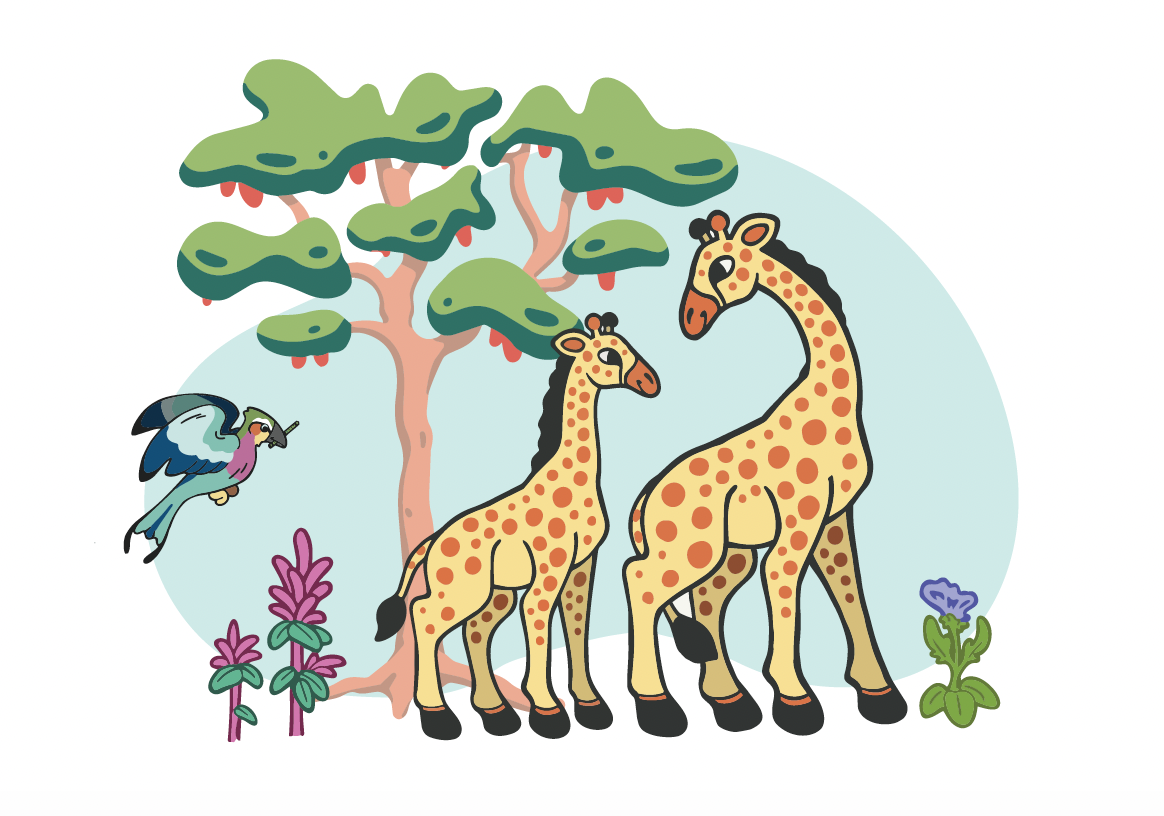
Two illustrated giraffes under an acacia tree with a lilac-breasted roller, pink protea and violet wildflower
Giraffes, acacia & roller scene
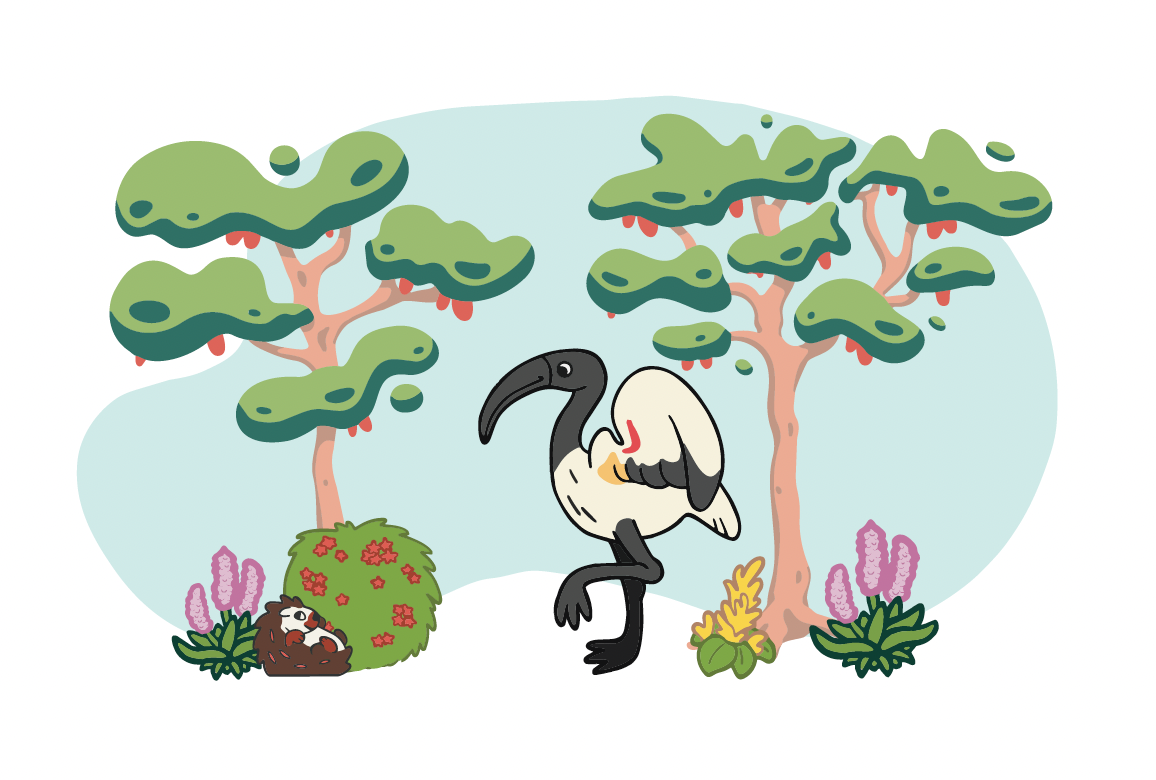
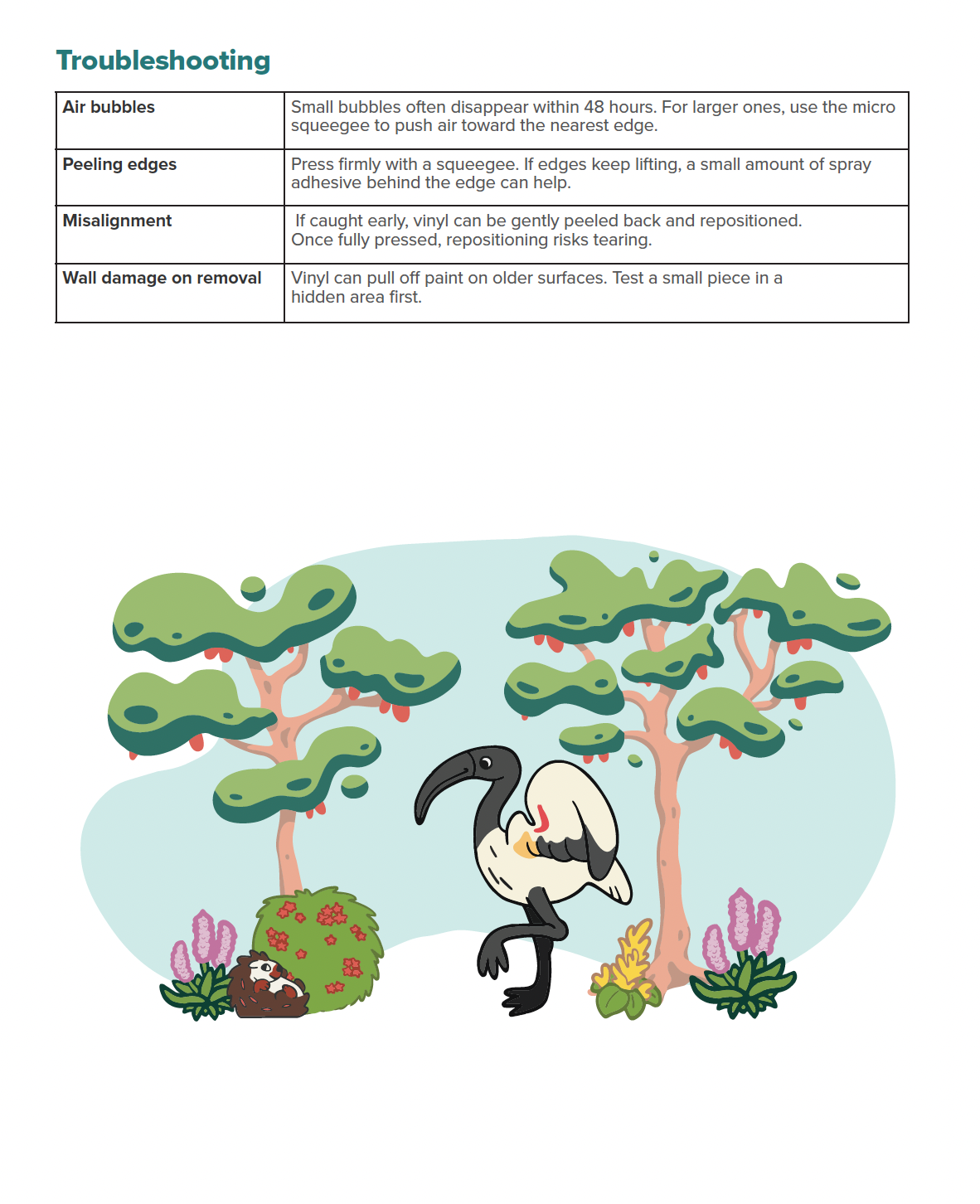
Sacred ibis walking between two acacia trees with flowering shrubs, a small bird in nest, and aloe blooms
Sacred ibis & acacia grove
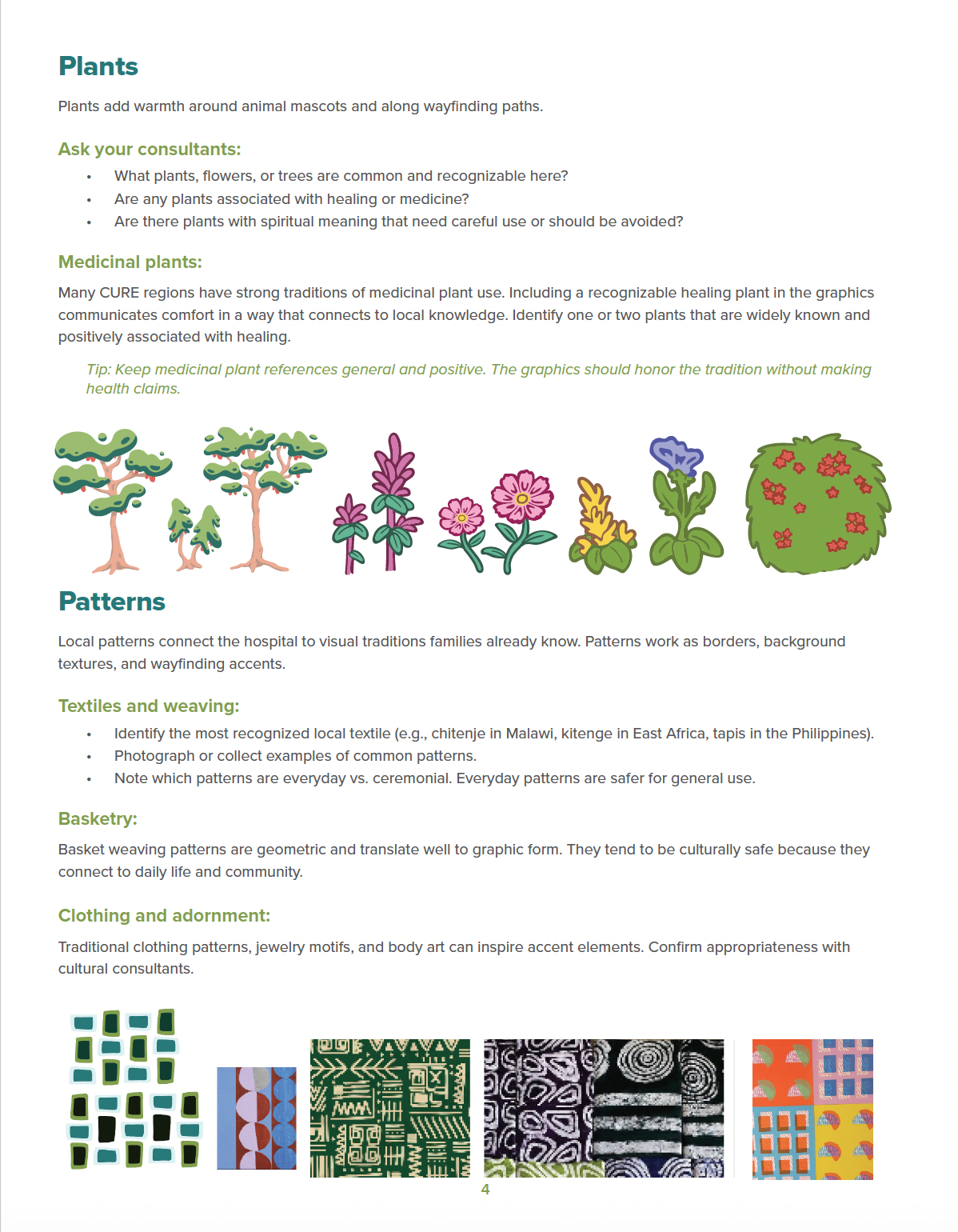
Plants and Patterns page with medicinal plants and textile pattern library
Plants & patterns
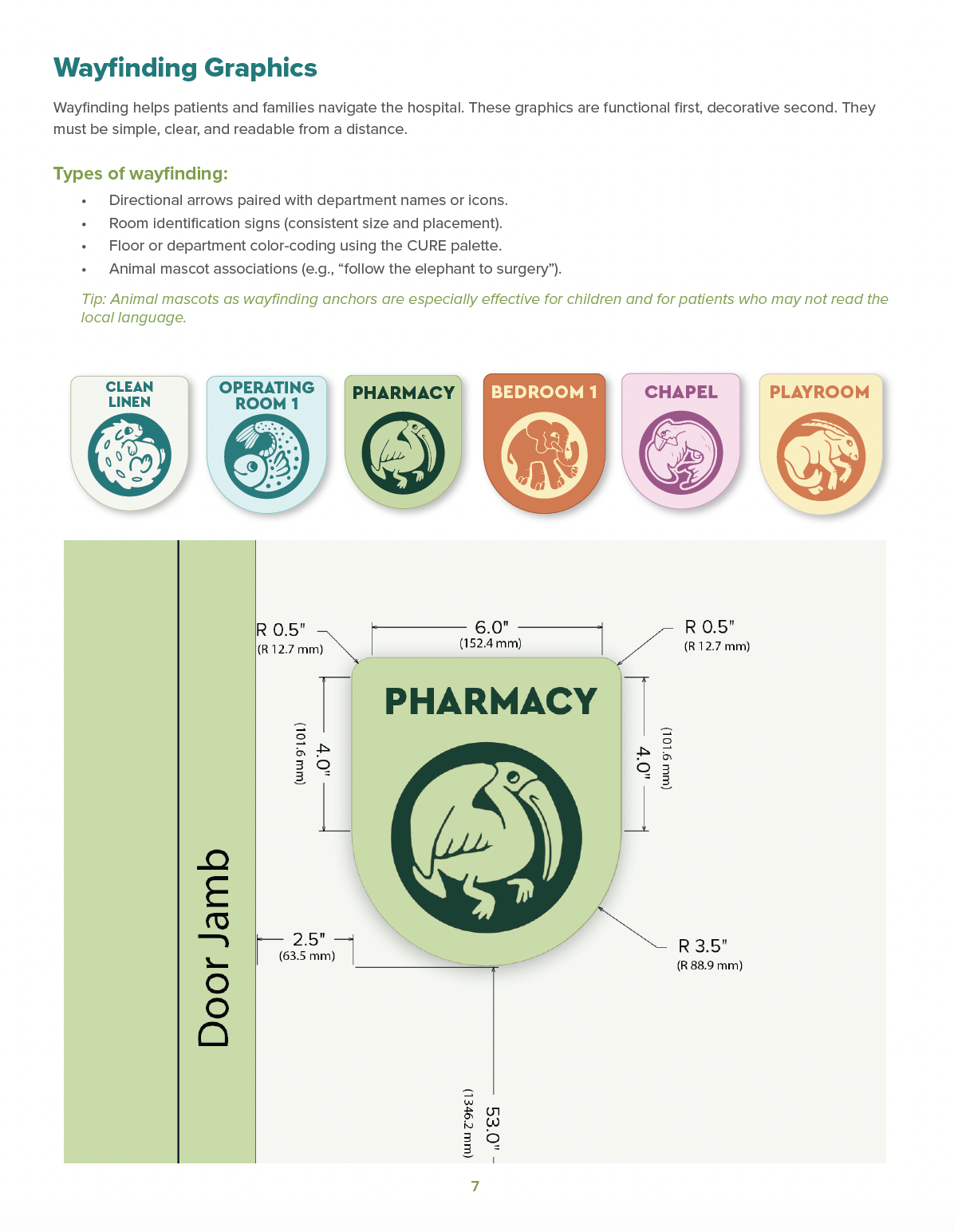
Wayfinding Graphics page with animal medallions and door-jamb spec drawing
Wayfinding medallions & spec
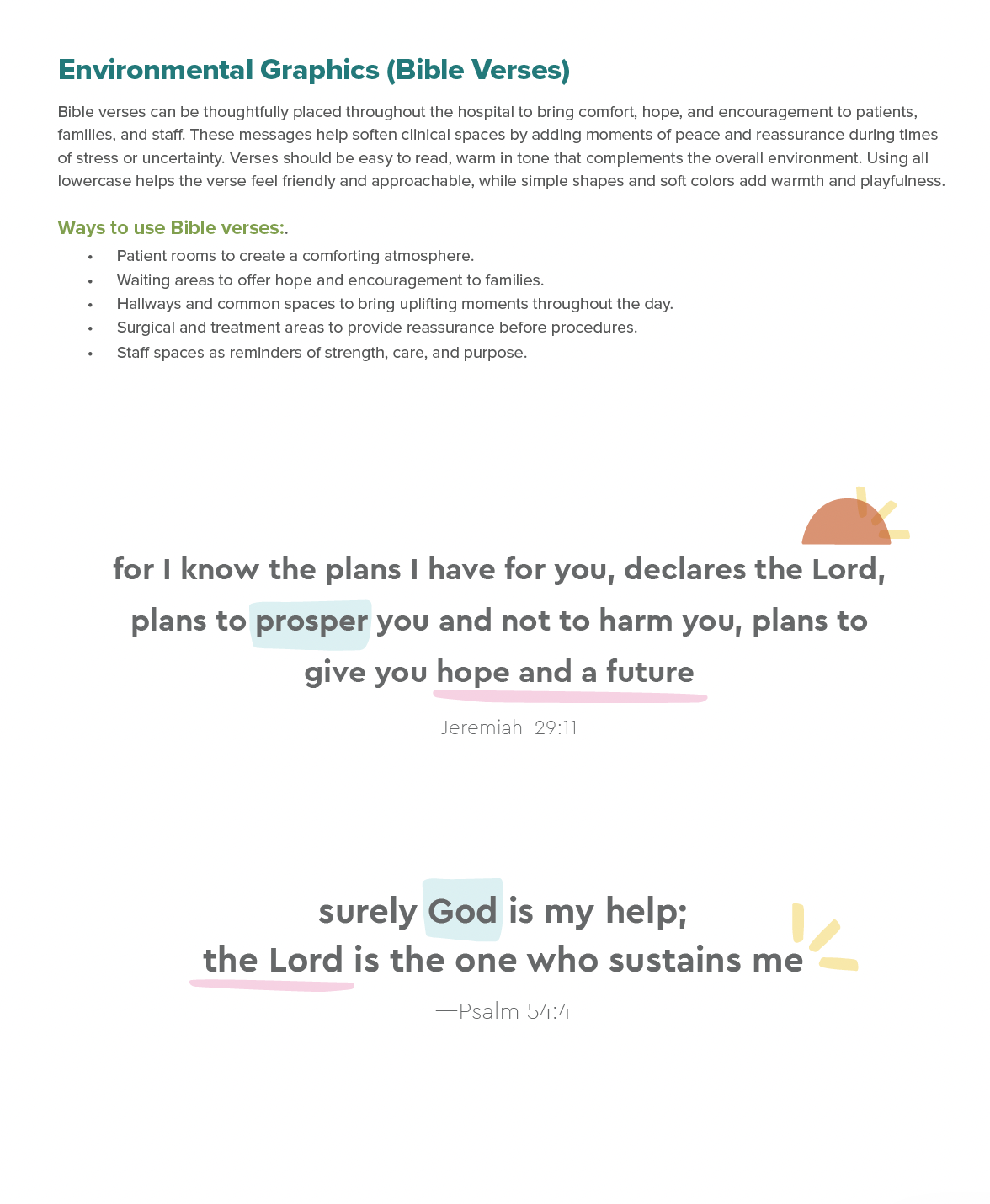
Environmental Graphics page with Bible verses Jeremiah 29:11 and Psalm 54:4
Environmental Bible verses
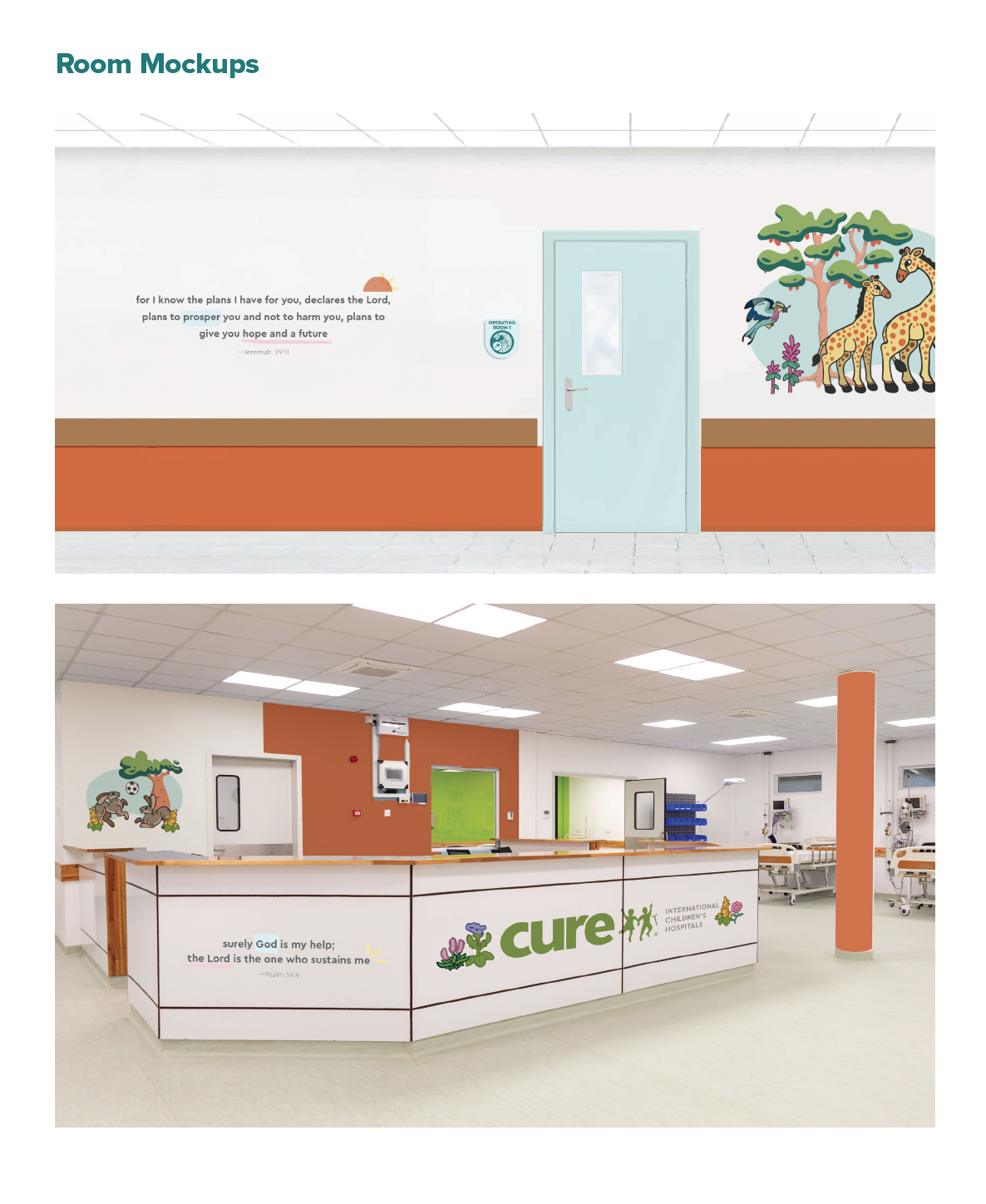
Room mockups showing hallway mural and reception desk with CURE branding
Room mockups
Troubleshooting table for vinyl installation: air bubbles, peeling edges, misalignment, wall damage
Install & troubleshooting
VIb
Near final · presented last week
June 3, 2026 · Presented last week
Rule29 Malawi Hospital Styleguide — near final direction

After reviewing the direction together, it was decided this look was more in line with what CURE wanted, and the possibility of engaging local Malawian artists to make the carvings, and carrying that craft through every space, is what made it feel uniquely theirs.

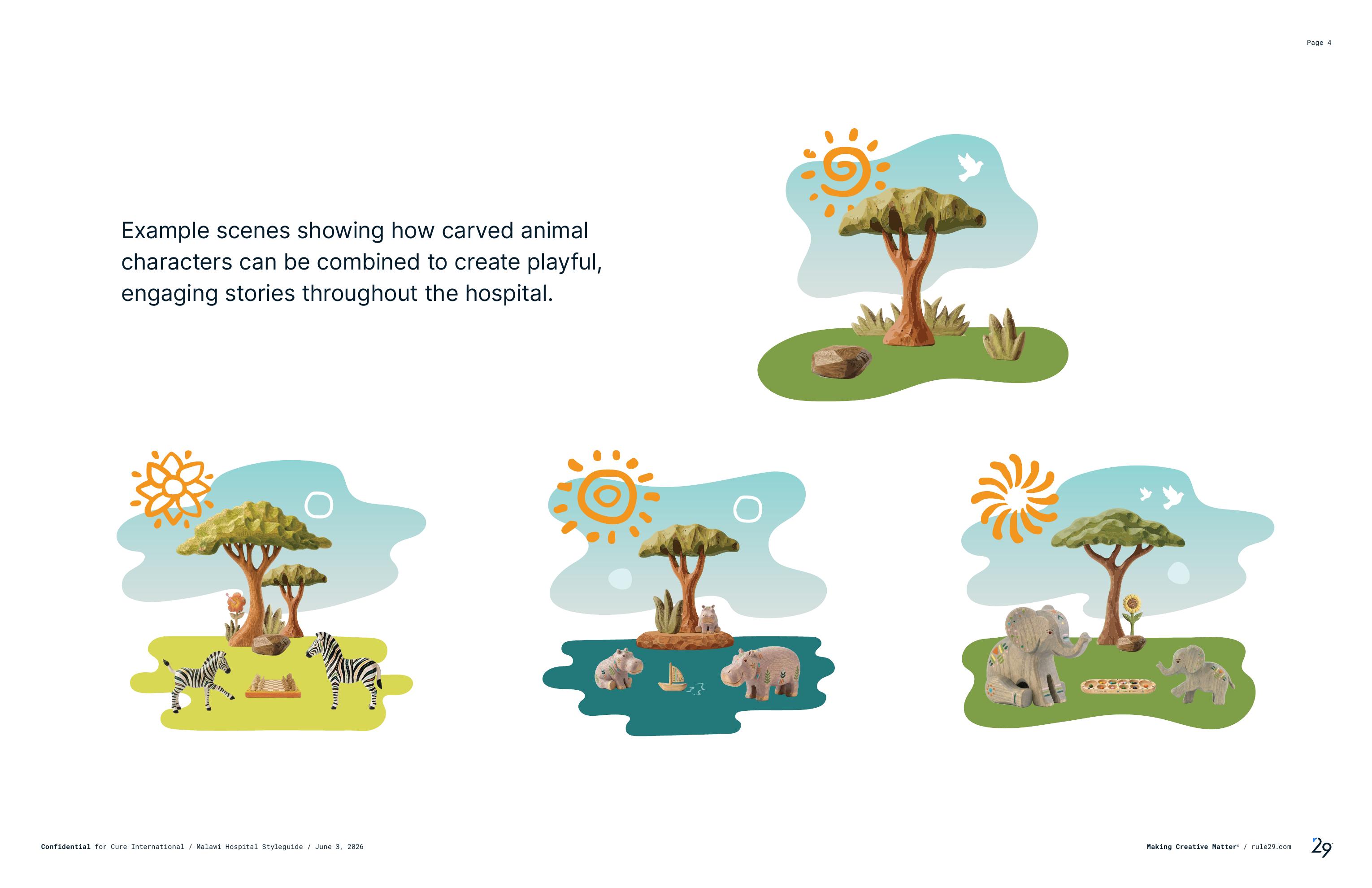
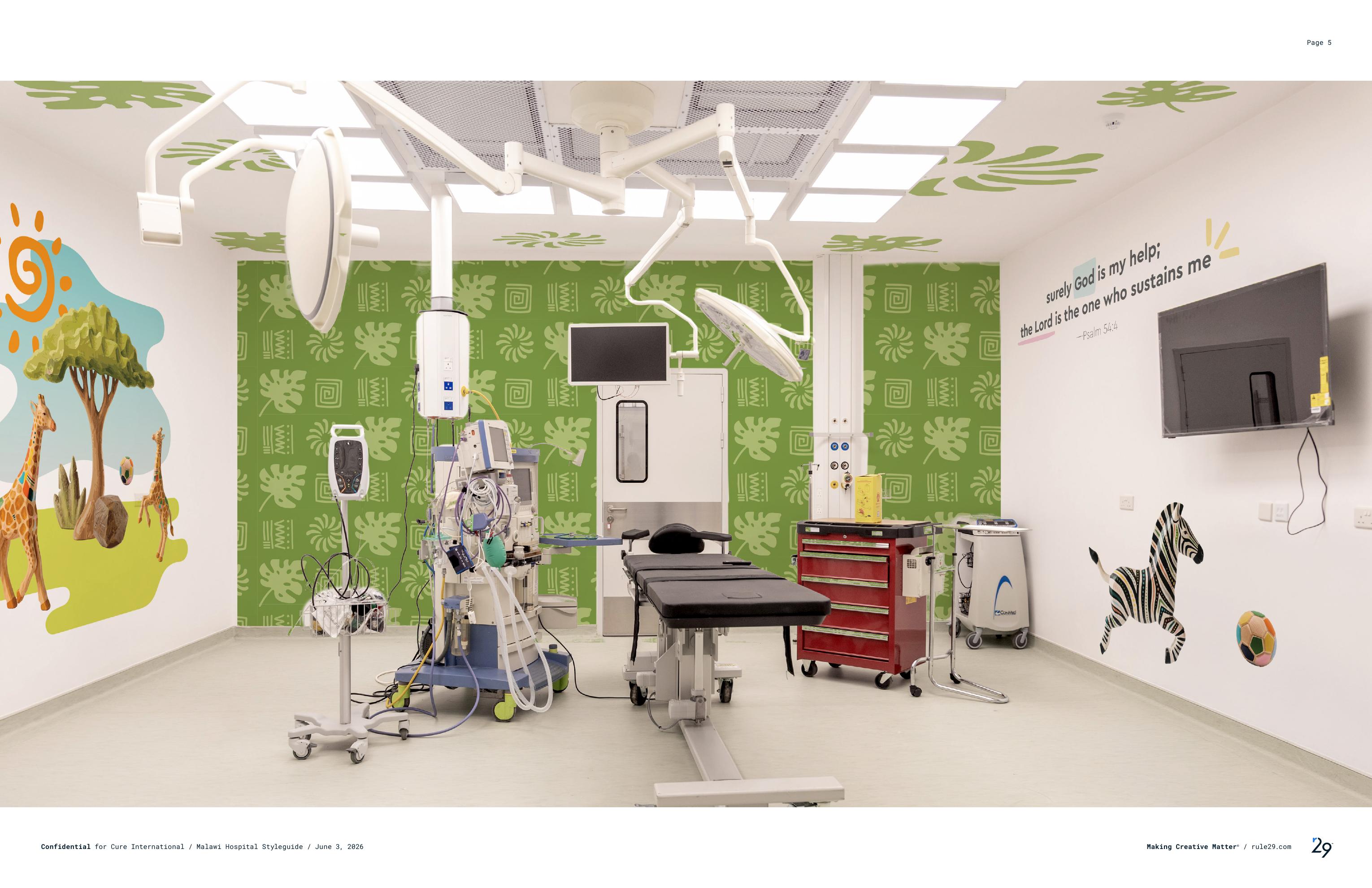
The near-final Rule29 design, presented to CURE last week. The hand-carved wooden toy direction is now codified into a working styleguide: a flexible library of animals, trees, rocks and objects that can be mixed and matched into custom scenes throughout the hospital; sample compositions for high-traffic areas (giraffes playing soccer under an acacia, hippos at the watering hole, an elephant family at mancala); the first installed scripture wall pairing Psalm 54:4 with the green leaf and spiral pattern inside an operating room; and a finished three-color pattern system, terracotta dove-and-sun, ochre textile, fern leaf and spiral, ready for production.

Rule29CURE International
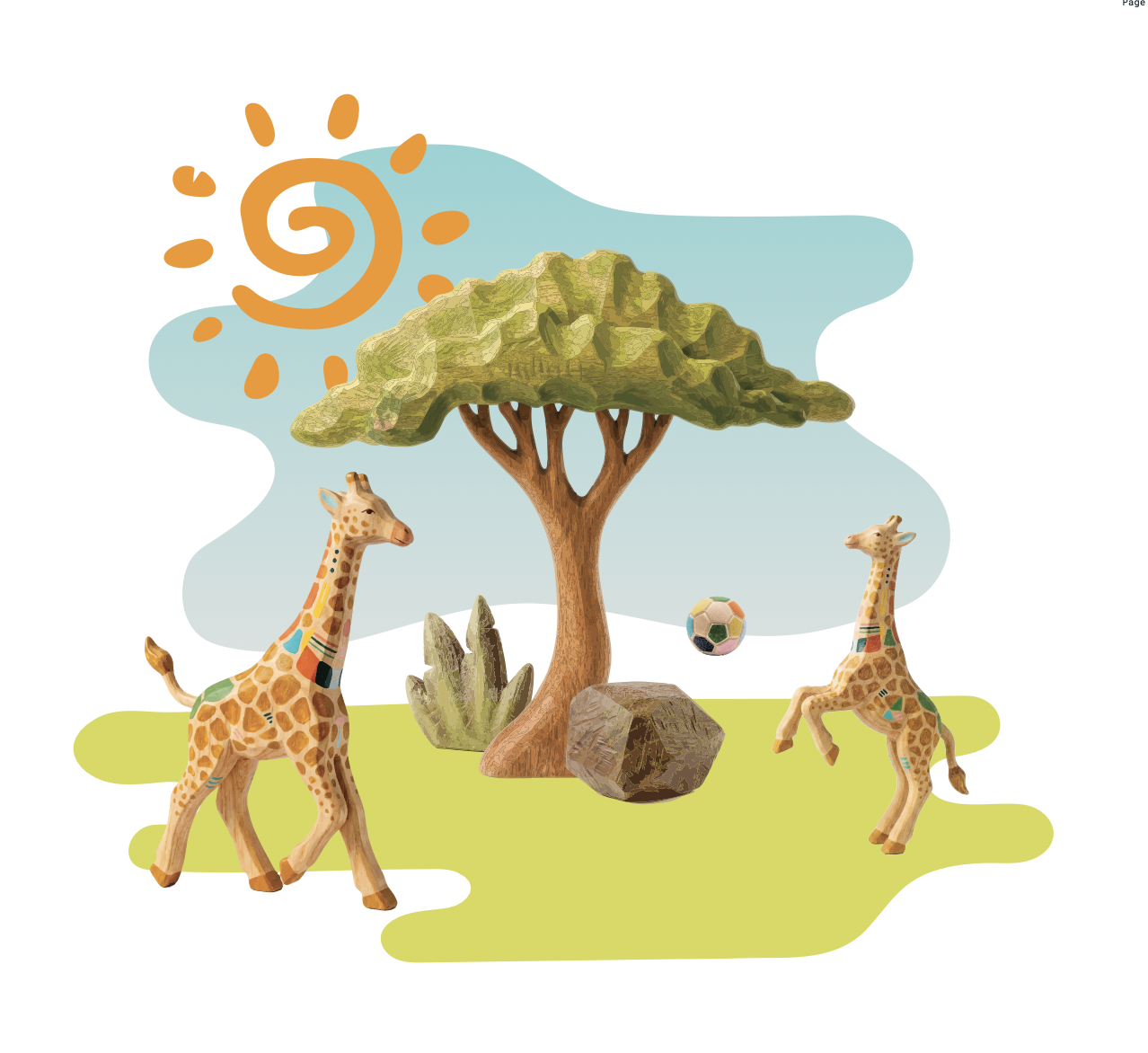
Hero scene: two hand-carved giraffes, acacia tree, swirling sun and soccer ball on a green grass field — signature mix-and-match composition
Signature scene · giraffes, acacia & sun
Graphic Elements page: hand-carved trees, rocks, grasses, giraffes, hippos, zebras, elephants, ball, mancala, boat and chess set
Graphic elements library
Graphic Style page: two carved giraffes, acacia tree, sun, soccer ball — foreground composition for high-traffic areas
Graphic style for high-traffic
Example scenes mixing carved animals: zebras with mancala, hippos in water with sailboat, elephant family with sunflower
Example mix-and-match scenes
Installed operating room with green leaf and spiral pattern wall, giraffe and zebra murals, and Psalm 54:4 scripture wall
Installed OR with scripture wall
Three production-ready patterns: terracotta dove and sun, ochre textile motifs, fern green leaf and spiral
Production-ready pattern system
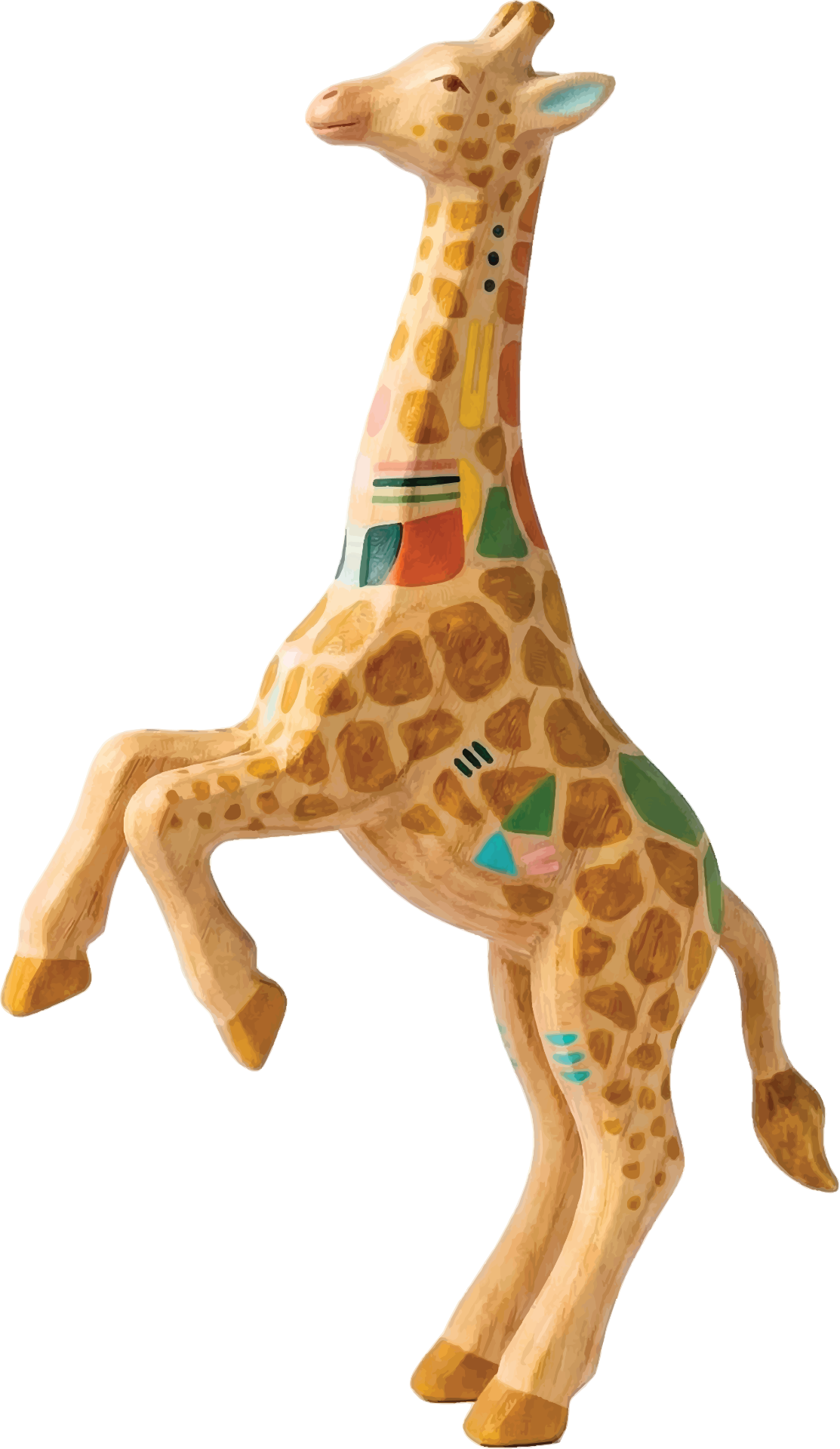
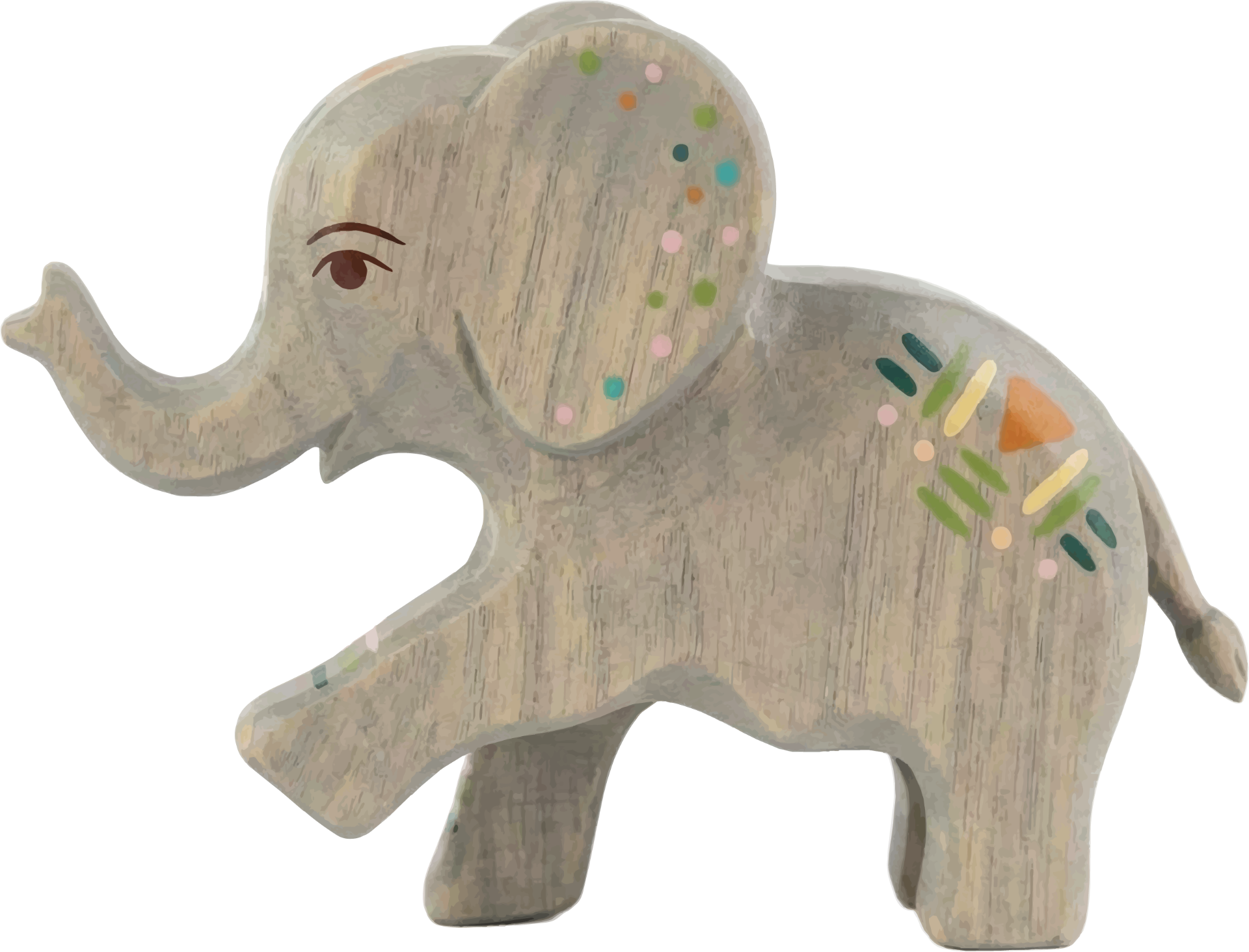
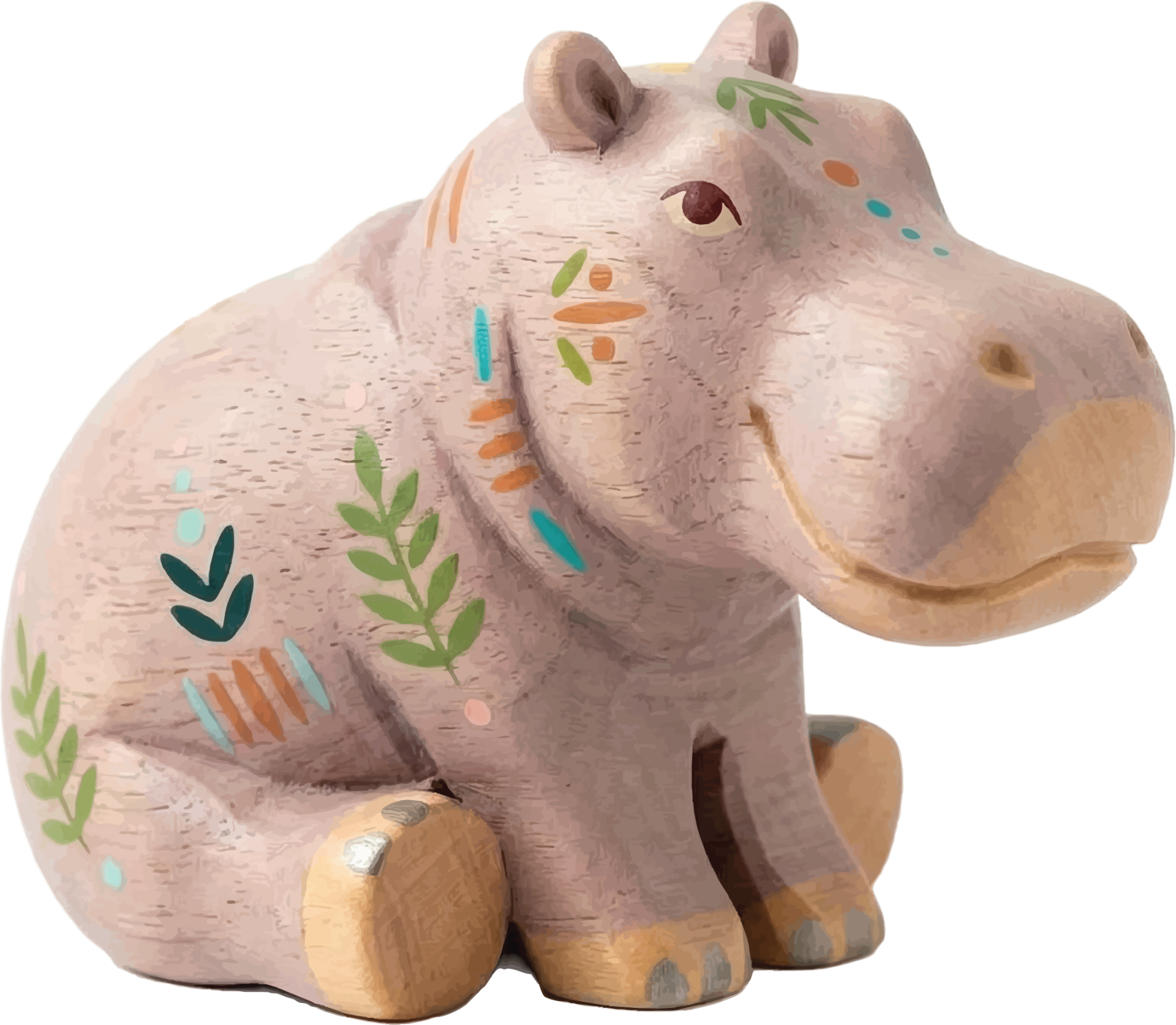
The carved-toy specimen library
Hand-carved giraffe rearing up, with painted spots and dabs of teal and orange
Giraffe
Hand-carved baby elephant with painted dots and grass strokes
Elephant
Hand-carved sitting hippo with green leaf and orange tally marks
Hippo
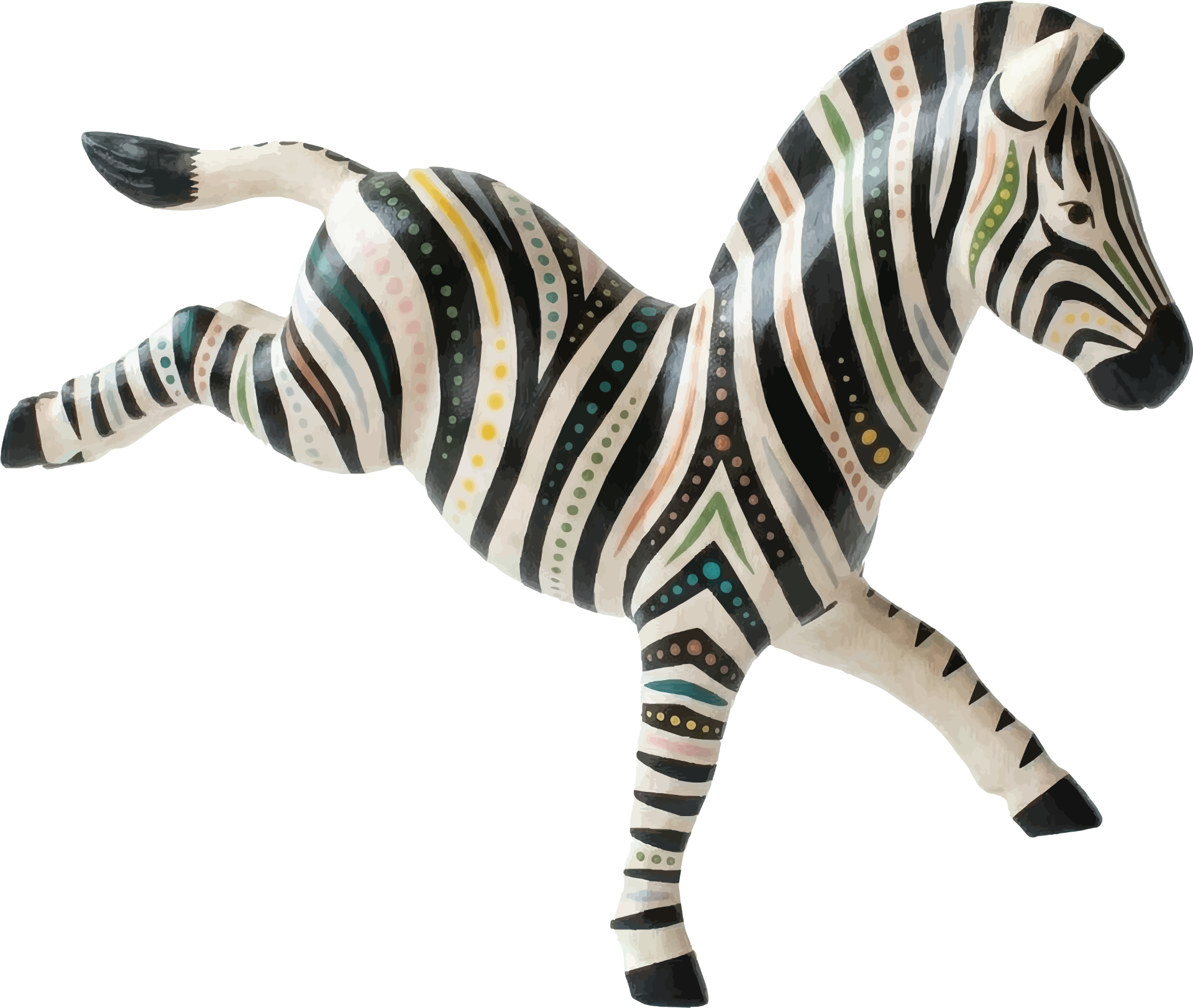
Hand-carved zebra in mid-leap with painted dots and color accents on its stripes
Zebra
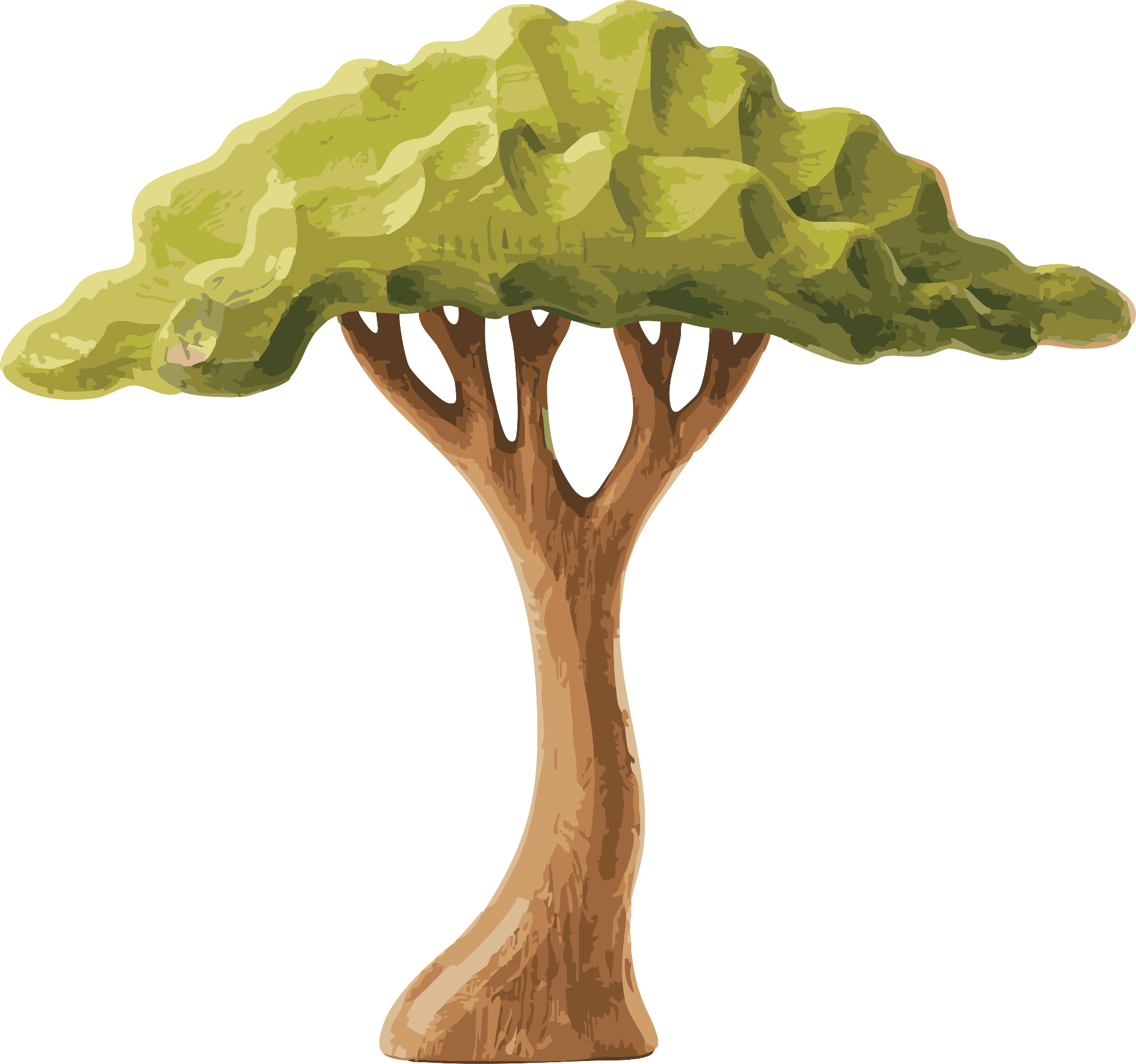
Hand-carved acacia tree with broad green canopy
Acacia
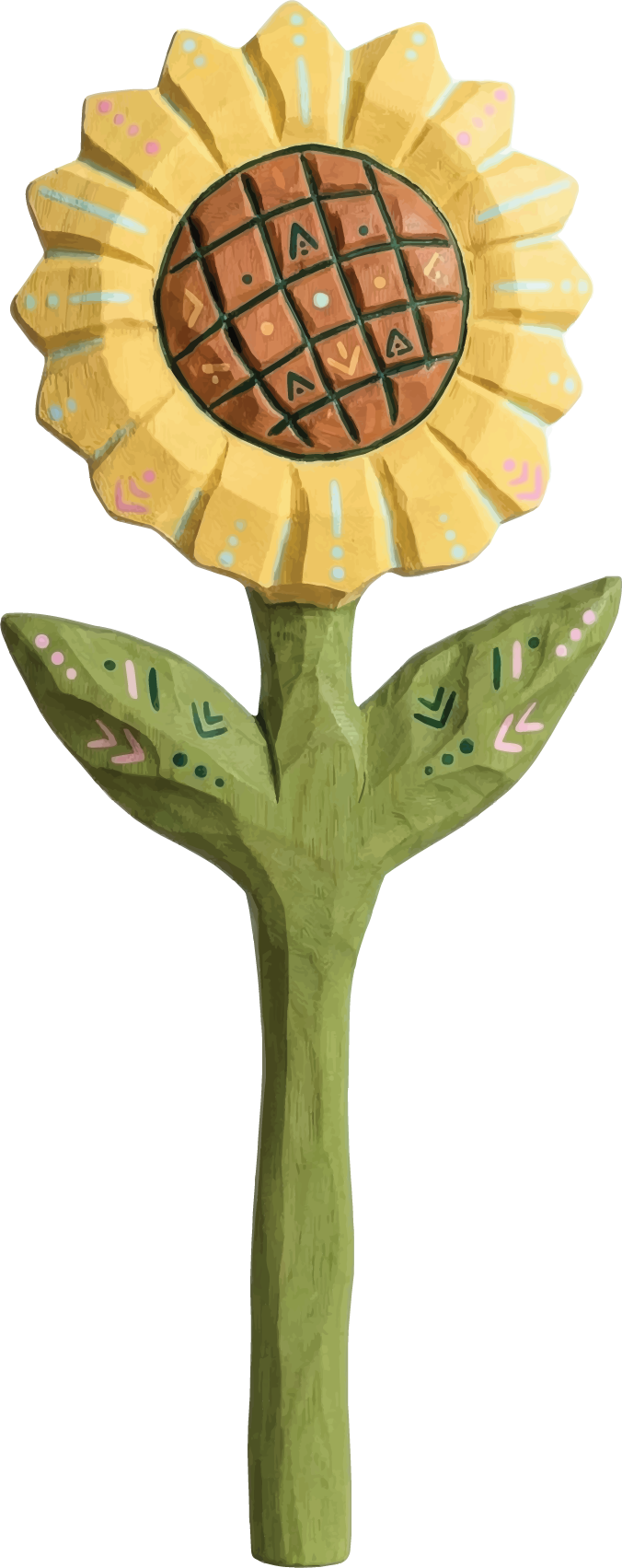
Hand-carved yellow sunflower with patterned terracotta center
Sunflower
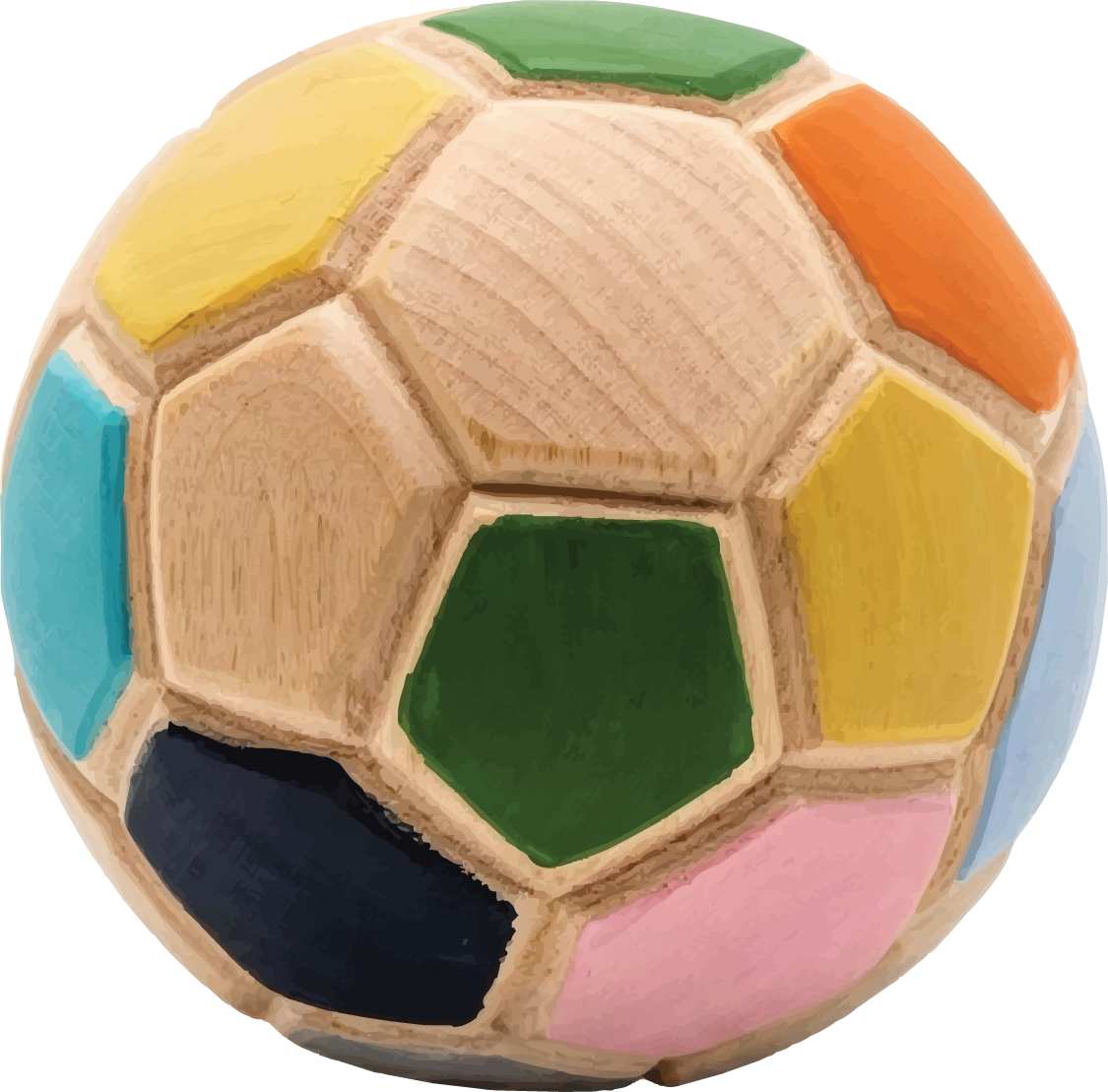
Hand-carved wooden soccer ball with painted color pentagons
Soccer ball

Production-ready specimens. Each piece is hand-carved, painted with the Calm Landscape palette, and combines into the murals you see above.

Where this is headed → Final artwork lockdown through July, O'Neil production through August, then the team flies to Blantyre the week of September 7 to install the first room. See the live month-by-month tracker ↓

VII
In Progress
Summer 2026
Rule29 + Kent State + O'Neil, Final Artwork & Production

Final room-by-room illustration being completed. Icon palette decision (two-tone vs. three-tone) pending CURE input before files go to press. O'Neil specifying materials for overseas production: wall vinyls, floor decals, ceiling tiles, door medallions, and wayfinding signage, all engineered to survive the Malawian climate and hospital environment.

Rule29Kent StateO'Neil Printing
Live · what your support is funding right now
Updated monthly through install · September 2026
Production · Stage 07 of 08

Thank you.Here is how far we have come.

Every percentage point on this ring is artwork your gift moved from a designer's screen to a printed wall in Blantyre. The circle grows each week as another piece is finished, color-locked, and shipped. Please keep us going through the final stretch.

68%
funded & in production
The production pipeline · tap any step
Production of 1st test room · in progress
O'Neil is producing the first fully-designed room for Blantyre — vinyls, decals, ceiling tiles and door medallions — so the team can install, photograph and learn from one complete space before the full rollout.
June 2026Design · Decision pending
Icon palette · two-tone vs. three-tone

Both approaches developed by Kent State. CURE Malawi team input needed before production files go to press. Two-tone reads cleaner as wayfinding; three-tone is richer as illustration. Final call by July 1.

June 2026Production · Press-check
O'Neil pulling color-matched proofs

Vinyl substrate being specified for Malawi's humidity range. Rule29 + Kent State review the proofs the week of July 15. This is the last gate before the press runs at scale.

VIII
July 2026
July 2026 · Update coming
July check-in — details TBD

A monthly note from the studio: what shipped, what shifted, what's next. Posted here as soon as the team files it. Want a heads-up when it lands? You'll see it on your next sign-in.

Rule29Kent StateO'Neil Printing
IX
Aug 2026
August 2026 · Update coming
August check-in — details TBD

Final production wrap, crating, and logistics into Blantyre. We'll post the trip-prep recap here the moment it's confirmed.

Rule29O'Neil Printing
X
Sept 2026
Week of September 7, 2026
First Installation, Blantyre, Malawi

The Rule29 team travels to Blantyre. One room, fully installed and documented by Wonderkind Studios. We assess remaining spaces and confirm quantities for the full installation round. Two years becomes one room a child walks into. And the proof that will fund eight more hospitals begins.

Rule29O'Neil PrintingWonderkind Studios
XI
Early 2027
Early 2027 · Return trip
Back to Malawi — to see the work in use

A few months after install, the team returns to CURE Malawi to see the rooms lived in: kids navigating by the animal medallions, parents finding calm in the waiting space, surgical teams working under the scripture walls. Wonderkind documents the second chapter — the proof of what your gift built, in motion. Field report, photos and video follow.

Rule29CURE InternationalWonderkind Studios
The Team

Six organizations.
One mission.

This project exists because the right people found each other. Each brings something irreplaceable. Together they're building something none could do alone.

Creative Lead

Strategic creative direction, environmental design, illustration system, wayfinding, and project coordination. 26 years making creative matter®. Geneva, Illinois.

Project Partner & Client

Nine pediatric hospitals. 2,500+ surgeries per year at CURE Malawi. 98% local staff. Operating across Africa and the Philippines since 1998.

Production & Manufacturing

116 years of print excellence. Employee-owned. Producing every environmental graphic and piece, engineered to reach Malawi and last.

Research & Co-Design

Graduate students delivering the evidence base and co-designing the illustration system, icons, wall patterns, and final artwork across two critical phases.

Discovery & Ideation

A design class built the earliest conceptual foundation, the ideation that everything else grew from. Fall 2025. Embedded in every room.

Film & Photography

Capturing the transformation through documentary film and photography. Telling the story that proves this model works, so it can be funded for eight more hospitals.

Support the Work

We're this close
to changing lives.

$69,400 raised. $600 from fully funding the first hospital. Every dollar goes to design, production, and installation, and to proving a model that will scale to eight more hospitals.

The $70,000 goal covers this initial phase. As we move into install, documentation, and the work that turns Malawi into a repeatable model, new expenses will surface — and we'll need to raise for them too. If you're moved to keep going with us, every dollar counts.

$0
raised of $70,000 goal
0%
0% fundedcalculating...
12%
Research
Kent State & Bradley evidence work
28%
Design
Rule29 creative & all artwork
35%
Production
O'Neil manufacturing everything
25%
Install
Shipping & installation in Malawi

"This project proves the value, with real data and documented outcomes, so we can raise the funds for the remaining eight hospitals."

Give Now at cure.org →
Tax deductible
100% to the project
Model for 9 hospitals

This experience was built for the people who made Malawi possible — but the work ahead is bigger than one room. If you've found your way here and feel moved to jump in, you're welcome at the table. Give above, ask Justin a question below, or simply forward this to someone who should see it.

Exclusive Donor Opportunity
Join us on the ground in Malawi.
We're inviting a small number of donors to witness this transformation firsthand. Two trips. Two chances to be part of the story we'll tell for eight more hospitals.
First Install
Week of September 7, 2026
Final Reveal
Early 2027
Thank you — Justin has your note.
Your interest in joining us in Malawi was delivered to justin@rule29.com. He'll reach out personally with trip details, logistics, and next steps.
✦ Delivered · CURE Malawi
Your note just landed in Justin's inbox.
It was delivered to justin@rule29.com. He reads every message personally and will be in touch soon. Thank you for being part of this.
✦ Delivered · CURE Malawi
The Bigger Picture

"When we design
for healing, we don't
just change spaces.
We change lives."

Malawi is hospital #1. The design system built here is built to travel. Eight more hospitals. One framework. Infinite impact.

9
Hospitals
1
Done by '27
Impact
Rule29·CURE International·O'Neil Printing·Kent State University·Bradley University·Wonderkind Studios